
Cosmic 'Black Hole Star' Found: Early Universe Object May Be New Cosmic Type
Astronomers using the James Webb Space Telescope may have found the first 'black hole star,' an enormous, superheated gas cloud surrounding a giant black hole. The object, MoM-BH*-1, could explain the mystery of 'little red dots' in the early universe.

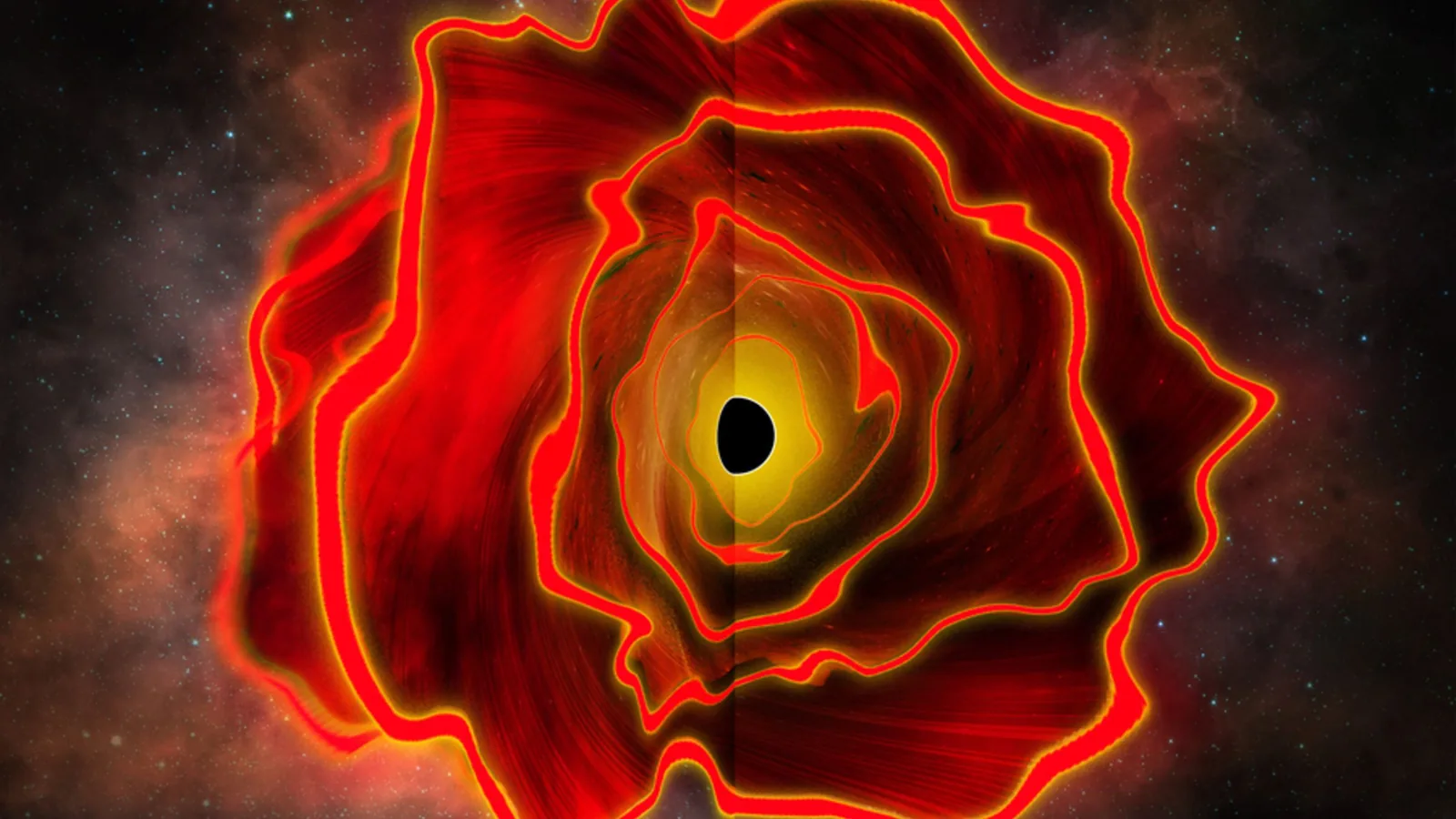
Astronomers have identified a compelling candidate for a 'black hole star,' a novel cosmic entity potentially lurking in the universe's nascent stages. This discovery, if validated, could illuminate the origins of elusive 'little red dots' (LRDs), hundreds of faint, crimson lights observed by the James Webb Space Telescope (JWST). These ancient LRDs, appearing almost as old as the universe itself, exhibit a brightness exceeding that of stars but fall short of fully formed galaxies, presenting a significant enigma in contemporary astronomy. The newly detected object, comparable in size to our solar system, was pinpointed by JWST's Miracle or Mirage (MoM) survey, an initiative dedicated to identifying distant galaxies. The reddish light detected originated approximately 660 million years after the Big Bang, when the cosmos was merely one-twentieth its present age. Researchers reported in the journal Nature that this object is about 100 billion times brighter than a typical star. They hypothesize it represents a black hole star—a colossal, hypothetical sphere of dense gas enveloped and intensely heated by a gargantuan black hole. Designated MoM-BH*-1, the object derives its name from the survey and the proposed 'black hole star one' designation.
"Our picture of this object is evolving very rapidly," stated Rohan Naidu, lead author of the study and an astronomer at the University of Hawaii, previously a NASA Hubble fellow at MIT. He described the object as "truly singular in so many ways." This is not the first time a 'black hole star' candidate has been proposed. Last year, a study involving many of the same researchers identified a similar object named 'the Cliff.' However, the team considers MoM-BH*-1 to be their "best evidence" for this previously unseen celestial phenomenon. Being more distant, and thus older, than 'the Cliff,' MoM-BH*-1 offers crucial insights into the formation of these nascent cosmic structures.
Unraveling the 'Little Red Dots' Mystery
The object's striking ruby hue was the initial indicator of its unusual nature, being redder than many other LRDs. "When we see something very red in the universe, we often assume that it is surrounded by dust," explained study co-author Robert Simcoe, director of MIT's Kavli Institute for Astrophysics and Space Research. Dust absorbs shorter blue wavelengths of light, leaving the longer red wavelengths to dominate, akin to how smoke can tint the sky orange. However, spectrographic analysis revealed missing wavelengths of light, a phenomenon known as a Balmer break. This specific spectral signature indicates that the light is not merely being filtered by dust but is passing through an exceptionally dense gas shell, similar to those found in massive stars. Furthermore, the object exhibits a scarcity of heavy elements, suggesting the dense gas consists primarily of hydrogen and helium, much like the sun.
Naidu elaborated, "the [Balmer] break we observed in this object is the deepest break we have ever observed in any object, ruling out 'ordinary' stars as the source." To reconcile the gas's behavior with stellar characteristics while ruling out stars, the researchers conducted extensive simulations. These models consistently pointed to a massive black hole hidden within the gas as the most plausible explanation. While typical black holes accrete matter through surrounding disks, exceptionally large and rapidly rotating black holes, known as quasars, can expel intense energy beams. The researchers propose that in a 'black hole star,' such a black hole could capture and compress surrounding gas into a dense sphere, superheating it and effectively mimicking the energy output of nuclear fusion in conventional stars.
The team estimates the central black hole in MoM-BH*-1 possesses a mass up to 100,000 times that of our sun, placing it within the supermassive category. This new understanding may resolve the central paradox of the LRDs: they are too massive for stars but too dim for galaxies. Quasars have been considered potential candidates due to their intermediate luminosity, but previous explanations failed to account for the lack of high-energy radiation (X-rays and gamma rays) typically emitted by quasars. 'Black hole stars,' however, could theoretically have their dense gas cocoons sufficiently mask this high-energy radiation. While 'black hole stars' have been previously suggested as an explanation for LRDs, their formation and variability in size remained unexplained. Many LRDs observed are considerably larger than MoM-BH*-1. The researchers theorize that most LRDs might actually be mini-galaxies with a central 'black hole star.' Such configurations could arise from collisions between primordial stellar clusters and black hole stars. MoM-BH*-1's trajectory suggests a potential collision with a galaxy in approximately 100 million years, supporting this theory. It is also possible that MoM-BH*-1 is already part of a larger galactic structure, its immense brightness from the central black hole phenomenon outshining its surroundings. However, further research is crucial to definitively link all LRDs to 'black hole stars,' with ongoing observations aiming to capture more data on these enigmatic objects. The discovery also has implications for understanding the early universe's chemical composition and the evolution of the first massive structures, moving beyond the standard models of stellar and galactic formation. The team is now focused on gathering more observational data to confirm the nature of MoM-BH*-1 and to search for other similar objects, which could fundamentally alter our understanding of cosmic evolution in the universe's infancy. The implications for cosmology are profound, potentially rewriting our understanding of the earliest luminous objects and their role in the formation of the first galaxies. The James Webb Space Telescope continues to push the boundaries of astronomical discovery, offering unprecedented views into the universe's most distant and mysterious epochs. Understanding these early cosmic phenomena is key to piecing together the complete history of the universe, from the Big Bang to the complex cosmos we observe today. The search for early universe objects like MoM-BH*-1 is vital for testing cosmological models and understanding the fundamental processes that shaped the universe.