
Blue Origin Accelerates Commercial Space and Lunar Exploration Plans
Blue Origin is intensifying its commercial spaceflight operations and lunar ambitions in 2026, with New Shepard flights expanding and orbital missions advancing. The company targets sustained revenue growth while competing for government contracts.

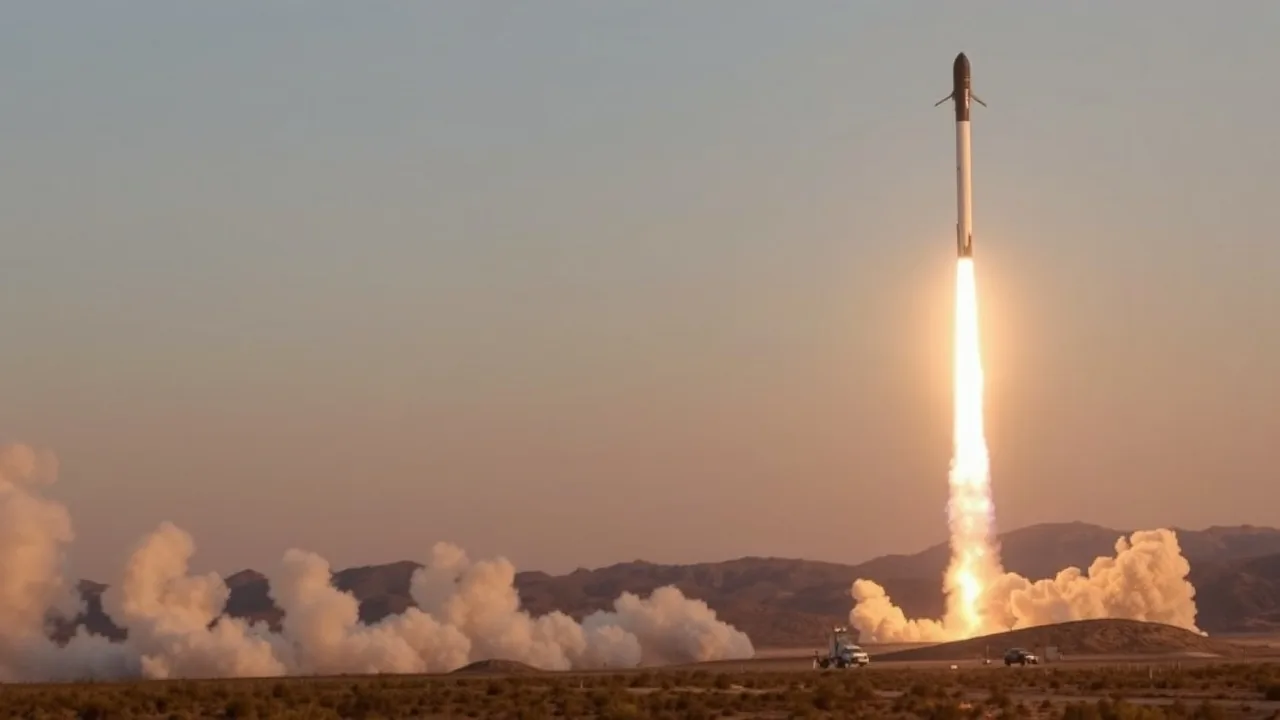
Blue Origin launched its 25th crewed New Shepard flight from West Texas on May 15, 2026, carrying six passengers to the edge of space and back in an 11-minute suborbital arc. The achievement marks the company's fastest cadence yet, reflecting a strategic pivot toward reliable, profitable commercial operations after years of development and regulatory approvals.
Founder Jeff Bezos established Blue Origin in 2000 with a stated mission to "make space accessible for the benefit of Earth." Today, the company operates from launch sites in Texas and Florida, employing over 3,500 people across research, manufacturing, and flight operations divisions. The latest phase centers on two parallel tracks: commercial space tourism and heavy-lift orbital capability.
Brian Burnham, a senior analyst at Forrester Research, noted in May 2026: "Blue Origin has transitioned from technology demonstrator to operations business. Their ability to maintain monthly New Shepard cadence while building out orbital infrastructure signals confidence in both market demand and execution." The company now charges $300,000 per seat for 10-minute flights, with a backlog exceeding 400 customers.
Expanding Fleet and Orbital Ambitions
New Shepard remains the centerpiece of Blue Origin's near-term commercial revenue. The suborbital vehicle carries six passengers to 330,000 feet (just over the Karman Line, the internationally recognized boundary of space) and deploys a parachute system for a soft landing.
In parallel, Blue Origin is advancing Blue Origin's orbital vehicles. The company's New Glenn heavy-lift launch vehicle underwent final assembly in 2025 and completed its first integrated systems test in February 2026. New Glenn is designed to lift 45 metric tons to geostationary orbit and compete directly with SpaceX's Falcon 9 and United Launch Alliance's Vulcan rocket.
Blue Origin also operates Blue Origin's Blue Moon program, an initiative to develop cargo and crewed landers for the lunar surface. The program received a $2.3 billion NASA contract in 2024 to develop Human Landing System (HLS) elements, and technical milestones in 2026 have advanced mockups and subsystem tests.
- New Shepard: Monthly crewed suborbital flights; 330,000-foot apogee; six-seat capacity.
- New Glenn: Heavy-lift orbital rocket; first flight targeted for late 2026; 45-ton GEO payload.
- Blue Moon: Cargo and crewed lunar lander variants; HLS development underway.
- BE-4 Engines: Propulsion systems powering ULA and Russian Angara rockets; sustained production revenue.
Government Contracts and Competitive Landscape
Space exploration funding remains contentious and fragmented across NASA, the Department of Defense, and the Space Force. Blue Origin competes against SpaceX (dominant in launch services), Axiom Space (commercial space station modules), and smaller providers in niche markets.
The National Aeronautics and Space Administration awarded Blue Origin an additional $3.3 billion in May 2026 for continued development of HLS systems and operational flight services. This follows earlier contracts totaling $13 billion since 2020. Competition for these funds reflects the Biden administration's commitment to NASA's Artemis program, which targets sustainable lunar presence and eventual human Mars missions.
Dr. Sarah Chen, director of the Planetary Science Institute, stated in a May 2026 industry forum: "Blue Origin's dual model, combining lunar exploration work with commercial revenue streams, insulates them from budget volatility. Tourism money funds infrastructure; government contracts fund innovation."
Blue Origin also manufactures and sells BE-4 rocket engines to United Launch Alliance and Roscosmos, generating steady licensing revenue independent of company launch operations. This diversification reduces dependence on any single program or customer.
Why This Matters in 2026
The commercial space sector reached $424 billion in global revenue in 2025, with launch services accounting for roughly $16 billion. Projections for 2030 suggest the sector could exceed $750 billion, driven by satellite constellations, space tourism, and government infrastructure contracts.
Blue Origin's acceleration signals confidence that New Shepard demand will sustain growth through the decade. The company is hiring engineers and operations staff in Texas and Florida, with plans to open a third production facility by 2027. This expansion supports jobs while signaling internal forecasts of 50-plus flights annually within 24 months.
Regulatory approval remains a constraint. The Federal Aviation Administration issues commercial space transportation licenses on a per-flight basis, and Blue Origin has maintained a clean safety record. Recent changes to FAA licensing streamlined approval timelines, allowing New Shepard to accelerate from quarterly to monthly cadence in early 2026.
Blue Origin's strategy also reflects future missions beyond Earth. The company has announced preliminary studies for orbital refueling depots, space-based manufacturing platforms, and cargo logistics hubs. These concepts remain 3-5 years from deployment but are essential to sustained lunar and deep-space operations.
The company's path is not without risk. New Glenn's first flight remains on critical path for 2026; delays would compress schedules for HLS certification. Competition from SpaceX's Starship (in development for similar heavy-lift and lunar roles) and international providers (China, Russia, India) intensifies. Yet Blue Origin's capitalization, technical bench strength, and diversified revenue model position it as a durable player in the coming decade of expanded commercial and government space activity.