
China's Tianwen-2 Probe Arrives at Asteroid Kamo'oalewa for Sample Mission
China's Tianwen-2 space probe has reached asteroid Kamo'oalewa after a 400-day journey. Launched in May 2025, the mission aims to collect samples and return them to Earth by late 2027, marking a significant step in China's deep-space exploration efforts.

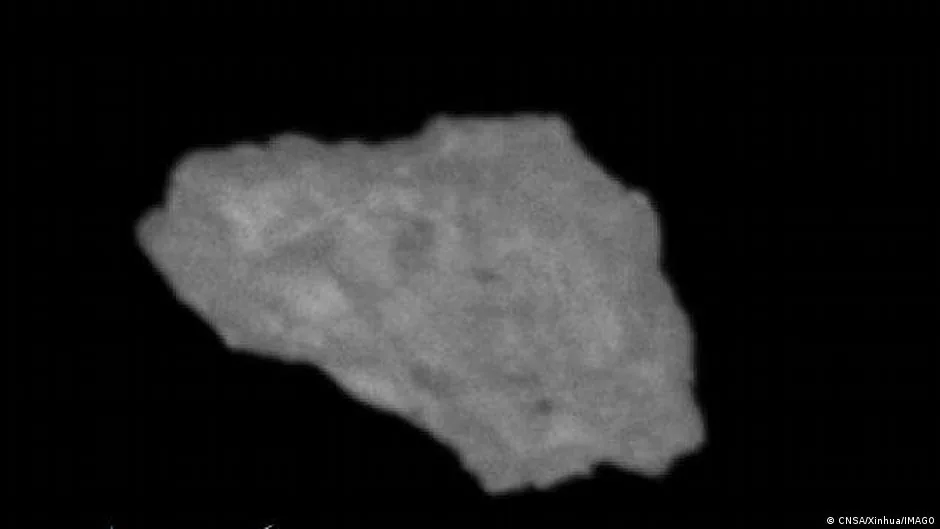
China's Tianwen-2 space probe has successfully reached its target, the near-Earth asteroid Kamo'oalewa, after a journey spanning approximately 400 days, the China National Space Administration (CNSA) announced on Monday. This achievement, following the probe's launch in May 2025, represents a pivotal moment for China's ambitions in deep-space exploration, as it embarks on its first attempt to retrieve samples from an asteroid.
Scientists suggest that analyzing asteroid samples could provide invaluable insights into the formation and evolution of the solar system. The CNSA confirmed that Tianwen-2 is now positioned about 20 kilometers (12 miles) from Kamo'oalewa, also known as 2016 HO3. This asteroid, discovered in 2016, is characterized by its small size, measuring only a few dozen meters in diameter, and its unique orbit which keeps it in near-synchronization with Earth, classifying it as a quasi-satellite.
The probe is expected to conduct progressively detailed scientific investigations. "The probe will progressively conduct more detailed scientific exploration to acquire data on the asteroid's morphology, material composition and internal structure, laying the groundwork for subsequent sample collection operations," the CNSA stated. This initial phase is crucial for understanding the asteroid's environment before the critical sample collection procedures begin. The mission aims to gather data that will pave the way for future sample return operations.
Asteroid Kamo'oalewa and Future Mission Phases
The Kamo'oalewa asteroid, a small body discovered in 2016, orbits the sun at a distance similar to Earth's. Its designation as a quasi-satellite means its orbital period is very close to that of Earth, causing it to remain in the planet's general vicinity. This makes it an attractive target for scientific study and potential resource utilization in the future.
Following the completion of its work at Kamo'oalewa, Tianwen-2 is scheduled to release a module carrying the collected samples. This module is expected to make its return journey to Earth, with its arrival anticipated by late 2027. This sample return capability is a complex feat in space mission design, requiring precise navigation and robust engineering.
Moreover, after concluding its primary objectives at the asteroid, the main Tianwen-2 spacecraft is planned to embark on a secondary mission. It will then travel towards a comet located in the main asteroid belt. This extended mission is designed to last for approximately a decade, showcasing the spacecraft's versatility and the long-term vision of China's space program. This ambitious plan highlights the dedication to furthering scientific understanding through extended deep-space exploration.
China's investment in its space program has seen a significant surge in recent years, with considerable financial resources allocated to advancing its capabilities. President Xi Jinping has frequently articulated a national aspiration for China to achieve a prominent position in space exploration, often referred to as the nation's "space dream." The current Tianwen-2 mission follows in the wake of successful sample return missions conducted by Japan's Hayabusa2 and NASA's OSIRIS-REx spacecraft. Beijing's intensified efforts reflect a global race among major spacefaring nations, including the United States and the European Union, to expand their presence and capabilities beyond the Moon and into the broader solar system. The ongoing developments in space exploration signify a new era of scientific discovery and technological competition.