
Euclid Telescope Finds Oldest Quasars, Deepening Cosmic Mystery
Europe's Euclid space telescope has identified 31 quasars, including the two oldest ever observed, dating to when the universe was only 670 million years old. This discovery adds to a growing puzzle about how supermassive black holes formed so early.

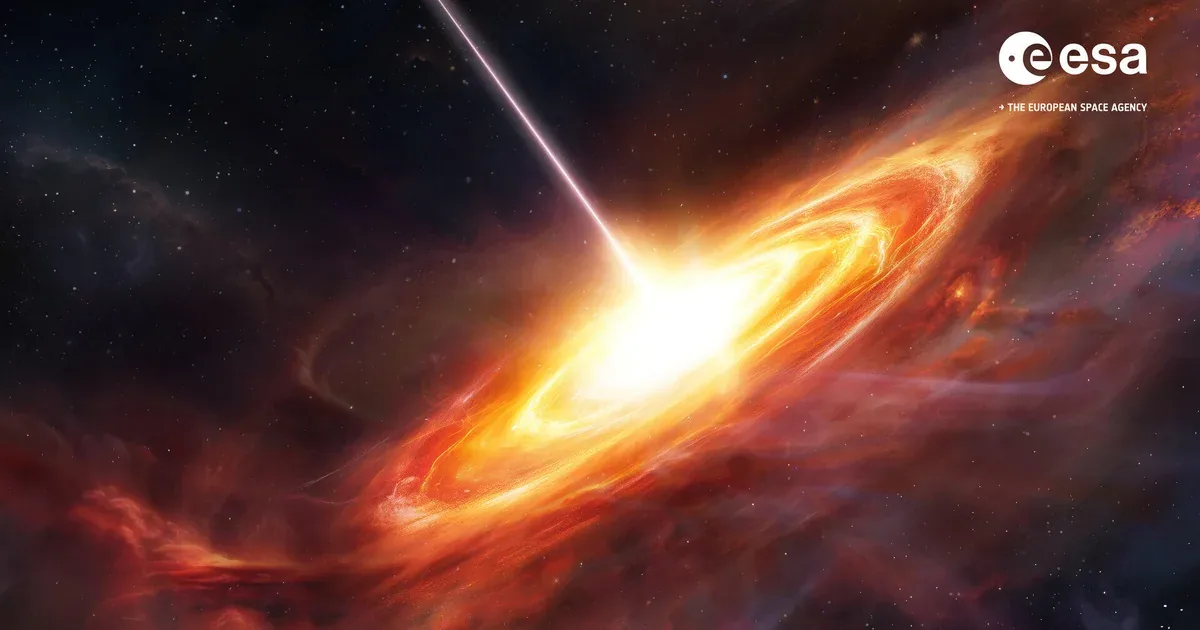
The European Space Agency's Euclid space telescope has achieved a significant breakthrough, identifying the oldest quasars ever detected. These ancient beacons, powered by supermassive black holes at the centers of early galaxies, are providing astronomers with crucial insights into the universe's infancy and exacerbating a perplexing cosmic mystery. The discoveries, announced in a study published Monday in Astronomy & Astrophysics, include 31 quasars, with the two most distant originating from a time when the universe was approximately 670 million years old, a mere five percent of its current 13.8 billion-year age.
Quasars are among the most luminous objects in the cosmos, shining trillions of times brighter than the Sun. They are fueled by gargantuan black holes actively consuming surrounding matter. Because the light from these objects has traveled across vast cosmic distances, observing them allows scientists to look back in time, offering a window into the universe's formative years. The newly discovered quasars push the boundary further than the previous record holder, found in 2021, by about 20 million years.
Daming Yang, the study's lead author and a PhD student at Leiden University in the Netherlands, emphasized the transformative impact of Euclid. "Before, we could only find a handful of the very brightest ancient quasars, but Euclid lets us search far more efficiently across huge areas of sky to capture much fainter light. It's a unique tool for quasar hunting," Yang stated. Since its launch in 2023, Euclid has effectively doubled the number of known ancient quasars, a feat previously accomplished with ground-based telescopes over much longer periods.
Deepening the Enigma of Early Cosmic Growth
The newly identified quasars emerge from the epoch of reionization, a critical period when the first stars and galaxies began to coalesce, signaling the end of the cosmic dark ages. "We can use quasars as a lighthouse to study the gas between us and them, so that we can trace how the universe was reionized through this cosmic history," explained Yang. However, these findings also add to a growing astrophysical quandary: galaxies and their central black holes appear to be far more massive in the early universe than current cosmological models predict. "Every step further back in time makes the puzzle more perplexing," noted study co-author Joseph Hennawi. "These monsters -- weighing billions of times the mass of our sun -- somehow already existed when the universe was in its infancy. We don't yet have a good understanding of how they grew so massive, so fast."
This rapid growth of supermassive black holes in the nascent universe challenges established theories of galaxy formation and evolution. Scientists are actively seeking even older quasars to refine their understanding, hoping to piece together a comprehensive cosmic chronicle of the first billion years. The James Webb Space Telescope, with its unparalleled infrared capabilities, has also observed these newly announced quasars, and the research team is eager to analyze its data.
Euclid, launched from Cape Canaveral on July 1, 2023, on a SpaceX Falcon 9 rocket, is on a six-year mission to map one-third of the observable sky. Its primary objectives are to unravel the mysteries of dark matter and dark energy, fundamental components of the universe that remain poorly understood. The Euclid telescope is positioned at a Lagrange point 1.5 million kilometers from Earth, offering a stable platform for its deep-space observations. In recent months, Euclid has also captured stunning images of our Milky Way galaxy's center and distant galaxy clusters like Abell 2390 and the Perseus cluster, showcasing its versatility and power in astronomical discovery.