
Solar Eclipse Dazzles Europe: Best Photos Capture Celestial Event
A rare total solar eclipse captivated millions across Europe on August 12, 2026, turning day into night for brief, awe-inspiring moments. Stunning photographs captured the dramatic celestial spectacle.

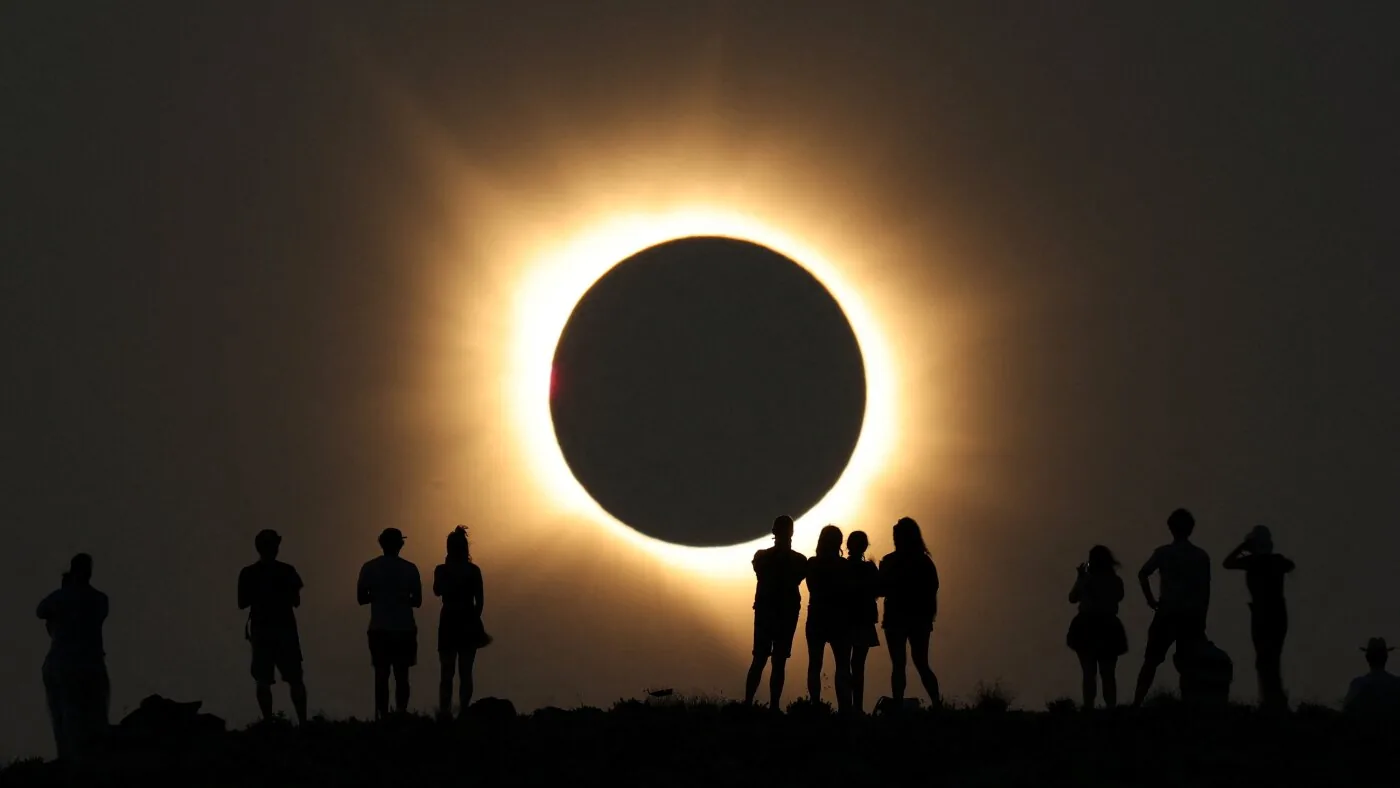
A rare total solar eclipse swept across parts of Europe and the UK on August 12, 2026, providing millions with a breathtaking view as the Moon completely obscured the Sun. The celestial event, the first total eclipse visible in Europe in decades, plunged areas into temporary darkness, creating a spectacle that photographers and skywatchers eagerly documented. The path of totality stretched across Spain and Iceland, offering a complete blackout, while other regions experienced a significant partial eclipse.
Spectators gathered in designated viewing locations, equipped with specialized glasses and cameras, to witness the phenomenon. Social media platforms were flooded with images and videos showcasing the sun's corona, visible only during totality, and the eerie twilight that enveloped the landscape. From the Iberian Peninsula to the British Isles, gasps of wonder were reported as the moon perfectly aligned with the sun.
The Science Behind the Spectacle
Solar eclipses occur when the Moon passes directly between the Sun and Earth, casting a shadow on our planet. A total solar eclipse happens when the Moon's apparent diameter is almost exactly the same as the Sun's, covering the solar disk completely. This alignment is not a daily occurrence due to the 5-degree tilt of the Moon's orbit relative to Earth's orbit around the Sun. The last total solar eclipse to cross parts of Europe occurred in 1999, making the 2026 event particularly noteworthy.
Dr. Elena Petrova, an astrophysicist at the European Space Agency, described the event as a powerful reminder of celestial mechanics. "Observing a total solar eclipse is a profound experience that connects us directly to the vastness of the cosmos," Dr. Petrova stated. "The precision required for this alignment, viewed from Earth, is truly astonishing and offers invaluable data for our understanding of solar physics and orbital dynamics." Her team collected data on atmospheric changes and solar wind patterns during the eclipse.
The eclipse's path of totality was approximately 100 kilometers wide, with durations of totality lasting up to three minutes in certain locations. Millions more in the United States witnessed a partial solar eclipse, with the Moon taking a significant bite out of the Sun. While not as dramatic as a total eclipse, these partial views still drew considerable attention, with many tuning into live streams and news coverage to follow the event across the Atlantic.
The successful observation of the 2026 solar eclipse highlights ongoing public fascination with astronomical events and the advancements in imaging technology that allow for the widespread sharing of such phenomena. As scientists continue to analyze the data gathered, the memory of the day turning to night will undoubtedly linger for those who witnessed this once-in-a-generation spectacle.