
Europe Eclipse: See Total Solar Eclipse Path & What to Expect
A total solar eclipse will be visible across parts of Europe on Wednesday, plunging areas into darkness. Here's when and where to see this rare celestial event and what observers can expect.

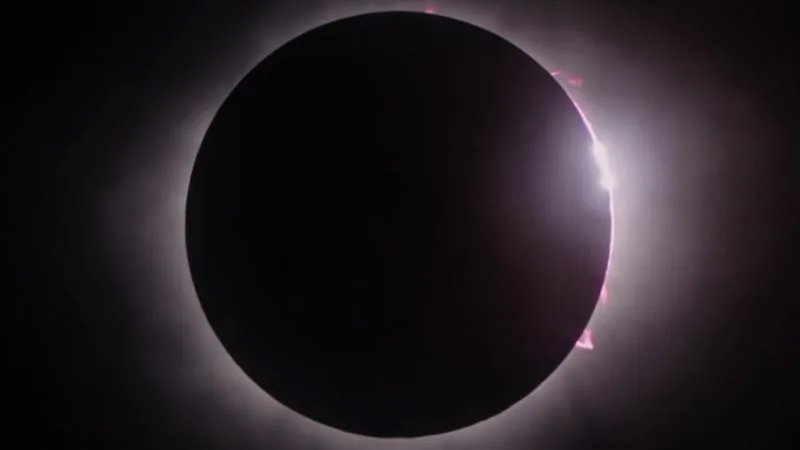
A rare total solar eclipse is set to captivate observers across Europe on Wednesday, with Iceland, northern Spain, and a sliver of northeastern Portugal lying in the direct path of totality. The celestial event occurs when the Moon passes precisely between the Sun and Earth, casting a shadow that completely obscures the Sun for a brief period. While these select regions will experience the full spectacle of the Sun disappearing from view, a partial eclipse will be visible across much of Europe, northern Africa, and parts of Canada and the northern United States.
The path of totality begins in a remote part of northern Russia, where the midday sky will momentarily darken. Viewers in Greenland and Iceland are set to experience the longest duration of totality, lasting approximately two minutes and 15 seconds, occurring in the late afternoon and early evening. However, Spain and the northeastern tip of Portugal will witness a particularly striking phenomenon: a sunset eclipse. Here, totality, lasting just under two minutes, will occur as the Sun dips below the horizon. In León, Spain, totality is scheduled to commence at 8:28 p.m. local time and conclude at 8:30 p.m. Dr. Ryan French, a solar astrophysicist at the Laboratory for Atmospheric and Space Physics in Boulder, Colorado, noted that he chose a viewing location north of Madrid for a slightly shorter, one-minute and 45-second totality, anticipating potentially clearer skies.
Observing the Eclipse Safely and What to Look For
For those outside the path of totality, the event will manifest as a partial eclipse, where only a portion of the Sun appears to be blocked by the Moon. The extent of this blockage depends on the viewer's proximity to the path of totality. For instance, residents in New York can expect about a 10% eclipse, a small sliver of the Sun obscured. In contrast, the United Kingdom, which will not experience a total solar eclipse again until 2090, is forecast to see approximately 95% of the Sun covered during this event. The timing of the partial eclipse will vary: it will occur in the morning for viewers in Alaska and northern Canada, in the afternoon for much of the northern US and eastern Canada, and in the evening for those in the UK, Ireland, Africa, and mainland Europe, where the unique sunset eclipse will be observable.
Experiencing a solar eclipse is a multi-stage process. It commences with a partial eclipse, where the Moon gradually appears to take a "bite" out of the Sun. This phase can last between 70 and 80 minutes. As totality approaches, dramatic changes will become apparent in the sky's luminosity. Just before the Sun is fully obscured, observers may witness Baily's beads, a string of bright spots caused by sunlight shining through lunar valleys along the Moon's edge. This phenomenon, named after English astronomer Francis Baily, is quickly followed by the "diamond ring" effect—a brilliant point of light that appears like a celestial jewel just as totality begins. This is the sole moment when it is safe to remove protective eyewear. During totality, the Sun's ethereal outer atmosphere, the corona, becomes visible as streams of white light. Dr. French described the phenomenon as giving the sky a "weird, twilighty, silvery glow." If wildfire smoke is present, it could potentially obscure the corona, though it might also lend a reddish hue to the Sun, possibly aiding photography without specialized filters. Observers might also catch a glimpse of the chromosphere, a thin, pinkish layer around the Moon. Bright planets or stars may become visible in the darkened sky, and a noticeable drop in temperature can be expected.
The return to daylight is marked by the reappearance of the diamond ring and Baily's beads before the partial eclipse phase resumes. It is crucial to put eclipse glasses back on as soon as totality ends. NASA strongly advises against looking at the Sun through unfiltered optical devices, such as cameras or telescopes, even with eclipse glasses on, as concentrated solar rays can still cause severe eye damage. For those who wish to capture the memory, Dr. French suggests focusing on capturing reactions. "Have somebody in your group position a phone pointing at yourselves and just get an authentic video," he advised. "Forget it’s there, set it up 20 minutes earlier and get a video of how your friends and family react. I think that’s a nice sentimental thing." For those already planning ahead, another total solar eclipse is scheduled for August 2, 2027, which will traverse southern Spain, Morocco, Egypt, and Saudi Arabia, offering an exceptionally long totality of over six minutes.