
Giant Planet Orbits Dead Star: Webb Telescope Reveals Solar System's Future
New observations of an exoplanet orbiting a white dwarf star may offer clues to the future of our own solar system's gas giants when the Sun eventually dies.

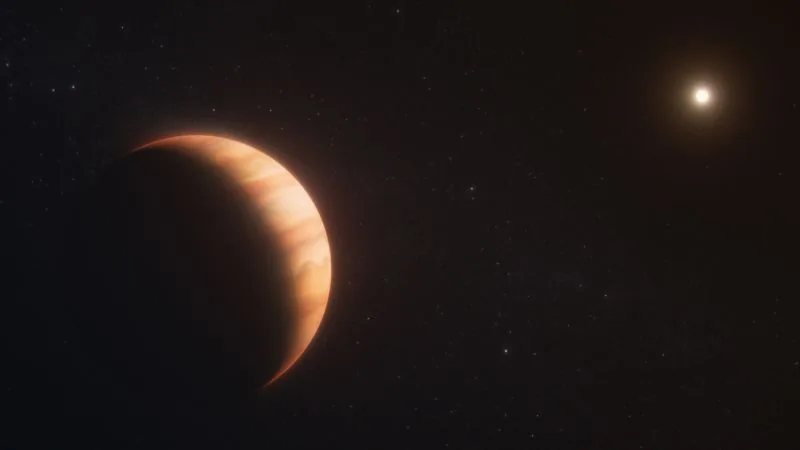
Astronomers using the James Webb Space Telescope have captured unprecedented new details of a Jupiter-sized exoplanet, known as WD 1856 b, that defies expectations by orbiting extremely close to its dead host star. The findings, published on Wednesday in the journal Nature, provide a rare glimpse into how massive planets might survive the dramatic end of their suns and offer a potential preview of the fate awaiting gas giants like Jupiter and Saturn in our own solar system billions of years from now.
Located 80 light-years away, WD 1856 b is a colossal planet, seven times the size of its star, a white dwarf remnant. It completes an orbit in a mere 34 hours, a startling proximity just 3 million kilometers (less than 2 million miles) from its stellar cinder. This closeness poses a significant puzzle, as massive stars like our Sun, after exhausting their nuclear fuel, expand dramatically before collapsing into dense white dwarfs. Scientists initially wondered how a planet of WD 1856 b's size could have survived such a violent stellar demise without being incinerated or torn apart.
“This is one of the most bizarre planetary systems we know of,” said Dr. Christopher O’Connor, a postdoctoral fellow at Northwestern University and a coauthor of the study. “For a theoretical astrophysicist, finding a strange object located where it ‘shouldn’t be’ feels a bit like an invitation from the universe to get creative in search of an explanation.”
An Unexpected Atmosphere and Surprising Temperature
The James Webb Space Telescope (JWST) was instrumental in these latest observations. Capturing the planet’s atmosphere required meticulous timing, as WD 1856 b’s transit—the brief period when it passes in front of its dim star—lasts only about 8 minutes. “If you blink, you miss it,” described study coauthor Victoria Boehm, a graduate student at Cornell University. The telescope’s sensitivity allowed the team to analyze the starlight filtered through the planet's atmosphere, revealing its composition, mass, and temperature.
Measurements indicated that WD 1856 b is between four and 11 times the mass of Jupiter. More surprisingly, the planet's measured temperature was around 127 degrees Celsius (260 degrees Fahrenheit), suggesting it is significantly hotter than it should be from just the faint light of the white dwarf. This excess heat has led researchers to believe the planet underwent a dramatic migration inward after its star's death, heating up as a byproduct of this journey. “That was really what started us on the track of figuring out the planet’s planetary migration from our data,” O’Connor explained.
The team’s analysis of the planet's WD 1856 b atmosphere also detected signatures of methane and other hydrocarbons, alongside hints of cloud particles. This marks the first time an atmosphere has been definitively observed on a planet transiting a dead star. Dr. Ryan MacDonald, lead author and lecturer at the University of St. Andrews, noted that the abundance of methane is higher than expected, potentially ruling out one prominent theory about the planet’s survival: engulfment by the star during its red giant phase. If engulfed, the methane would likely have been diluted.
However, not all experts agree on the interpretation of the heat data. Dr. Caroline Morley of the University of Texas at Austin, who was not involved in the study, expressed skepticism about the “reheated” planet theory. She suggested that water clouds, which are plausible at the observed temperatures, might better explain the atmospheric observations. “I do think that the tentative methane detection looks plausible, and the detection of clouds and/or hazes is solid,” Morley wrote.
Dr. Ian Crossfield from the University of Kansas, part of the team that discovered WD 1856 b in 2020, commented that while the migration conclusions are “provocative,” further study will be needed. He highlighted that JWST’s ongoing observations of gas giants, even those orbiting dead stars, continue to yield significant insights analogous to our own solar system.
The study of WD 1856 b is particularly compelling because it serves as a potential analogue for our own solar system. In approximately 5 billion years, our Sun will expand into a red giant, likely consuming Mercury and Venus and possibly Earth. While the fate of Earth remains uncertain, the giant planets like Jupiter and Saturn may survive, continuing their existence in a much-changed cosmic neighborhood. The WD 1856 system's long-term stability, potentially lasting trillions of years, suggests that stellar death does not necessarily mean the end for all planetary bodies.