
First Atmosphere Detected on Rocky Exoplanet in Habitable Zone
Astronomers have directly detected helium in the atmosphere of LHS 1140 b, a rocky exoplanet 48 light-years away. This marks the first time an atmosphere has been confirmed around a rocky world within its star's habitable zone.

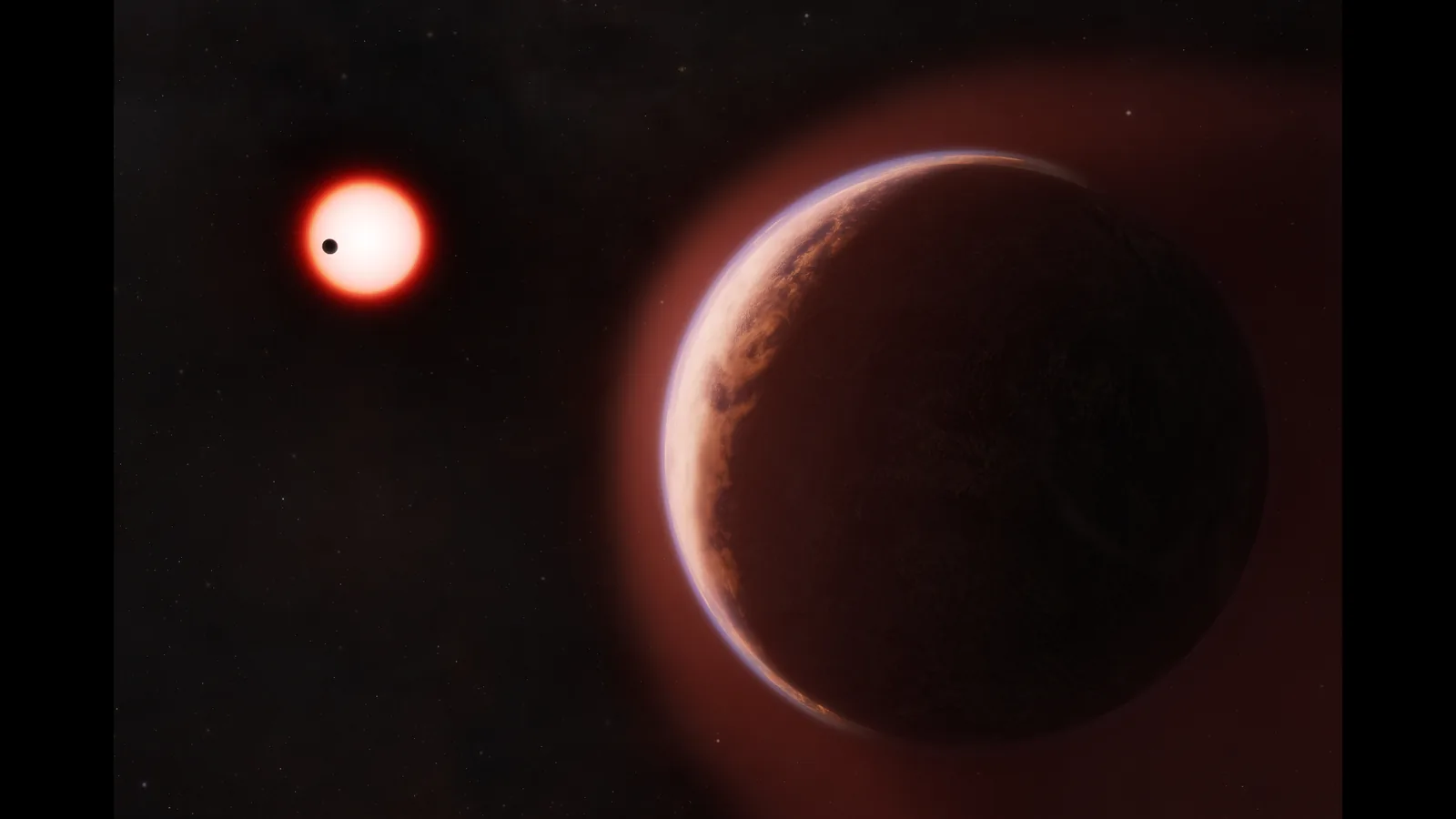
Astronomers have achieved a significant milestone in the search for extraterrestrial life, directly detecting helium in the atmosphere of a rocky exoplanet, LHS 1140 b, located 48 light-years from Earth. This discovery, announced recently, is the first time an atmosphere has been confirmed on a rocky planet situated within its star's habitable zone, the region where temperatures could potentially allow for liquid water to exist on the surface. The finding significantly bolsters the possibility of habitability beyond our solar system.
LHS 1140 b, first identified in 2017, orbits a red dwarf star. While rocky planets within habitable zones have been found before, confirming an atmosphere on such a world is a groundbreaking achievement. "We have actually detected directly the helium present in the atmosphere itself, and that's the first direct detection for any rocky exoplanet, which is really exciting," said lead author Collin Cherubim, who recently completed his Ph.D. at Harvard University. "And then there's this added bonus that it's in the habitable zone, which is super exciting for astrobiology and habitability and searching for life.". He described the feeling as "kind of surreal.".
The exoplanet's host star, a red dwarf, is smaller and cooler than our Sun. However, LHS 1140 b orbits its star at a closer distance, maintaining a temperature suitable for liquid water, often referred to as the "Goldilocks zone." Researchers believe the planet likely possesses substantial amounts of water, enhanced by a greenhouse effect from its newly confirmed atmosphere. "If it has some amount of atmosphere that can provide a bit of a greenhouse effect, which we know that it does now … it will very likely be what we consider to be habitable conditions on Earth, and conditions that would likely support liquid water," Cherubim explained.
Atmospheric Survival on Rocky Worlds
The existence of an atmosphere on a rocky planet orbiting a red dwarf presents a compelling case for atmospheric resilience. Red dwarfs are known for their intense stellar activity, including frequent bursts of radiation such as solar flares and coronal mass ejections, which can strip atmospheres from orbiting planets. "This discovery is a big deal because it's showing that at least this rocky planet has retained an atmosphere over billions of years," Cherubim stated. "It's a bona fide, robust way of saying yes, atmospheres can survive on rocky exoplanets.". While some helium may be slowly escaping LHS 1140 b's atmosphere over time, the planet, estimated to be around 6 billion years old, is expected to retain it, according to co-author Jason Dittmann. Even Earth experiences a slow escape of helium from its own atmosphere.
The confirmation of helium was made possible by advanced spectrographic analysis. Cherubim developed a theoretical model during his Ph.D. studies, predicting the existence of atmospheres on rocky exoplanets beyond Earth. He then employed a technique typically used for observing gas giants to analyze LHS 1140 b. Using the Warm Infrared Echelle (WINERED) Spectrograph on the Magellan Observatory in Chile, the team observed the planet transit its star. This allowed them to detect the spectral signature of helium, validating Cherubim's predictions and marking a significant application of the scientific method.
While the discovery of a rocky planet with an atmosphere in the habitable zone naturally raises questions about the potential for life, scientists caution that there is insufficient data to draw conclusions. "I'm not claiming this planet has life," Cherubim emphasized. Future observations aim to identify other atmospheric components and confirm the presence of water, furthering our understanding of potentially habitable worlds. This landmark finding represents a crucial step forward in humanity's enduring quest to determine if we are alone in the universe.