
Hayabusa2 Captures New Images of Asteroid Torifune 62 Million Miles Away
Japan's Hayabusa2 probe conducted a close flyby of asteroid Torifune, capturing detailed images and scientific data from 62 million miles away. The mission adds to the probe's impressive record of asteroid exploration.

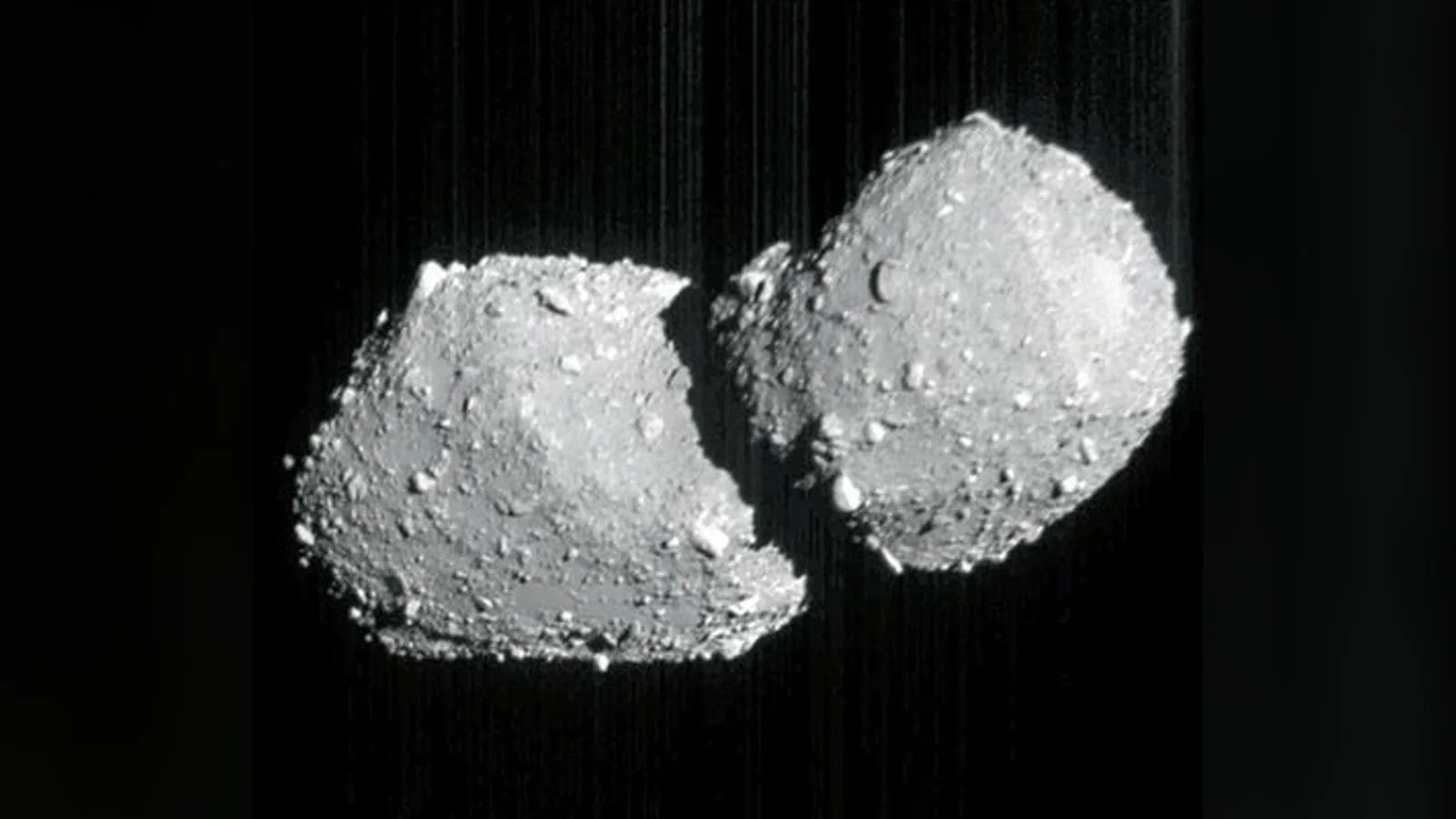
Japan's Hayabusa2 spacecraft has successfully executed a close flyby of asteroid Torifune, transmitting striking new images and scientific data from its vantage point approximately 62 million miles from Earth. The maneuver, conducted by the Japan Aerospace Exploration Agency (JAXA) on Sunday, July 5, 2026, involved one of the closest high-speed passes a spacecraft has ever achieved with an asteroid. Torifune, a space rock measuring about 1,475 feet (450 meters) in diameter, is part of the Apollo group, which includes near-Earth asteroids with orbits that intersect Earth's path around the sun. The probe utilized its optical camera to capture breathtaking imagery during the encounter. Additionally, Hayabusa2 employed its Mid-Infrared Camera (TIR) to gather crucial data on the asteroid's surface temperature, thermal inertia, and roughness, revealing cooler areas in shadow and warmer surfaces exposed to the sun.
This close observation of Torifune was not part of Hayabusa2's original mission parameters. JAXA scientists had previously acknowledged the operation as a "risky endeavor" due to the limited knowledge about the asteroid. The acquisition of this new data and imagery significantly enhances our understanding of such celestial bodies. Torifune completes one orbit around the sun every 383 days and has a rotation period of approximately 5 hours. Its classification within the Apollo group of asteroids highlights its potential proximity to Earth, underscoring the value of detailed reconnaissance missions like this one.
Expanding the Legacy of Asteroid Exploration
The recent encounter with Torifune further cements the Hayabusa2 probe's legacy as a trailblazer in asteroid exploration. Launched in December 2014, the mission's primary objective was the collection and return of asteroid samples to Earth. This ambitious goal was realized in December 2020, when JAXA successfully retrieved samples from asteroid Ryugu. Subsequent analysis of these samples has provided invaluable insights into the early solar system's history, notably including the discovery of all five nucleobases essential for DNA and RNA within Ryugu's composition. Following its sample collection from Ryugu in 2019, Hayabusa2 has continued its journey through space.
The probe's current objective is to reach asteroid 1998 KY26, a significantly smaller celestial body measuring approximately 36 feet (11 meters) across. This target is comparable in size to the asteroid that caused the 2013 Chelyabinsk event in Russia. Hayabusa2 is projected to arrive at 1998 KY26 in 2031. Upon arrival, the probe is scheduled to orbit the diminutive asteroid before attempting a surface landing. JAXA's ultimate aim is to deepen scientific understanding of the structure and composition of small asteroids, contributing crucial data to planetary defense strategies and the broader field of planetary science. This mission continues to push the boundaries of what is possible in deep space exploration.