
Hunter's Moon and Saturn Visible This October
Stargazers can look forward to October's full Hunter's Moon, which will be visible alongside the planet Saturn. The celestial event offers a unique opportunity to observe both.

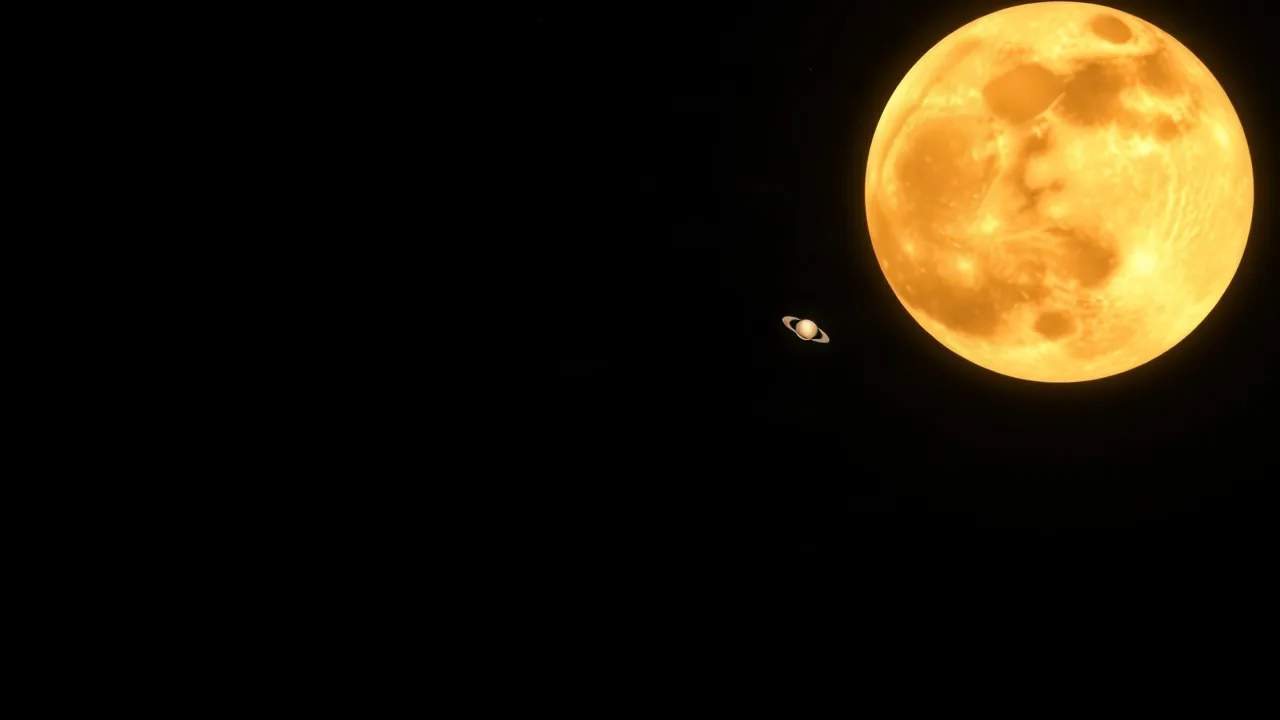
Residents across the United States will have a prime opportunity to witness the annual Hunter's Moon in October, appearing alongside the distant planet Saturn. The full moon, often appearing with an orange hue as autumn progresses, will reach its peak illumination on the night of October 25, 2026. This celestial display provides an accessible event for amateur astronomers and casual observers alike, promising clear views of both the moon and one of its cosmic neighbors.
The Hunter's Moon gets its name from its timing, following the Harvest Moon in September, and signaling the traditional hunting season. As daylight hours shorten and trees shed their leaves, the moon's rising in the east around sunset provides ample light for hunters to track game. This year, the spectacle is enhanced by the visible presence of Saturn, which will appear as a bright, steady point of light near the moon.
A Double Feature in the Night Sky
The proximity of Saturn to the moon is not merely coincidental; both celestial bodies are observable from Earth due to their positions in their respective orbits. Saturn, known for its prominent rings, will be visible as a distinct point of light, though its rings will require a telescope for detailed observation. Its appearance will be relatively close to the moon throughout the night, making for a visually striking pairing. Astronomers recommend looking towards the eastern horizon shortly after sunset for the best views as the moon begins its ascent.
Dr. Evelyn Reed, a planetary scientist at the National Astronomical Observatory, explained the significance of such alignments. "These opportunities allow us to connect with the cosmos on a fundamental level," Dr. Reed said. "While the moon is our constant companion, seeing it juxtaposed with a planet like Saturn reminds us of the vastness and order of our solar system. It’s a chance for public engagement with astronomy, fostering curiosity about space exploration."
Observing the Hunter's Moon does not require specialized equipment, as it will be visible to the naked eye. However, binoculars can enhance the view of the moon's craters and surface details. For those hoping to catch a glimpse of Saturn's rings, a telescope with moderate magnification will be necessary. Clear skies are crucial for optimal viewing, and weather forecasts for October 25, 2026, will be closely monitored by astronomy enthusiasts nationwide. Many local astronomy clubs are also planning public viewing events to celebrate the occasion.
The appearance of the Hunter's Moon is a recurring event, but its combined visibility with Saturn at such a prominent angle is less common. This makes the October 25th event a noteworthy astronomical occasion. The moon's position in its orbit will make it appear full for about three days, centered on the 25th, offering a wider window for observation. This celestial alignment serves as a reminder of the predictable yet awe-inspiring movements of objects within our solar system, encouraging people to look up and appreciate the wonders of the universe.