
Kilauea's Halemaumau Crater Sees 51st Lava Fountain Episode
Lava fountaining has reignited at Hawaii's Kilauea volcano, marking the 51st event since the current eruption began in December 2024. The activity is confined to Halemaumau crater, with fountains reaching approximately 160 feet.

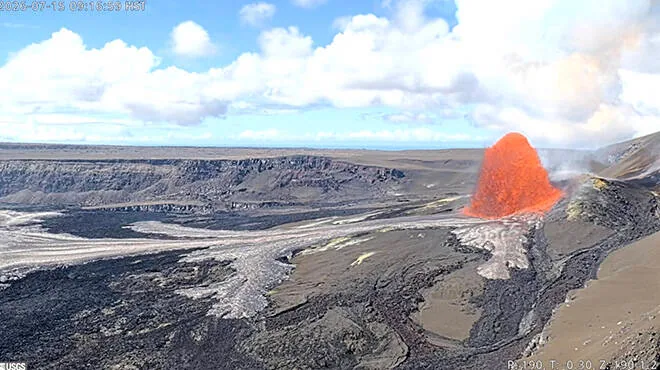
Lava fountaining returned to Halemaumau crater at Hawaii's Kilauea volcano on July 16, 2026, marking the 51st distinct event since the current eruption commenced on December 23, 2024. Scientists at the Hawaiian Volcano Observatory (HVO) confirmed that the fountaining began at 8:30 a.m. local time, originating from the north vent within the crater at the volcano's summit. The dramatic displays have sent lava soaring to heights of about 160 feet above ground level.
These energetic fountains are feeding substantial lava flows that are spreading across the crater floor. HVO noted that prevailing winds, blowing at 5-10 mph from the east-northeast, are likely to carry volcanic gas emissions and airborne material, such as tephra and ash, towards the west-southwest. This trajectory could impact communities in the Ka’u district, including Pahala and Naalehu, as well as areas along Highway 11 southwest of the volcano.
Higher-altitude winds are coming from the south, raising the possibility of tephra dispersal into communities situated adjacent to and north of Hawaii Volcanoes National Park. The National Weather Service (NWS) in Honolulu issued a special weather statement on Tuesday, cautioning residents about the potential for varying levels of ash and Pele’s hair to fall downwind of the eruption. They emphasized that smaller particles can travel considerable distances, potentially affecting communities farther from the eruption site.
Volcanic Precautions and Advisories
In response to the renewed activity, residents living downwind of the Kilauea summit, or those planning to visit the summit area, have been urged to stay informed about the latest volcanic and weather conditions. Officials recommend preparing homes by closing windows and disconnecting water catchment systems if necessary. The NWS advised following all guidance from the National Park Service and the County of Hawaii, and to be aware that road or park closures may be implemented.
The current eruption sequence, which began in late 2024, has seen all reported volcanic activity exclusively contained within the summit crater of Kilauea. According to HVO, each of the 51 observed episodes has typically lasted for a day or less. This pattern of contained summit activity is a key characteristic of the ongoing eruption, differentiating it from past events that have produced more extensive lava flows across the island.
The HVO continuously monitors the volcano using a network of seismometers, GPS stations, and gas sensors, providing critical data for forecasting and public safety. Understanding the dynamics of these summit eruptions is vital for the region's preparedness and resilience. While the lava remains within the Halemaumau crater, the associated gas and ash emissions highlight the ever-present hazards of living in proximity to active volcanoes like Kilauea.