
KY26 Asteroid Accelerates in Space as Ice Theory Fails
Researchers studying the accelerating asteroid KY26 find it is too warm to retain the cometary ice needed to power its motion.

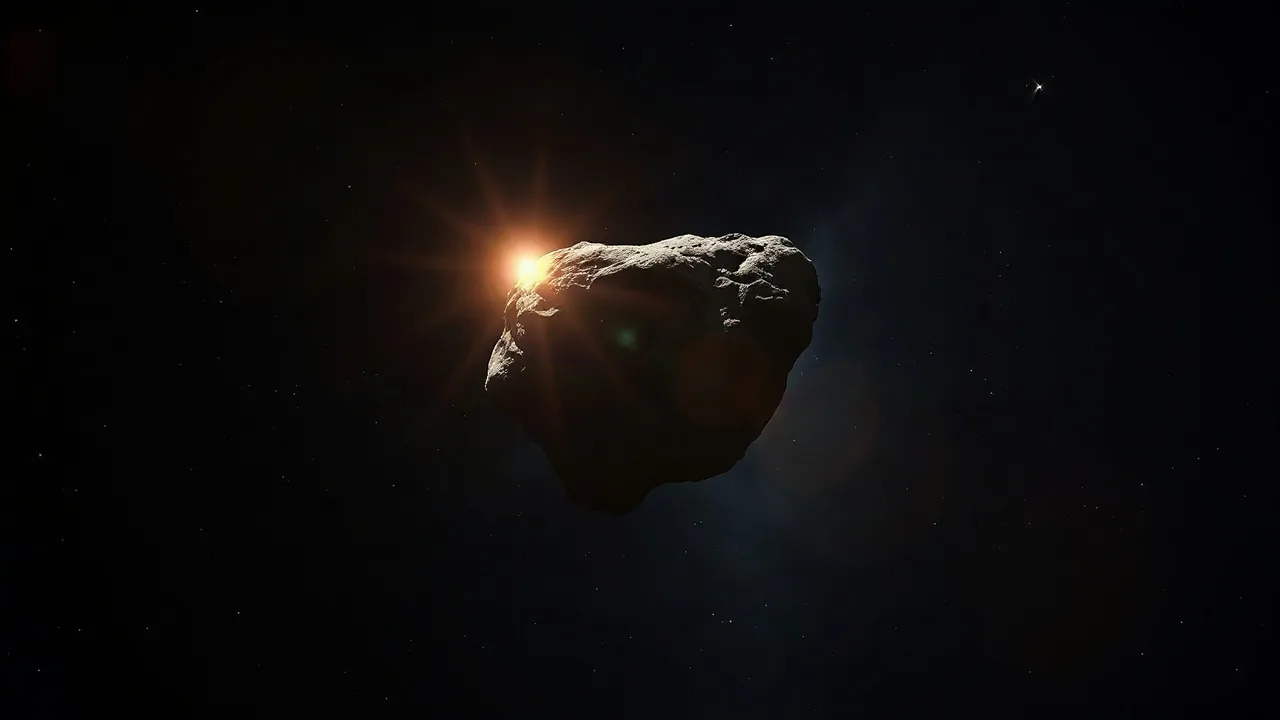
Aerospace engineers at the Georgia Institute of Technology have cast doubt on a leading theory explaining the unusual movement of the 11-meter space rock known as KY26. While asteroids typically follow predictable paths driven by gravity and solar radiation pressure, KY26 has exhibited an unexpected acceleration that defies standard expectations. Scientists previously proposed that the object might be a 'dark' comet, whose invisible outgassing could propel it along a different route. However, new temperature modeling suggests the asteroid is simply too warm to sustain the ice required for such propulsion.
To investigate the composition of the object, researchers Korbin Hansen and Masatoshi Hirabayashi combined existing data on the size, orbit, reflectivity, and likely composition of KY26 to model temperatures across its surface and interior. For buried water ice to survive over long periods, temperatures must remain below roughly 145 Kelvin, which translates to -128 degrees Celsius. Yet, the team discovered that even the coldest regions of the space rock maintain an average temperature of at least 212 Kelvin, or -61 degrees Celsius, throughout its orbit around the Sun.
Evaluating the Temperature Data
At these elevated temperatures, calculations indicate that if water ice comprised 1 percent of the mass of KY26, it would completely vanish in just over 2,000 years. If that same hypothetical ice were driving the current acceleration of the asteroid, it would be depleted in a mere 62 years. “Our temperature model results indicate that the water outgassing rate on 1998 KY26 would be too high to maintain buried ice, refining the understanding of the asteroid's composition,” Hansen and Hirabayashi write in a paper published in Icarus.
Although the object could theoretically be billions of years old, uncertainty remains regarding how long it has occupied its current orbit. Despite this caveat, the latest findings combined with earlier research pointing toward an asteroid belt origin continue to narrow the window of possibility for the dark comet hypothesis. As scientists continue searching for answers regarding what might be pushing the space rock off its standard path, solar radiation pressure remains a viable alternative candidate. Meanwhile, the Japanese space agency's Hayabusa2 spacecraft is currently traveling toward the object, with a planned rendezvous scheduled for July 2031.