
Lava Planet Clouds Defy Astronomical Models
Astronomers have detected clouds on a scorching lava planet, defying current models of exoplanet atmospheres. This discovery on TOI-2180 b offers new insights into planetary formation and atmospheric dynamics.

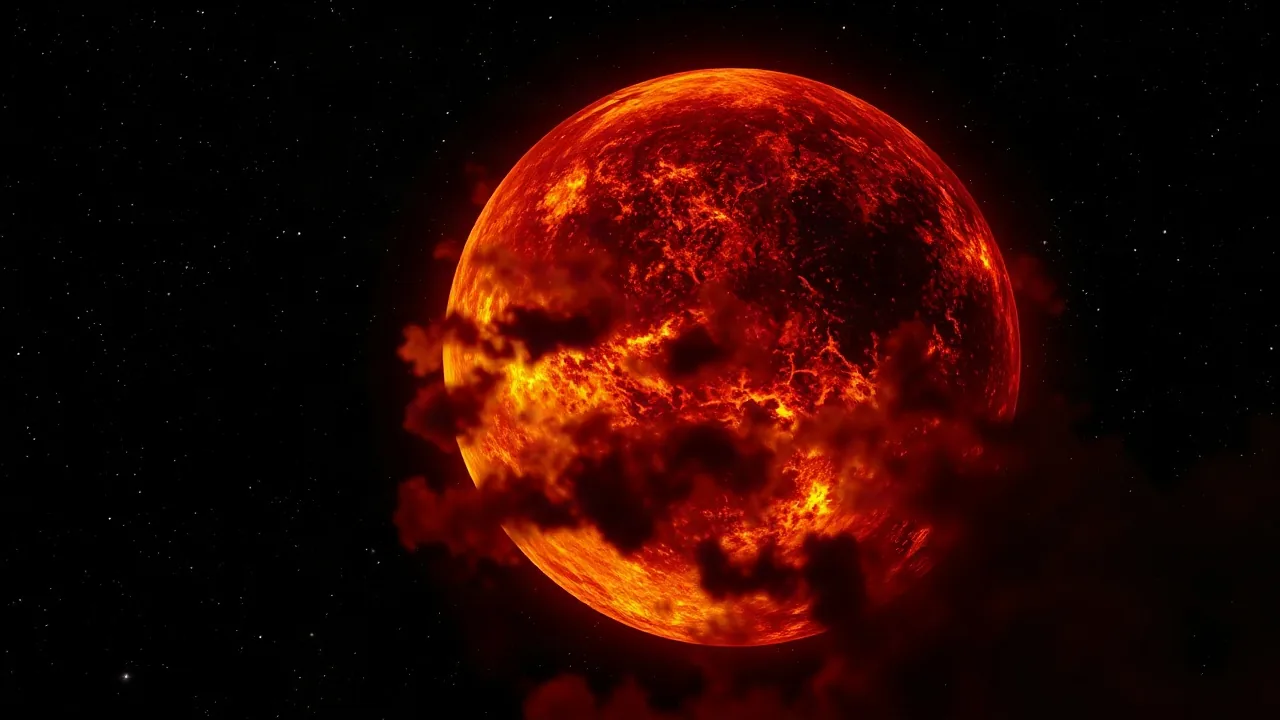
Astronomers have identified clouds on a distant, scorching exoplanet designated TOI-2180 b, a finding that challenges prevailing theories about the atmospheric composition of extreme worlds. The observations, made using advanced telescope data, suggest that atmospheres on planets with molten surfaces might be far more complex than previously understood. This revelation stems from a detailed analysis of the planet's transit across its host star, where subtle changes in light absorption indicated the presence of atmospheric particles.
TOI-2180 b, located approximately 377 light-years away in the constellation Eridanus, orbits its star at an extremely close distance, resulting in surface temperatures estimated to be around 2,300 degrees Fahrenheit (1,260 degrees Celsius). This intense heat would naturally lead to a molten, lava-like surface. The prevailing scientific expectation was that such extreme conditions would prevent the formation of stable clouds, or at least lead to atmospheric compositions dominated by vaporized rock and metals.
Atmospheric Puzzles in Extreme Environments
The detection of clouds, composed likely of silicate particles – essentially tiny grains of rock – indicates a dynamic atmospheric system capable of sustaining these formations even under intense heat and pressure. "We were surprised to find evidence of clouds on such a hot planet," said Dr. Anya Sharma, lead researcher on the study from the Institute for Planetary Science. "It suggests that our understanding of atmospheric chemistry and cloud formation processes in these extreme environments is incomplete." The team utilized spectral analysis, studying the wavelengths of light that passed through the planet's atmosphere as it transited its star. Specific absorption patterns pointed to the presence of suspended silicate particles, a key indicator of rocky clouds.
This discovery has significant implications for the broader field of exoplanet research. Understanding the diversity of exoplanetary atmospheres is crucial for identifying potentially habitable worlds and for piecing together the puzzle of planetary formation across the galaxy. For years, scientists have used models to predict the atmospheric makeup of exoplanets based on their size, mass, and distance from their star. However, the case of TOI-2180 b demonstrates that these models may need refinement. The planet's atmosphere, far from being a simple vapor-filled void, appears to harbor complex weather patterns, potentially involving condensation and cloud formation similar in principle, though vastly different in composition, to those on Earth.
The research team is planning follow-up observations with more powerful instruments, such as the James Webb Space Telescope, to further characterize the composition and structure of TOI-2180 b's atmosphere. Future studies will aim to determine the exact particle size and distribution within the clouds, as well as search for other atmospheric components. This meticulous approach to studying exoplanet atmospheres provides invaluable data for refining theoretical frameworks. The existence of such clouds on a lava planet underscores the vast array of planetary conditions possible in the universe and highlights the ongoing need for empirical observation to guide theoretical astrophysics. The insights gained from TOI-2180 b could reshape how astronomers interpret data from future discoveries of rocky planets orbiting distant stars, pushing the boundaries of our cosmic comprehension.