
Massachusetts Coast Meteor Explodes, Rocking State With Loud Boom
A meteor exploded off the Massachusetts coast on Saturday afternoon, generating a loud boom heard across the state and parts of Rhode Island. The event rattled windows and startled residents.

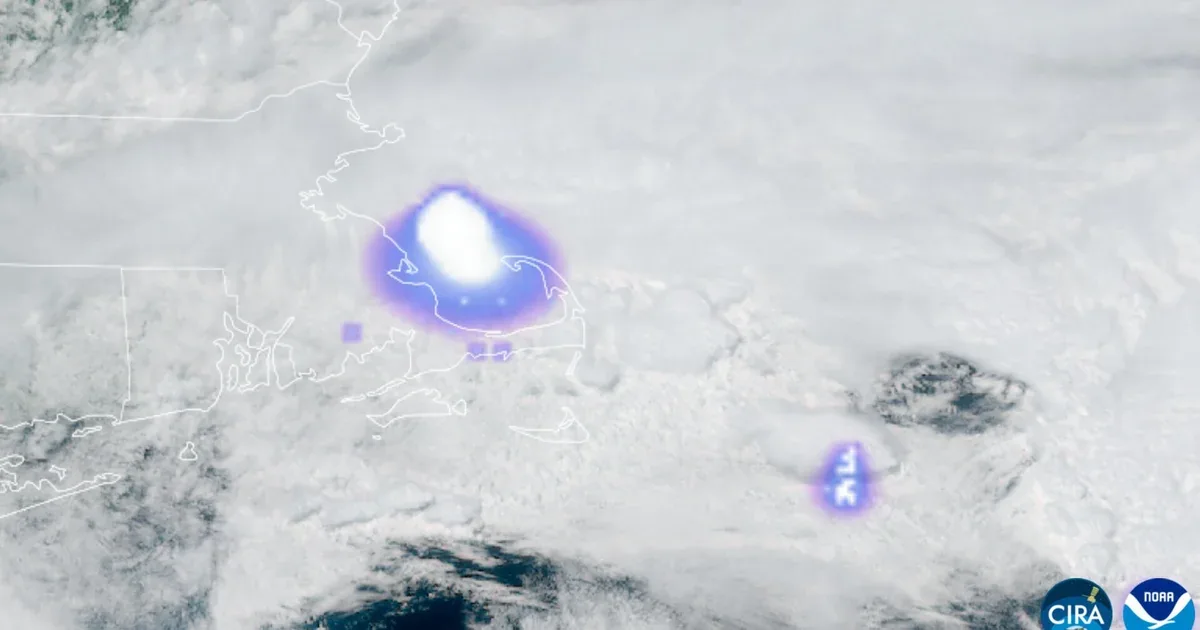
A meteor streaked across the sky and exploded off the coast of Massachusetts on Saturday afternoon, unleashing a powerful boom that resonated throughout the state and even reached into Rhode Island. The sonic event occurred around 2:11 p.m. Eastern Time, prompting dozens of calls to local newsrooms as residents reported windows rattling and pets becoming distressed.
Eyewitnesses described a sudden, intense bang, with some noting that their homes experienced vibrations. Reports of the phenomenon extended from Boston's suburbs as far north as Ipswich and south to Johnston, Rhode Island. The American Meteor Society confirmed it received preliminary reports from numerous individuals across the Northeast who witnessed a bright fireball around 2 p.m. Saturday. These sightings, spanning multiple states, are crucial for scientists attempting to map the meteor's trajectory through Earth's atmosphere.
Data from the National Oceanic and Atmospheric Administration's satellite lightning detection system registered a signature consistent with a meteor event occurring at the approximate time of the reported boom. Analysis of this data suggests the object likely entered the atmosphere in the vicinity of Boston's South Shore. Officials have not reported any evidence of the meteor's impact or landing location.
Understanding Meteor Sonic Booms
While most meteors disintegrate harmlessly far above the Earth, larger objects can survive this fiery descent, creating spectacular fireballs and audible shockwaves. Meteors enter Earth's atmosphere at extremely high velocities, frequently ranging from 25,000 to 160,000 miles per hour. The vast majority are no larger than sand grains and vaporize without incident. However, when a more substantial object penetrates deeper into the atmosphere, its passage generates intense pressure waves, analogous to those produced by a supersonic aircraft. These waves can propagate to the ground, manifesting as a sonic boom, sometimes perceivable dozens of miles from the meteor's atmospheric path. This explains how individuals could hear the loud bang without necessarily seeing the fireball.
Saturday's event in Massachusetts is the latest in a series of significant fireball sightings reported across North America in 2026. Earlier this year, an exploding meteor over Ohio in March produced a sonic boom audible in several states. Shortly thereafter, a separate fireball over Texas generated a potent shock wave and scattered meteorites, with one fragment reportedly breaching the roof of a home near Houston. Scientists affiliated with the American Meteor Society have noted an unusual uptick in substantial fireball occurrences and associated sonic booms during the initial months of 2026.
Adding to the recent atmospheric phenomena, residents across South Carolina reported a mysterious blast just a day prior to the Massachusetts event, which many initially attributed to seismic activity. The U.S. Geological Survey later concluded that the South Carolina incident was consistent with a sonic boom, though its precise origin remains under investigation. Researchers emphasize that there is currently no indication of any impending impact threat to Earth from celestial bodies.