
NASA AI Spots Rare Black Hole Devouring Star Far From Galaxy Center
NASA's AI identified a rare "orphan" black hole tearing apart a star 750 million light-years away. This marks the first observed tidal disruption event outside a galaxy's core.

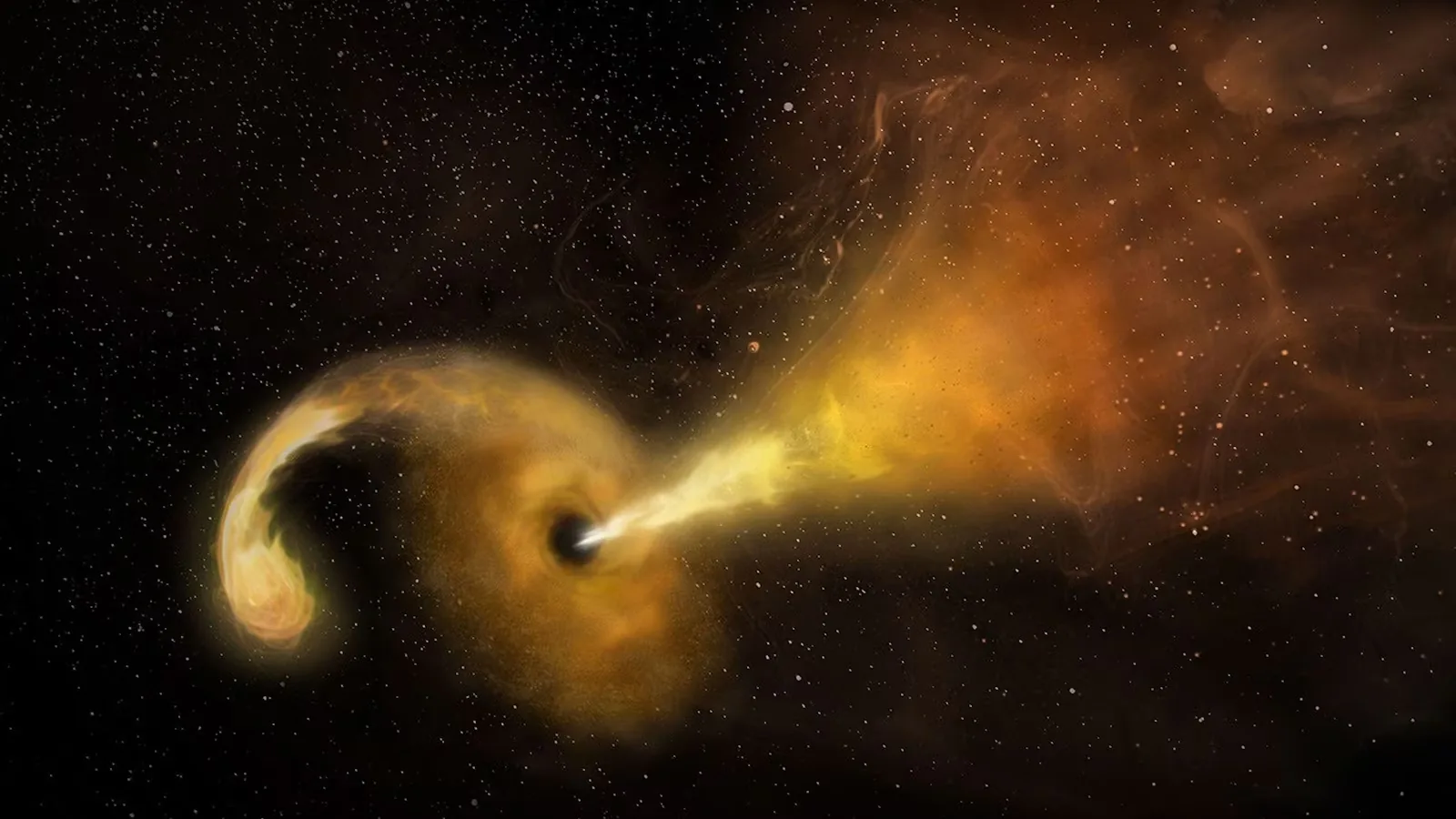
Astronomers utilizing a sophisticated artificial intelligence algorithm have detected a rare cosmic event: a colossal black hole, weighing roughly a million times the mass of our sun, consuming a star on the fringes of a distant galaxy. The phenomenon, known as a tidal disruption event (TDE), occurred approximately 750 million light-years from Earth. This particular black hole is classified as an "orphan" or "wandering" black hole because it resides far from the galaxy's central hub, a location never before observed for such an event.
The unprecedented discovery was made possible by an advanced AI algorithm developed by researchers. This AI was instrumental in sifting through vast amounts of astronomical data, identifying an unusual flare in November 2025 captured by the Zwicky Transient Facility at Palomar Observatory in Southern California. Out of hundreds of thousands of celestial events observed nightly, the AI flagged a specific brightening pattern characteristic of a TDE. "We were looking for these star-shredding events as a way to find otherwise invisible supermassive black holes wandering away from the galactic cores where they usually reside," explained Robert Stein, a research fellow at the University of Maryland, College Park, and NASA's Goddard Space Flight Center, in a statement. Stein is the lead author of the study published in The Astrophysical Journal Letters.
A New Method for Finding Wandering Giants
The extreme gravitational pull of the "monster" black hole overwhelmed the star, tearing it apart and unleashing an immensely bright flare. This flare, temporarily outshining its entire host galaxy in ultraviolet wavelengths, radiated with the intensity of about 10 billion suns for months. Scientists then employed ground-based observatories like the Southern Astrophysical Research (SOAR) telescope in Chile and NASA's Neil Gehrels Swift Observatory satellite to confirm the nature of the TDE. This verification was crucial, especially given the unusual placement of the event. "The combination of all this data helped us rule out other explanations and confidently say it's a tidal disruption event, despite its strange location," stated Jonathan Carney, a doctoral student at the University of North Carolina at Chapel Hill, who provided the initial spectral data supporting the TDE interpretation. The discovery validates a novel technique for detecting these elusive celestial objects.
Researchers theorize the black hole's peripheral location might stem from a galactic merger. During such cataclysmic events, the gravitational interactions between multiple supermassive black holes at the cores of merging galaxies could eject a lighter black hole to the galaxy's outskirts, about 30,000 light-years from the center in this case. Alternatively, the black hole might belong to a dwarf galaxy still in the process of merging with a larger one, and a star strayed too close as the dwarf galaxy's contents were drawn inward.
Tidal disruption events are inherently rare, with a star approaching a supermassive black hole under such destructive circumstances occurring roughly once every 100,000 years, according to NASA. Until recently, these events were exclusively observed within the dense galactic centers, largely because that is where astronomers primarily searched for them. The first TDE detected outside a galactic core occurred in May 2025, approximately 2,600 light-years from its host galaxy's center. This prior observation spurred further investigation into similar phenomena in less conventional locations. The successful identification of this latest TDE signals a significant advancement in the ongoing quest to locate and study these enigmatic, often invisible, supermassive black holes. The application of artificial intelligence in astronomical surveys is proving invaluable, accelerating the pace of discovery and expanding our understanding of the universe's most extreme phenomena, including black holes.