
NASA Captures Cosmic Red, White, and Blue Images for US Anniversary
NASA has released a new series of stunning cosmic images, rendered in patriotic colors, to celebrate the United States' 250th anniversary. The images combine data from multiple space telescopes and observatories.

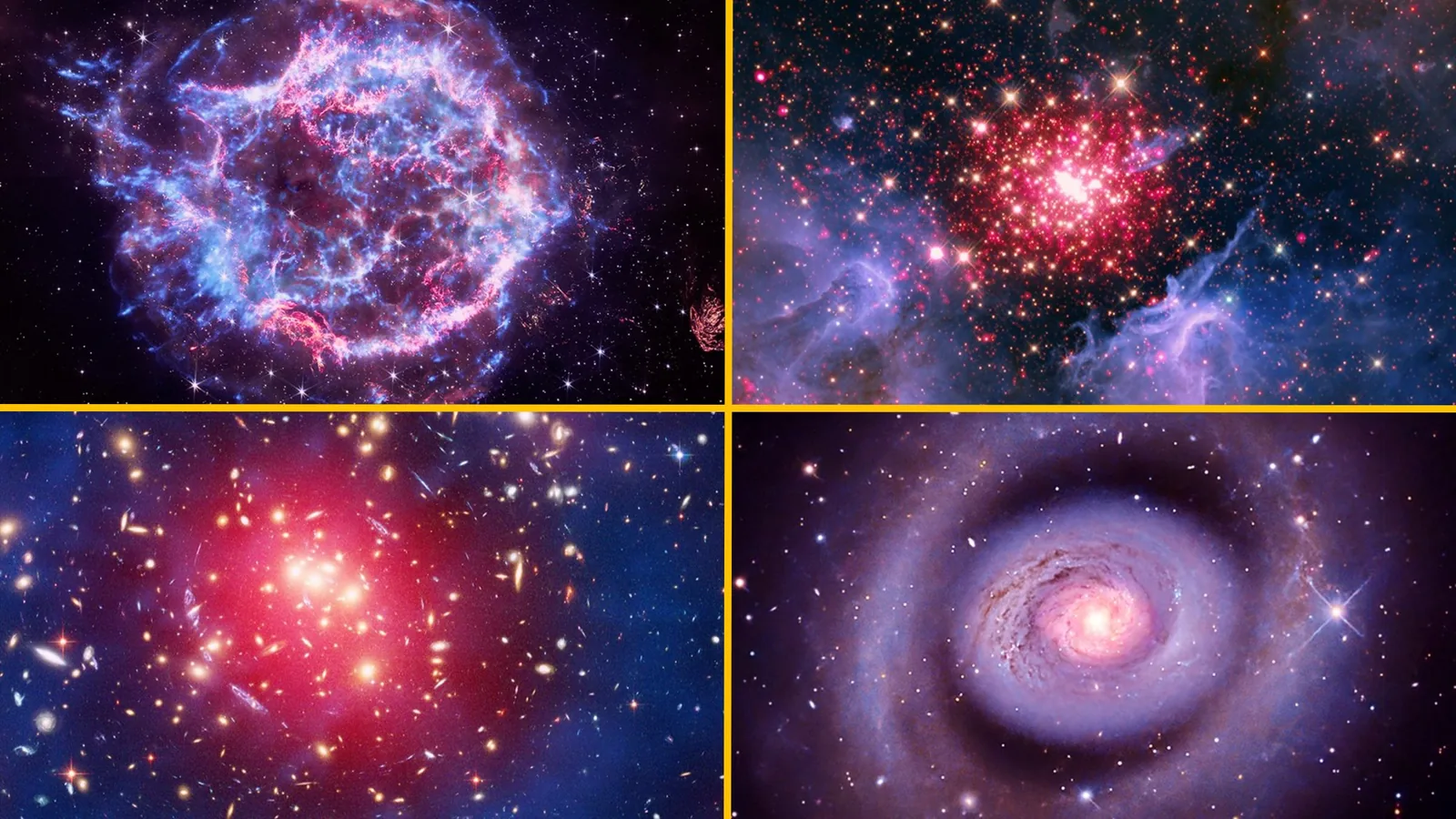
NASA marked the United States' upcoming 250th anniversary by unveiling a breathtaking collection of cosmic images, processing data from its premier observatories into a patriotic palette of red, white, and blue. The striking visuals showcase four distinct deep-space objects, combining X-ray observations from the Chandra X-ray Observatory with visible and infrared light data from NASA’s Hubble and James Webb Space Telescopes, alongside ground-based facilities.
The curated images highlight some of the universe's most dynamic phenomena, including the remnants of a stellar explosion and a colossal galaxy cluster influenced by dark matter. Each celestial scene is presented with colors evoking the American flag, offering a unique perspective on astronomical wonders.
Perhaps the most visually evocative of the Fourth of July is the image of Cassiopeia A, a renowned supernova remnant located approximately 11,000 light-years away in the Cassiopeia constellation. Data from Chandra, depicted in blue and purple hues, reveals the powerful blast wave from a monumental stellar detonation and maps the distribution of elements such as iron, calcium, and oxygen. Complementing this, infrared data from the James Webb Space Telescope, shown in red and white, illuminates the expanding shell of cosmic dust and debris. This spectacular event is the aftermath of a massive star's explosion that occurred about 340 years ago.
Galactic Neighborhoods in Patriotic Hues
Another featured object is NGC 3603, a vast nebula situated about 20,000 light-years from Earth within the Carina spiral arm of the Milky Way. In this representation, it appears as a luminous expanse populated by intensely active, newly formed stars. Chandra's X-ray data captures the nebula's energetic emissions, while Hubble's optical, infrared, and ultraviolet imagery reveals its dazzling array of stars, gas, and dust. NGC 3603 holds the distinction of being the largest nebula observable in visible light within our galaxy.
The galaxy NGC 4736, also cataloged as M94, presents a different cosmic spectacle. Located roughly 19 million light-years away in the Canes Venatici constellation, this spiral galaxy is recognized for its faint outer arms and an oval-shaped central region known as a "starburst ring," an area of intense new star formation. The NASA presentation incorporates Chandra's X-ray observations layered with visible-light imagery captured by terrestrial astrophotographers.
The fourth image showcases ZwCl 0024+1652, a distant galaxy cluster where Hubble data has been instrumental in inferring the presence of dark matter. Situated approximately five billion light-years away in the Pisces constellation, Chandra's X-ray observations reveal an immense reservoir of superheated gas in ZwCl 0024+1652. This gas, depicted in red, possesses a mass greater than that of all the galaxies within the cluster combined. The release of these striking images also includes novel sonifications for NGC 3603, NGC 4736, and ZwCl 0024+1652, translating complex astronomical data into sound. This initiative aims to allow the public to experience the universe through both auditory and visual means, connecting audiences more deeply with space exploration.
These visualizations serve not only as a celebration of American heritage but also as a testament to the advanced capabilities of modern astronomical instruments. By reinterpreting vast datasets from observatories like Chandra and Hubble, scientists can unlock new insights into the structure, evolution, and composition of the cosmos. The application of color, while often aesthetic, is guided by scientific principles, helping researchers differentiate between various energy levels, elements, and phenomena. This approach allows for a more comprehensive understanding of celestial bodies, from the violent remnants of supernovae to the intricate dynamics of galaxy clusters, providing a richer narrative of the universe's ongoing story. The project underscores NASA's ongoing mission to explore the unknown and share its discoveries with the world.