
NASA Spots Cosmic 'Evil Eyes': New Black Hole Clue
Astronomers have identified a new object, dubbed an 'X-ray dot,' providing the first direct evidence that 'little red dots' are an unknown phase of supermassive black hole evolution.

NASA scientists have identified a new cosmic phenomenon, an "X-ray dot," which they believe represents an entirely new class of object and a crucial clue to understanding the enigmatic "little red dots" observed in the early universe. This discovery, reported in The Astrophysical Journal Letters, utilized data from NASA's Chandra X-ray Observatory and the James Webb Space Telescope (JWST).
The "little red dots" are a class of extremely luminous and massive objects that existed billions of years ago but are not found in the present-day cosmos. First detected by the JWST in 2022, these objects have perplexed astronomers due to their unusual characteristics: they are too massive to be stars but too compact to be entire galaxies, with some spanning only a few hundred light-years across.
For years, researchers have speculated that a rapidly growing supermassive black hole might reside at the center of these perplexing objects. However, until now, none of the hundreds of observed "little red dots" had shown any detectable X-ray emissions, which are a typical signature of black holes. The absence of these emissions, along with their surprisingly dim appearance, made definitive identification challenging. Supermassive black holes are usually surrounded by a bright, swirling disc of superheated matter, which would typically make them highly visible.
A Glimpse Inside the Enigma
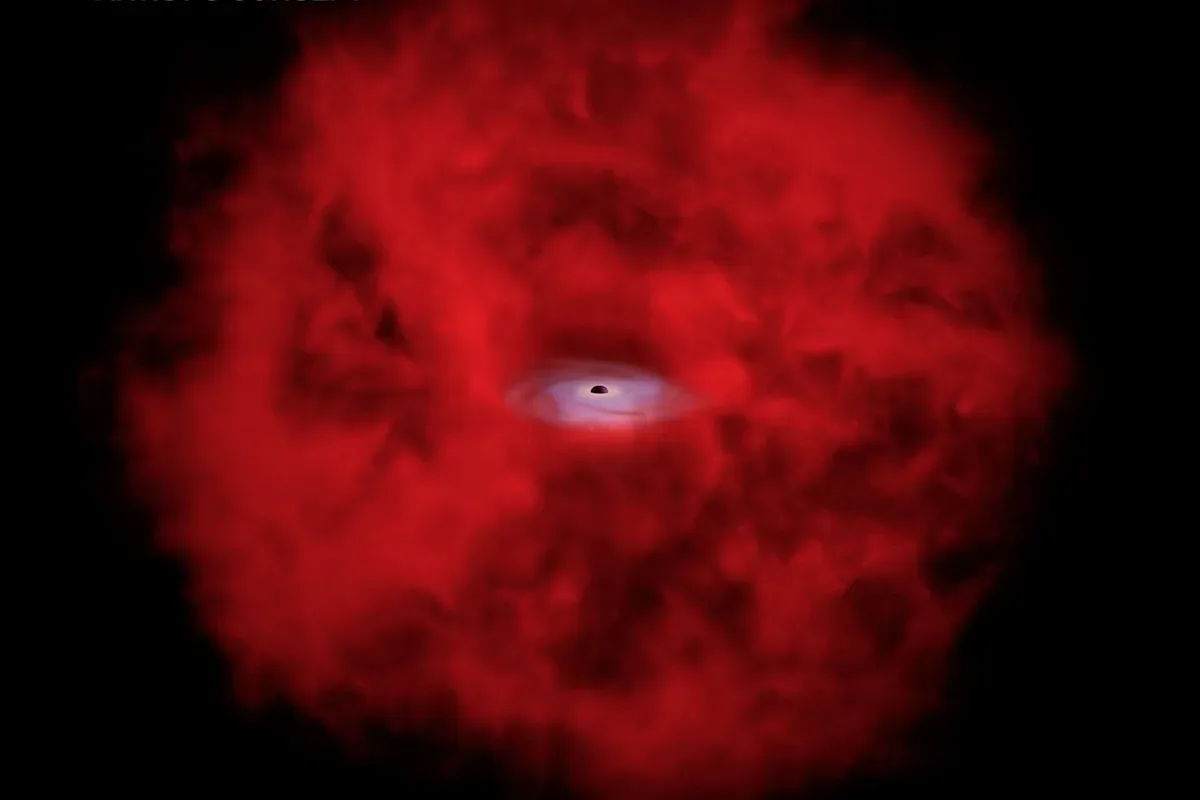
The breakthrough came when astronomers compared archival Chandra X-ray Observatory images with recent data from the JWST. They discovered that one specific "little red dot" was emitting X-rays. This finding strongly suggests that the object is indeed powered by a black hole. An artist's conception of this X-ray emitting object depicts it resembling a giant evil eye gazing into space, a striking visual metaphor for its observational impact.
Lead author Raphael Hviding of the Max Planck Institute for Astronomy in Germany stated, "Astronomers have been trying to figure out what little red dots are for several years. This single X-ray object may be—to use a phrase—what lets us connect all of the dots." The presence of X-ray emissions provides the first direct evidence linking these ancient objects to black hole activity.
This discovery lends significant support to a leading theory that the "little red dots" are a previously unrecognized stage in the evolution of supermassive black holes. Specifically, the theory posits that these objects are black holes that have become encased in an extremely dense cloud of gas. This gaseous shell would not only obscure the X-ray emissions, explaining their previous absence, but would also give the object a compact appearance, fitting the observed dimensions.
"If we confirm the X-ray dot as a little red dot in transition, not only would it be the first of its kind, but we may be seeing into the heart of a little red dot for the first time," explained co-author Hanpu Liu of Princeton University. "We would also have the strongest piece of evidence yet that the growth of supermassive black holes is at the center of some, if not all, of the little red dot population."
The findings are particularly significant because they help explain how the earliest and most massive black holes formed and grew so rapidly in the universe's infancy. Understanding these early universe objects is crucial for piecing together the timeline of cosmic evolution and galaxy formation. The continued observation and analysis of these objects promise to shed further light on the fundamental processes that shaped the universe we see today.