
NASA's 'Evil Eye' Discovery: New Object Hints at Black Hole Evolution
NASA scientists have identified a new celestial object, dubbed an 'X-ray dot,' which may be a previously unknown stage of supermassive black hole evolution. This discovery could help unravel the mystery of 'little red dots' in the early universe.

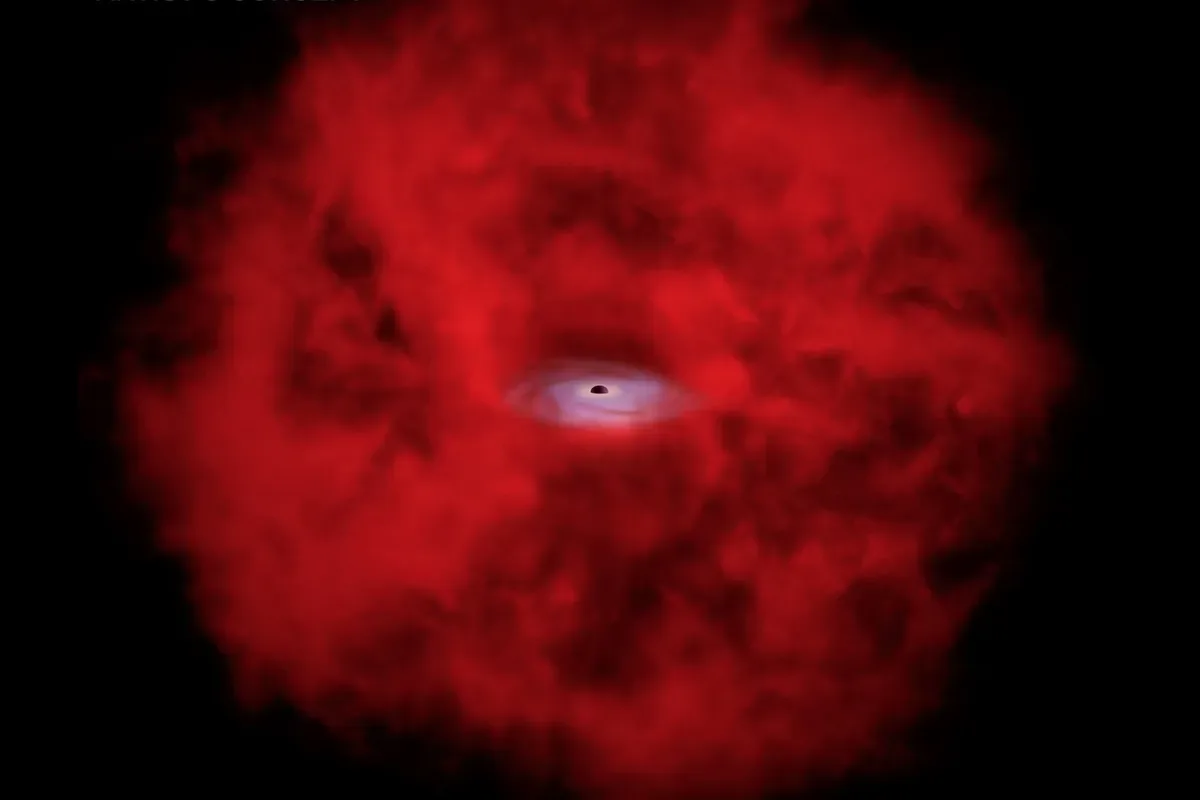
Astronomers analyzing data from NASA's Chandra X-ray Observatory and the James Webb Space Telescope have identified a novel cosmic object, an "X-ray dot," offering a potential key to understanding enigmatic "little red dots" observed in the early universe. These newly identified crimson specks are theorized to represent an extreme, never-before-seen phase in the evolution of supermassive black holes. The findings were published in The Astrophysical Journal Letters.
The "little red dots" are a class of luminous, massive objects that existed in the universe's infancy but have not been observed in later cosmic epochs. Their existence was only confirmed after the James Webb Space Telescope began providing unprecedented views of the ancient cosmos in 2022. Most of these objects are located approximately 12 billion light-years away, with some dating back to when the universe was less than a billion years old. Scientists have struggled to explain their nature, as they are too massive to be stars but too compact to be typical galaxies, often spanning only a few hundred light-years across.
For years, many astronomers suspected that a rapidly growing supermassive black hole resided at the core of these "little red dots." However, until the discovery of this "X-ray dot," none of the hundreds of known examples showed any detectable X-ray emissions, which are characteristic of black holes. Furthermore, these objects were unusually dim. Typically, a feeding supermassive black hole is surrounded by a brightly glowing accretion disk of superheated matter, akin to water swirling down a drain. The absence of such visible emissions from the "little red dots" posed a significant puzzle.
Unveiling the 'X-ray Dot'
The breakthrough came from comparing archival Chandra X-ray Observatory images with recent data from the James Webb Space Telescope. This comparison revealed that one "little red dot" was emitting X-rays, a definitive signature of black hole activity. Raphael Hviding, lead author of the study from the Max Planck Institute for Astronomy in Germany, stated in a NASA release, "Astronomers have been trying to figure out what little red dots are for several years. This single X-ray object may be—to use a phrase—what lets us connect all of the dots." An artist's impression depicts this object resembling a vast, watchful eye surveying the universe.
This discovery lends substantial support to the theory that "little red dots" might represent a phenomenon some researchers are calling a "black hole star." In this scenario, a supermassive black hole becomes encased within an extraordinarily dense cloud of gas. This gas cloud is so thick that it effectively mimics the outer layers of a star and significantly obscures the black hole's emissions, explaining their previous undetectability. "If we confirm the X-ray dot as a little red dot in transition, not only would it be the first of its kind, but we may be seeing into the heart of a little red dot for the first time," noted co-author Hanpu Liu of Princeton University in New Jersey, also via the NASA statement. "We would also have the strongest piece of evidence yet that the growth of supermassive black holes is at the center of some, if not all, of the little red dot population."
The implications of this finding extend to our understanding of the early universe's formation. The existence of such massive objects so early in cosmic history challenges current cosmological models. If these "X-ray dots" are indeed a transitional phase of supermassive black hole growth within these primordial structures, it could provide crucial insights into how the first large-scale structures and galaxies emerged. The research team plans further observations using both Chandra and Webb to gather more data on this and similar objects, aiming to confirm their hypothesis and refine models of early cosmic evolution.