
NASA Swift Telescope Rescue Mission Clears Key Test for June Launch
A critical mission to save NASA's $500 million Swift space telescope from atmospheric re-entry has successfully passed a major environmental testing milestone. The rescue spacecraft, Link, is slated for a June launch.

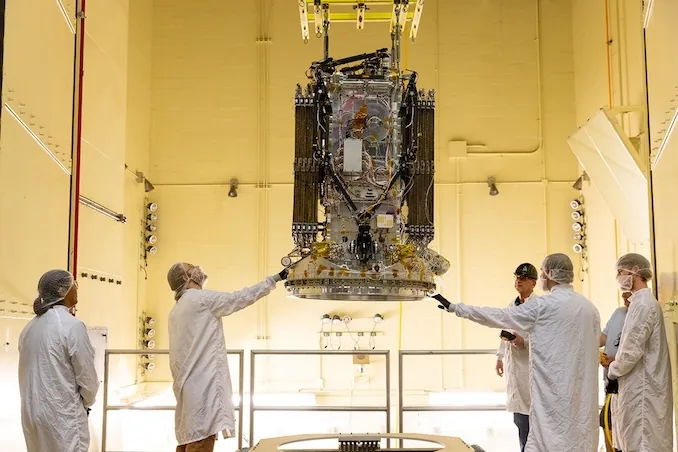
A vital mission to save NASA's $500 million Neil Gehrels Swift Observatory from a premature end has successfully completed a significant pre-launch testing phase. The observatory, launched in 2004, faces potential re-entry into Earth's atmosphere and destruction due to its decaying orbit. NASA announced on Friday that the Link spacecraft, developed by Katalyst Space Technologies to provide an orbital boost, has finished its environmental testing at NASA's Goddard Space Flight Center in Greenbelt, Maryland. The testing, conducted in the Space Environment Simulator, concluded on May 4, and the Link spacecraft has since returned to Katalyst's Colorado facilities for further pre-flight preparations.
The Swift boost attempt represents a rapid, high-stakes endeavor with significant potential rewards, according to John Van Eepoel, Swift's mission director at NASA Goddard. "Swift will likely re-enter the atmosphere sometime later this year if we don’t attempt to lift it to a higher altitude," Van Eepoel stated in a NASA press release. "Katalyst has gotten to this point in just eight months, and we’re glad they were able to use NASA’s facilities to test Link and draw on our expertise to help tackle questions that popped up along the way." Swift lacks its own propulsion system, leading to a natural orbital decay over time. However, heightened solar activity in recent years has accelerated this process, dropping the observatory from an initial altitude of approximately 600 km to 400 km, with reentry anticipated by late 2026 without intervention. To address this, NASA awarded Katalyst a $30 million contract in September 2025 to engineer a spacecraft capable of docking with Swift and elevating its orbit.
Race Against Time for Orbit Boost
Given the urgency of Swift's orbital decay, the mission is a race against time. "We are in a race against the clock, but by leveraging commercial technologies that are already in development, we are meeting this challenge head-on," commented Shawn Domagal-Goldman, acting director of NASA Headquarters' Astrophysics Division, at the time of the contract award. "This is a forward-leaning, risk-tolerant approach for NASA. But attempting an orbit boost is both more affordable than replacing Swift’s capabilities with a new mission, and beneficial to the nation — expanding the use of satellite servicing to a new and broader class of spacecraft." Kieran Wilson, Link's principal investigator at Katalyst, highlighted the unusual circumstances. "We’re in an unusual situation where the schedule dictates how much risk we’re willing to accept, rather than the other way around," Wilson said. "The clock is ticking on Swift’s descent, so we have to find a balance between testing and problem solving that gives the mission the best chance of success."
The unique orbital inclination of Swift, which is 20.6 degrees from the equator, influenced Katalyst's choice of launch vehicle. In November, the company selected Northrop Grumman's Pegasus XL air-launched rocket for the mission. Kurt Eberly, Director of Space Launch for Northrop Grumman, explained the suitability of the rocket. "The versatility offered by Pegasus’ unique air-launch capability provides customers with a space launch solution that can be rapidly deployed anywhere on Earth to reach any orbit," Eberly stated. "The stringent mission requirements necessary to save the Swift observatory, including the unique low-inclination orbit and the tight mission timeline, all pointed to Pegasus being the perfect choice." The mission is scheduled to launch in June. The Link spacecraft will initially be integrated with the Pegasus rocket at NASA's Wallops Flight Facility in Virginia early in the month. Subsequently, Northrop Grumman's specialized L-1011 aircraft will deploy the spacecraft from the Marshall Islands later in June, marking the critical moment in this high-stakes rescue operation for the valuable NASA space telescope.