
Mars Helicopter Rotors Break Sound Barrier in Crucial NASA Tests
NASA's next-generation Mars helicopter rotor blades successfully exceeded the speed of sound during recent tests, paving the way for more capable aerial exploration on the Red Planet.

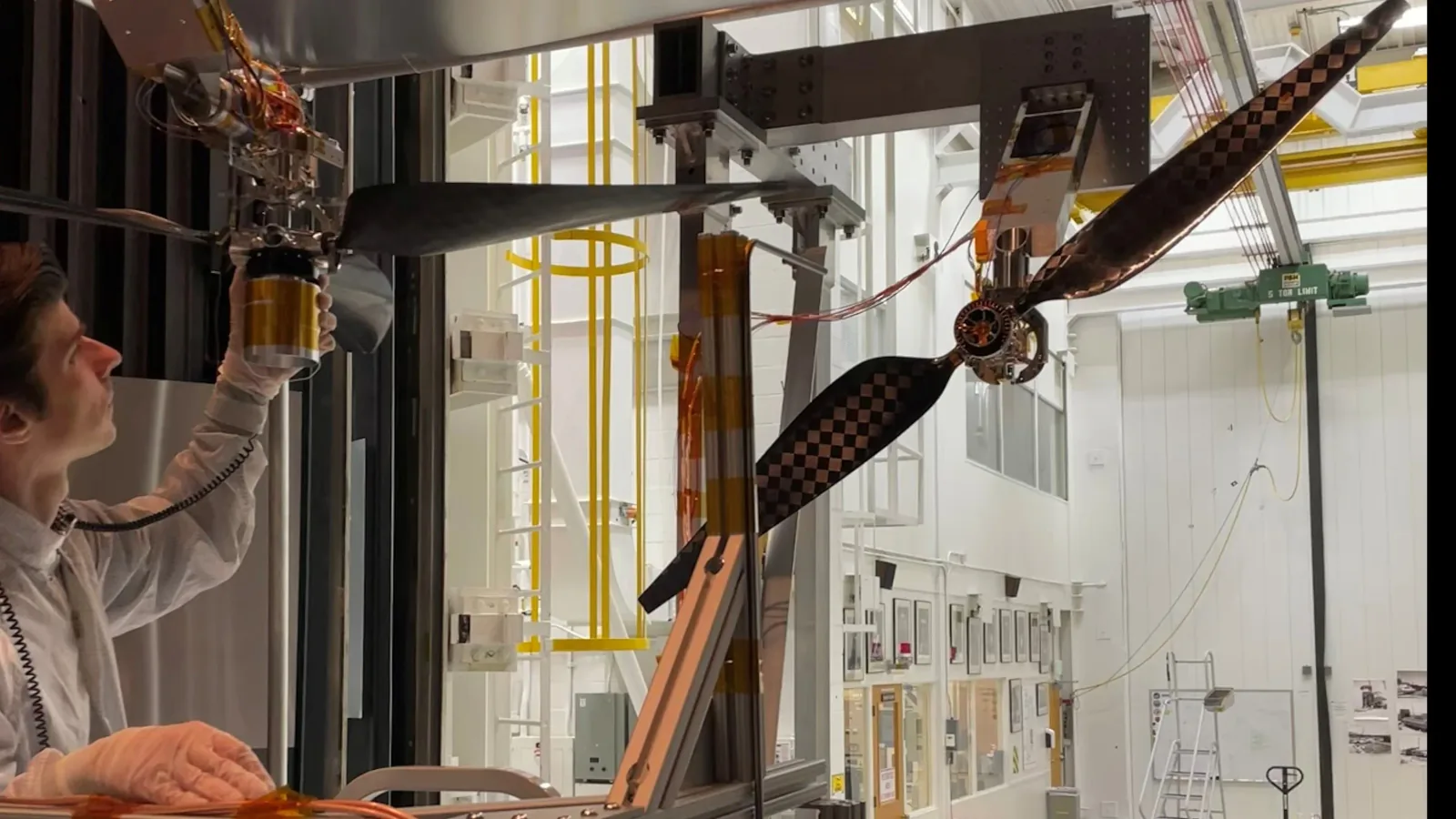
NASA’s next-generation Mars helicopter rotor blades surpassed the sound barrier during crucial tests conducted at the Jet Propulsion Laboratory (JPL) in Southern California. The trials, held within a specialized chamber simulating Martian atmospheric conditions, confirmed that the rotor tips, the fastest-moving component, can accelerate beyond Mach 1 without structural failure. The data collected from these 137 test runs are expected to inform the design of future aircraft capable of carrying heavier payloads, including advanced scientific instruments.
“NASA had a great run with the Ingenuity Mars Helicopter, but we are asking these next-generation aircraft to do even more at the Red Planet,” stated Al Chen, Mars Exploration Program manager at JPL. “That’s not an easy ask. While everything about Mars is hard, flying there is just about the hardest thing you can do. That’s because its atmosphere is so incredibly thin that it is hard to generate lift, and yet Mars has significant gravity.” Ingenuity, which achieved the first powered, controlled flight on another world in April 2021, was a pioneering technology demonstration without scientific instruments. Future Mars aircraft, such as the recently announced SkyFall project, aim to carry significant payloads, leveraging aerial exploration's advantages for human and robotic missions.
Pushing the Limits of Martian Flight
In aeronautics, increasing rotor speed or diameter generates more thrust. However, engineers designing aircraft for Mars face unique challenges due to the planet’s atmosphere, which is only 1% as dense as Earth’s. To achieve substantial lift, blade tips must approach the speed of sound. While Earth-based rotors can spin at thousands of revolutions per minute (rpm) with more air molecules to push against, Martian rotors require a more aggressive approach. The Ingenuity helicopter maintained a rotor speed below 2,700 rpm during its 72 flights to avoid the complexities of the sound barrier and potential instability from Martian wind gusts.
“If Chuck Yeager were here, he’d tell you things can get squirrely around Mach 1,” commented JPL’s Jaakko Karras, the rotor test lead. “With that in mind, we planned Ingenuity’s flights to keep the rotor blade tips at Mach 0.7 with no wind so that if we encountered a Martian headwind while in flight, the rotor tips wouldn’t go supersonic. But we want more performance from our next-gen Mars aircraft. We needed to know that our rotors could go faster safely.” The speed of sound on Earth at sea level is approximately 760 mph, but on Mars, it is significantly slower, around 540 mph, owing to its thin, cold, carbon dioxide atmosphere.
The testing involved mounting a three-bladed rotor, developed by AeroVironment, inside JPL’s 25-Foot Space Simulator. The chamber was filled with carbon dioxide to match Martian atmospheric density and then subjected to wind. Engineers lined part of the chamber with sheet metal as a precaution. From a control room, the team monitored data as the rotor spun up to 3,750 rpm, with tip speeds reaching Mach 0.98. Subsequently, a fan generated headwinds, increasing the challenge. The team successfully pushed rotor tip speeds to Mach 1.08, enhancing the vehicle’s lift capability by an estimated 30%. This advancement is critical for future missions requiring heavier scientific payloads and extended operational durations.
Similar tests were conducted with the two-bladed SkyFall rotor. Due to its slightly longer span, it required only 3,570 rpm to reach near-supersonic speeds before headwinds were introduced. “The successful testing of these rotors was a major step toward proving the feasibility of flight in more demanding environments, which is key for next-gen vehicles,” said Shannah Withrow-Maser, an aerodynamicist from NASA’s Ames Research Center and a member of the test team. “We thought we’d be lucky to hit Mach 1.05, and we reached Mach 1.08 on our last runs. We’re still digging into the data, and there may be even more thrust on the table. These next-gen helicopters are going to be amazing.” The Mars Exploration Program funded these tests, aiming to maximize future aircraft capabilities. JPL manages this program for NASA, with the goal of supporting both human and robotic exploration of the Red Planet.