
SpaceX Starship Advances Toward Interplanetary Exploration Goals
SpaceX's Starship program achieved critical flight milestones in recent tests, positioning the fully reusable rocket as NASA's primary vehicle for lunar missions and eventual Mars exploration.

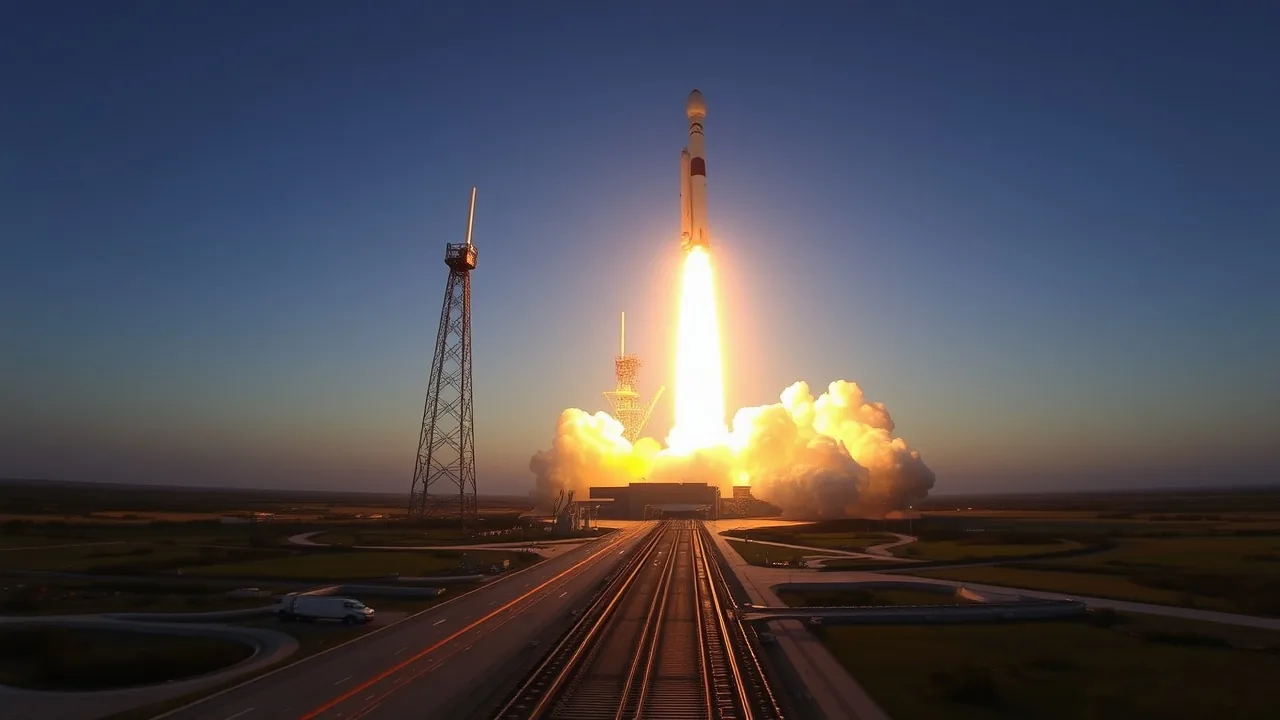
SpaceX conducted its fifth integrated flight test of Starship in October 2024, bringing the massive super-heavy lift vehicle closer to operational status for deep space missions. The test marked progress on engine performance, structural integrity, and autonomous landing systems, three areas central to making interplanetary travel viable at scale.
Elon Musk and his team have spent five years developing Starship as a fully reusable rocket designed to carry crews and cargo beyond Earth orbit. Unlike traditional expendable launch systems, Starship's core architecture relies on recovering both the Super Heavy booster and the upper-stage Ship for rapid turnaround flights, a capability that could slash mission costs and accelerate exploration timelines.
The vehicle stands 120 meters tall with a payload capacity of 100 metric tons to Mars, dwarfing every operational launcher. For comparison, NASA's retired Space Shuttle carried 27 metric tons to low Earth orbit. That scale advantage directly enables the ambitious missions SpaceX has promised.
NASA Partnership and Lunar Gateway
NASA selected Starship as the Human Landing System (HLS) for its Artemis III mission, scheduled for 2026 or 2027. This decision represents the most significant vote of confidence in the platform yet, committing the agency's $3.35 billion Artemis program to the success of SpaceX's architecture.
"Starship is the most capable vehicle ever designed for moving large amounts of cargo and crew beyond Earth," said NASA Administrator Bill Nelson during a 2023 briefing. The agency plans to dock a separate orbital refueling vehicle with Starship in lunar orbit, allowing a single Starship to deliver multiple crews to the Moon's south polar region.
The landing configuration differs from historical lunar landers. Rather than using legs and small engines, Starship will execute a tail-first descent using Raptor engines at fractional thrust. Dust control and sensor validation remain open engineering challenges for this novel approach.
From Orbit to Mars: Interplanetary Infrastructure
Beyond near-term lunar missions, SpaceX Starship forms the backbone of Mars transportation architecture. SpaceX has publicly committed to establishing a self-sustaining city on Mars within 20 to 30 years, with Starship as the sole transport vehicle.
This ambition requires solving several technical problems that testing is addressing:
- Rapid refueling of Starship in orbital mechanics without pre-staging thousands of kilograms of propellant
- Life support and radiation shielding for six-month interplanetary trajectories
- Autonomous guidance during Mars atmospheric entry at hypersonic speeds
- Water production and fuel synthesis from Martian resources
Starship's 100-ton payload enables delivering heavy manufacturing equipment, mining hardware, and habitat modules in single flights. Previous Mars mission architectures required dozens of smaller launches to assemble equivalent cargo on the Red Planet.
The economics matter enormously. Current estimates suggest launch costs per kilogram will fall to $100 to $200 once Starship reaches full operational status, compared to $50,000 per kilogram on traditional expendable rockets. That 250-fold cost advantage reshapes what becomes economically viable in space.
Technical Maturation and Remaining Hurdles
October's flight test involved 17 Raptor engines firing simultaneously in the Super Heavy booster, the largest single-engine cluster ever flown. Recovery of the booster in the Gulf of Mexico remains the highest-priority remaining goal. Achieving booster catch via mechanical arms at the launch tower would eliminate the need for ocean barges and accelerate turnaround times to days rather than weeks.
Engine reliability is the next frontier. Raptor design pushes combustion chamber temperatures and pressures to record levels. Operating 33 of these engines reliably on a single flight demands precision manufacturing and quality control that SpaceX has been incrementally improving across test iterations.
The thermal protection system covering Starship's nose cone and fuselage uses silicon-carbide tiles inspired by the Space Shuttle but engineered for reusability across 100 consecutive flights. Recent tests have shown localized damage and erosion, requiring tile design refinements before crewed missions proceed.
Space exploration communities and industry analysts closely watch each Starship test for these incremental improvements. "Every flight teaches us about failure modes we must harden," noted aerospace engineer Jon Roth in an interview with Aviation Week in November 2024. Those lessons cycle directly into the next vehicle construction and launch sequence.
SpaceX currently operates two Starship-production facilities in Texas and plans to increase manufacturing cadence to 3 to 5 flight tests per year through 2025. That acceleration assumes no major anomalies trigger redesigns, a realistic caveat for technology this complex.
The wider rocket technology sector watches Starship's progress intently. If SpaceX demonstrates routine booster recovery and payload delivery on schedule, competitors will face intense pressure to pursue similar architectures. Blue Origin's New Glenn and Relativity's mid-lift vehicle programs already incorporate reusability principles influenced by Starship's public development.
Success with interplanetary travel through Starship would also unlock commercial space tourism beyond current suborbital rides. Point-to-point Earth transport and orbital hotels become possible once launch costs fall and flight cadence rises to dozens per year.
Near-term milestones for 2025 include booster catch, full-duration Raptor engine burns, and thermal protection validation at re-entry speeds. By late 2025 or early 2026, SpaceX expects to attempt its first orbital refueling demonstration, proving the logistics architecture that Mars missions depend upon. Each test brings the company and its government partners measurably closer to the moment when the first human boots touch Martian soil aboard a Starship vehicle.