
NASA's Psyche Spacecraft Captures Trippy Mars Timelapse During Gravity Assist
NASA's Psyche spacecraft captured a unique timelapse of Mars during a gravitational slingshot maneuver, using the planet's pull to gain speed on its journey to a metal-rich asteroid.

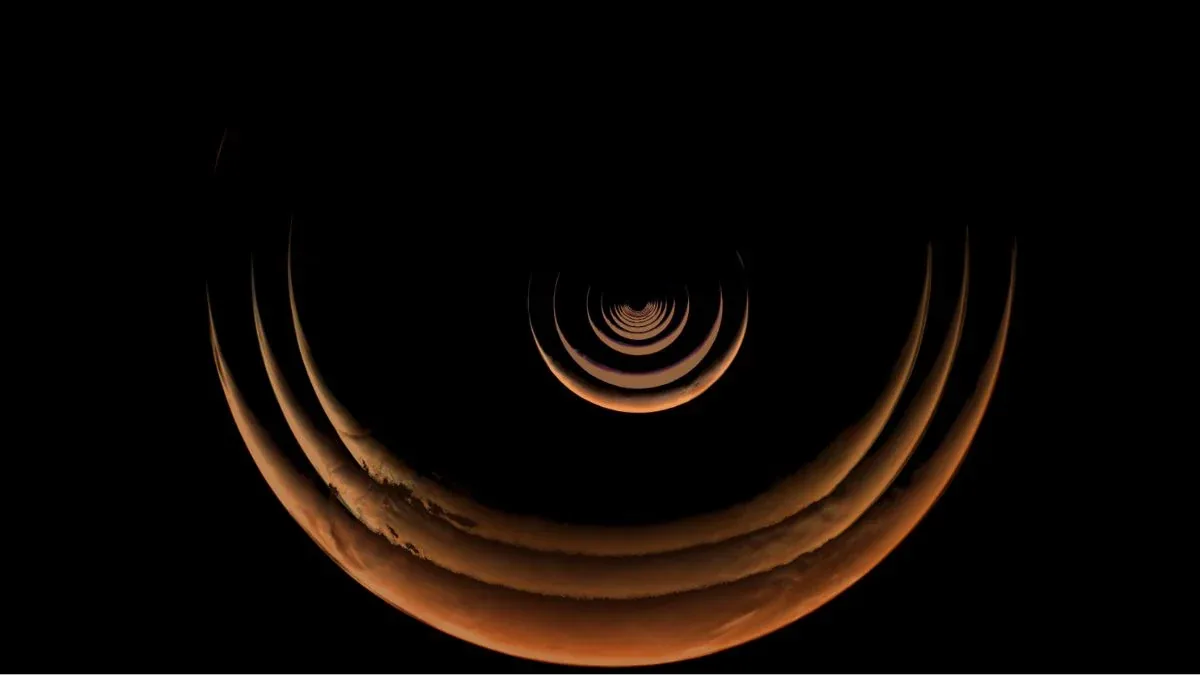
NASA's Psyche spacecraft recently provided a spectacular view of Mars, capturing a mesmerizing timelapse during a crucial flyby on May 15. The probe passed within approximately 4,600 kilometers (2,800 miles) of the Red Planet's surface, traveling at over 19,848 kilometers (12,000 miles) per hour. This encounter served a dual purpose: it allowed for fine-tuning of the spacecraft's scientific instruments and provided a vital speed boost, utilizing Mars' gravity as a cosmic slingshot to propel Psyche toward its ultimate destination, a unique metal asteroid.
During the flyby, the Psyche mission team calibrated sensors by observing Mars' bow shock, a region where the solar wind is deflected around the planet. The spacecraft also imaged the planet's southern polar ice cap and the Huygens crater. More significantly, the maneuver, often referred to as a gravity assist, was instrumental in increasing Psyche's velocity by roughly 1,000 miles per hour and altering its orbital plane by about one degree relative to the Sun. This precisely executed gravity assist was years in the planning, ensuring the spacecraft remains on its trajectory to rendezvous with the asteroid in the summer of 2029.
Journey to a Metal World
The primary objective of the Psyche spacecraft is to explore the asteroid of the same name, located in the main asteroid belt between Mars and Jupiter. Discovered in 1852 by Annibale de Gasparis, the asteroid is believed to be the exposed iron core of a protoplanet, a remnant from the early solar system when planetary bodies frequently collided. This makes asteroid Psyche a unique target, offering scientists an unprecedented opportunity to study a celestial body composed primarily of metal, rather than rock or ice.
The asteroid itself is roughly 280 kilometers (170 miles) across at its widest point, comparable in size to the state of Massachusetts. Its composition, however, has been a subject of debate among astronomers. The mission, a collaboration involving NASA, Arizona State University, and Caltech, aims to provide definitive answers about its nature when it arrives at the asteroid around August 2029. The spacecraft, launched in 2023 on a SpaceX Falcon Heavy rocket, is equipped with a suite of advanced instruments. These include a multispectral imager for capturing visual data, a gamma-ray and neutron spectrometer to analyze surface chemistry, and a magnetometer to detect magnetic fields. An X-band radio telecommunications system will also help determine its gravitational field and internal structure.
The mission is also testing NASA's deep space optical communication system (DSOC), which uses lasers to transmit data back to Earth, a significant advancement over traditional radio wave communication. This innovative technology holds the promise of faster and more efficient data transfer for future deep space missions. The successful gravity assist maneuver off Mars ensures that the spacecraft is on track for its ambitious exploration of this metallic world.