
NASA's Psyche Probe Captures Stunning Mars Images During Gravitational Assist
NASA's Psyche spacecraft has captured striking new images of Mars during a crucial gravitational assist maneuver. The probe, en route to the metal-rich asteroid 16 Psyche, used Mars' gravity to boost its trajectory.

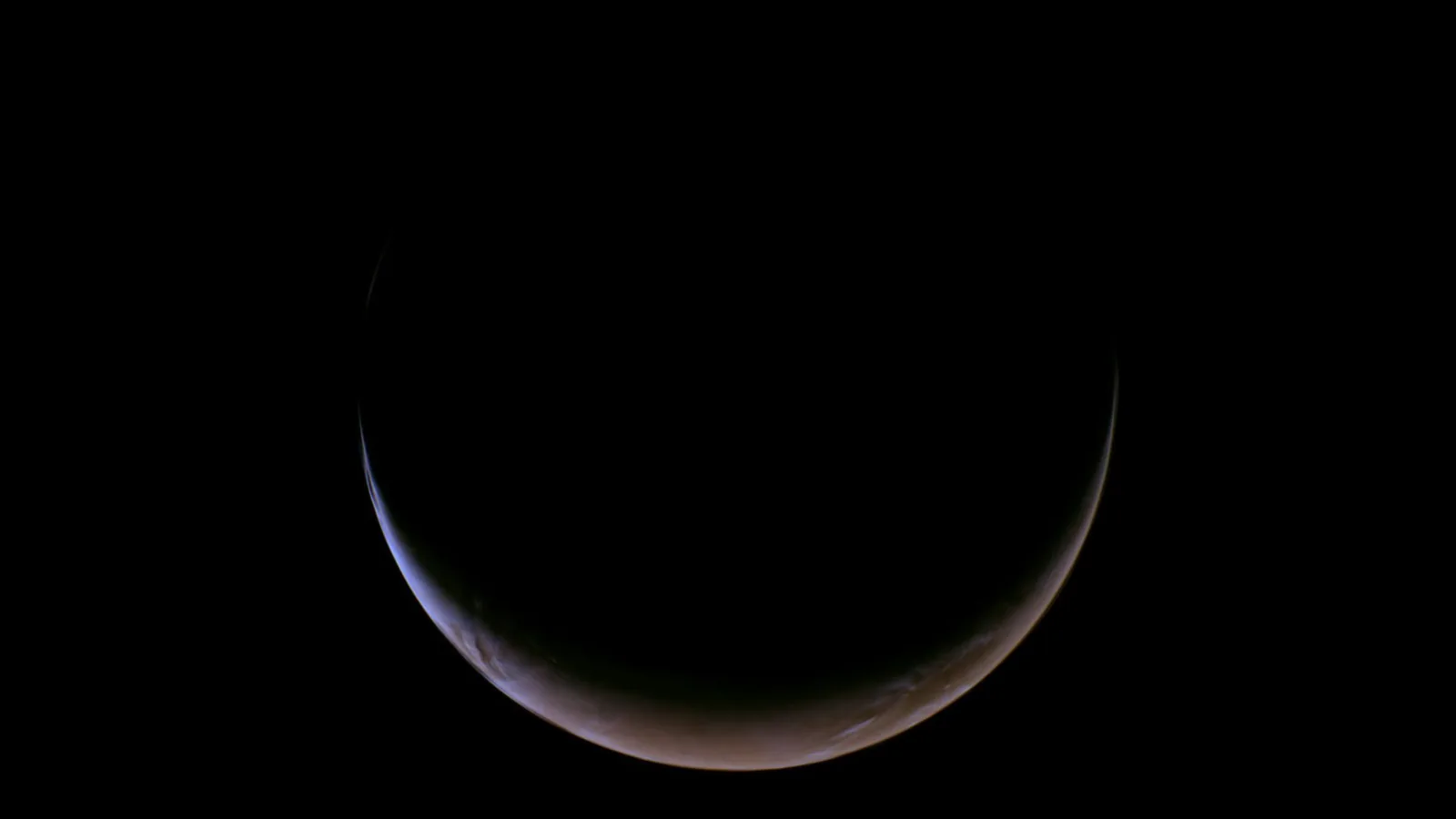
NASA's Psyche spacecraft captured a series of remarkable images of Mars during a recent flyby, showcasing the Red Planet's crescent and surface features. The probe, on its multi-year journey to the 16 Psyche asteroid, utilized Mars' gravitational pull for a critical maneuver to adjust its trajectory. The encounter occurred on May 15, 2026, as Psyche passed within 2,864 miles (4,609 kilometers) of Mars' surface.
The images reveal the planet's atmosphere and surface in unprecedented detail, offering valuable data for calibrating Psyche's instruments. The multispectral imager, capable of capturing both visible and near-infrared light, provided unique insights. NASA explained that the crescent appeared brighter and extended farther than anticipated due to the scattering of light by Mars' dusty atmosphere. This instrument will be vital for analyzing the composition of the 16 Psyche asteroid upon arrival in summer 2029.
Instruments Tested During Martian Encounter
During the Mars flyby, several instruments designed for the 16 Psyche mission were activated and tested. This included magnetometers that may have detected a "bow shock" related to solar wind dynamics near Mars. The data gathered will aid in calibrating the cameras and testing image-processing tools that will be used at the asteroid. "We've captured thousands of images of the approach to Mars and of the planet's surface and atmosphere at close approach," stated Jim Bell, the Psyche imager instrument lead at Arizona State University. "This dataset provides unique and important opportunities for us to calibrate and characterize the performance of the cameras, as well as test the early versions of our image-processing tools being developed for use at the asteroid Psyche."
Among the released images was a view of a nearly "full Mars," highlighting its south polar cap. This icy region, composed of water ice, is over 430 miles (700 kilometers) wide. Another image showcased wind streaks extending approximately 30 miles (50 km) across the Martian surface over craters averaging 30 miles in diameter. An enhanced color view revealed Huygens crater, a significant impact feature measuring about 290 miles (470 km) in width.
The flyby was not just for capturing imagery; it served a crucial navigational purpose. The maneuver, known as a gravity assist, used Mars' gravitational influence to provide the spacecraft with a significant speed boost and alter its orbital path. "We've confirmed that Mars gave the spacecraft a 1,000 mile‑per‑hour boost and shifted its orbital plane by about 1 degree relative to the sun," said Don Han, Psyche's navigation lead at NASA's Jet Propulsion Laboratory. "We are now on course for arrival at the asteroid Psyche in summer 2029." This adjustment ensures the probe remains on its optimal trajectory.
The Psyche mission also continues to test advanced communication technologies. It is utilizing the Deep Space Optical Communications (DSOC) system, which employs laser-beaming to transmit data back to Earth. This innovative system has demonstrated remarkable capabilities, including the transmission of an image across 19 million miles (30 million km) of space. "We've been anticipating the Mars flyby for years, but now it’s complete," commented Lindy Elkins-Tanton, principal investigator for Psyche at the University of California, Berkeley. "We can thank the Red Planet for giving our spacecraft a critical gravitational slingshot farther into the solar system. Onward to the asteroid Psyche!" The mission's success hinges on reaching the unique asteroid, believed to be rich in metals like iron and nickel, potentially offering unprecedented insights into planetary cores. This journey represents a significant step in understanding planetary formation and the composition of the solar system's early building blocks.