
Neptune's Moon Nereid: Ancient Collision Survivor?
New James Webb Space Telescope data suggests Neptune's moon Nereid may be the sole intact survivor of an ancient cosmic collision that reshaped the planet's moon system billions of years ago.

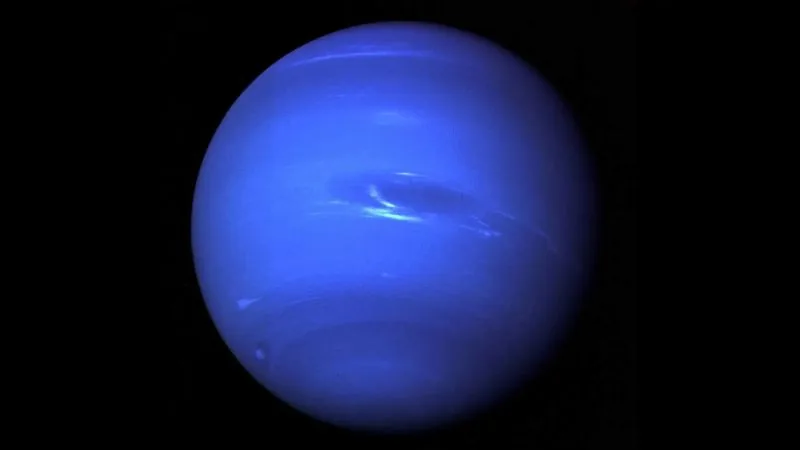
Neptune's third-largest moon, Nereid, may be the only surviving member of an ancient moon family obliterated early in the solar system's history, according to a new analysis leveraging data from the James Webb Space Telescope. Neptune, the solar system's most distant planet, possesses a unique collection of moons compared to its outer planet neighbors like Jupiter, Saturn, and Uranus. While the other gas giants boast a more uniform and predictable set of satellites orbiting in alignment with their planet's spin, Neptune's moon system is notably smaller and more chaotic. Its largest satellite, Triton, orbits in the opposite direction of Neptune's rotation—an anomaly among the solar system's large moons, suggesting it originated not from Neptune's formation but possibly from the Kuiper Belt. Billions of years ago, scientists theorize that Triton's capture by Neptune's gravity led to a catastrophic collision with Neptune's original moons, scattering and destroying most of them. The current inner moons are believed to be fragments from this ancient impact.
However, the latest research challenges the notion that all original moons were destroyed. Analysis of Nereid using the James Webb Space Telescope indicates its composition does not align with that of typical Kuiper Belt objects, a finding that prompts a reevaluation of its origin. "I think Nereid is the only intact survivor of this process," stated Matthew Belyakov, lead author of the study published in Science Advances and a graduate student at the California Institute of Technology. "The other survivors are Neptune’s innermost moons, but they are not intact because we have images of them from Voyager, and they look like disrupted rubble piles." This suggests Nereid might have indeed been part of Neptune's original satellite system.
A Moon's Mysterious Identity
Nereid, a faint and distant moon, has long been poorly understood. The only prior image of Nereid comes from a blurry 1989 fly-by by NASA's Voyager 2 spacecraft. Its orbit is highly eccentric, taking 360 Earth days to circle Neptune. Around 210 miles (338 kilometers) in diameter, Nereid's status as an irregular satellite—meaning its orbit is inclined, distant, or retrograde—led many to believe it was captured. However, its substantial size compared to other irregular satellites and some of its characteristics have long cast doubt on a Kuiper Belt origin. The new James Webb observations, specifically a 10-minute infrared scan, provided crucial compositional data. "What we found was an object that was highly water-rich on the surface, brighter than a lot of Kuiper Belt objects, and with some presence of CO2," Belyakov explained. "The overall signature was more similar to that of regular satellites around Uranus rather than Kuiper Belt objects."
This discovery prompted computer simulations by Belyakov and his team. These simulations modeled the impact of Triton entering Neptune's system. They found that in approximately 25% of scenarios where Triton survives, one or more moons could remain intact in distant orbits. This outcome supports the hypothesis that Nereid could have survived the ancient cataclysm, being flung into its current eccentric orbit rather than being destroyed. This event would have also stabilized Triton's own orbit, bringing it closer to Neptune.
The possibility of Nereid being an original moon is gaining traction. "I think people have already wanted this to be true," Belyakov commented. "Now we can start the actual science feedback loop. There is more data to be gathered for Nereid compositionally that can help us really talk through the formation of the Neptunian system, and if we treat Nereid as a regular satellite, maybe that can tell us a lot about how satellites form around ice giants." Future observations with the James Webb telescope could further illuminate Nereid's composition, though a dedicated mission would be required for definitive answers.
Planetary scientists are calling the new findings significant. Carolyn Porco, a planetary scientist familiar with the Voyager and Cassini missions, remarked that the study compellingly explains Neptune's moon system's current state. "It is Triton that was the captured body and it subsequently caused havoc, gravitationally scattering Neptune’s original moons hither and thither but mostly out of Neptune orbit," Porco wrote. "The authors show it is plausible that Nereid lucked out by remaining in orbit around Neptune but at a much larger distance than Triton. This would explain why its composition observed by James Webb does not match that of the bodies in the Kuiper Belt." Leigh Fletcher, a professor at the University of Leicester, added that the James Webb telescope continues to demonstrate its power in solar system exploration. "We’ve long known there’s something special about Neptune’s collection of moons, having been severely disrupted by the arrival of Triton and other satellites captured by Neptune’s gravity over the years," Fletcher wrote. "Given those destructive processes, I don’t think we expected to see anything left of Neptune’s original satellite system, other than rubble and debris." He concluded that the findings are "a compelling idea, and something that can certainly be tested with future JWST observations."