
NASA Swift Telescope Rescue Mission Reaches Orbit
A mission to save NASA's aging Swift Observatory telescope has successfully launched into orbit. The Link spacecraft will attempt to grapple the observatory and boost it to a higher orbit to extend its scientific life.

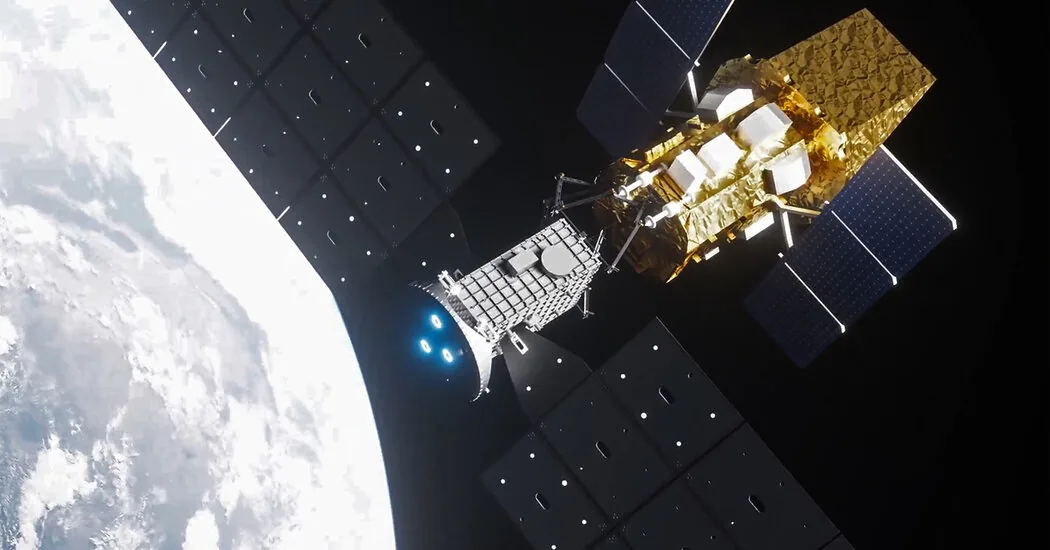
A daring mission to rescue NASA’s Neil Gehrels Swift Observatory telescope before its inevitable fiery descent into Earth's atmosphere has successfully launched into orbit on Friday. The space agency is engaged in a critical race against time, as atmospheric friction threatens to pull the 1.6-ton spacecraft down for destruction within the coming months. A refrigerator-sized rescue craft, dubbed Link, has been deployed with the ambitious goal of capturing Swift and propelling it into a more stable, higher orbit.
“We have a really good start to the mission,” stated Ghonhee Lee, chief executive of Katalyst Space Technologies, the Flagstaff, Arizona-based company that developed and operates the Link spacecraft from its command center in Broomfield, Colorado. If Katalyst's bold endeavor proves successful, the Swift telescope could continue its vital observations of gamma-ray bursts. These intense flashes of high-energy light originate from some of the universe's most cataclysmic events, including the spectacular collisions of stars.
Extending the life of a cosmic detective
The launch of the Link spacecraft marks a significant milestone after a series of setbacks. The mission experienced three prior launch attempts that were ultimately scrubbed. Two were called off due to unfavorable weather conditions, while a third was postponed because of an unspecified technical issue. This final successful ascent signifies a renewed hope for the preservation of a crucial scientific instrument.
The NASA Swift Observatory, launched in 2004, has been instrumental in astronomical discoveries. Its primary mission has been to detect and observe transient astronomical events, particularly gamma-ray bursts (GRBs). These bursts, lasting from milliseconds to minutes, are associated with the deaths of massive stars and the merging of neutron stars. Swift's ability to rapidly slew to follow-up observations of these events has provided invaluable data on the afterglows and the cosmic environments where they occur. Without this intervention, the observatory’s valuable data collection would cease prematurely.
The challenge of orbital debris and satellite servicing is a growing concern for space agencies worldwide. As the number of satellites in orbit increases, the risk of collisions and the creation of more debris also rises. Missions like the one undertaken by Katalyst Space Technologies represent a potential paradigm shift in how space assets are managed, moving towards an era of repair and refueling rather than simply accepting the end-of-life of expensive hardware. The success of this rescue attempt could pave the way for future servicing missions, not only for scientific satellites but also for commercial and governmental infrastructure in orbit.
The implications of extending Swift's operational life are substantial for the scientific community. Continued observations could lead to further breakthroughs in understanding the origins of GRBs, the nature of neutron stars, and the expansion rate of the universe. The mission is a testament to human ingenuity and the drive to push the boundaries of what is possible in space exploration and maintenance. The fate of the Swift Observatory now rests on the precise maneuvers of the Link spacecraft and its ability to safely dock and reposition the much larger telescope.