
Near-Total Lunar Eclipse Dazzles North America Thursday Night
A spectacular near-total lunar eclipse will grace the skies across North and South America on Thursday night. Skywatchers can witness over 96% of the moon submerged in Earth's shadow.

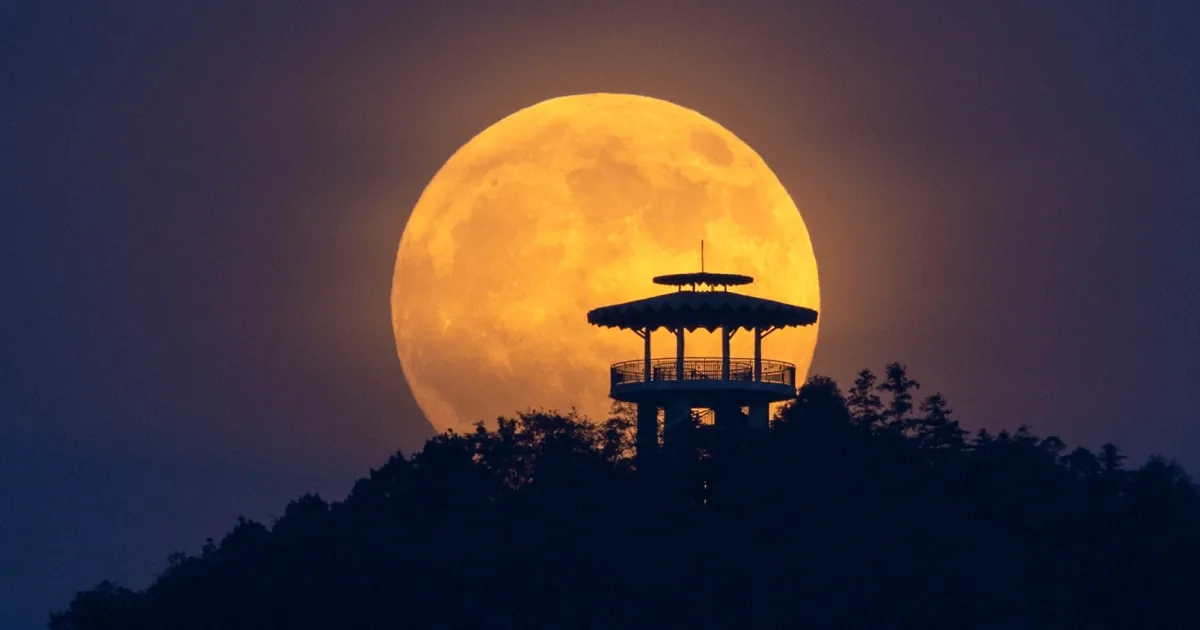
A breathtaking celestial display is set to captivate skygazers across North and South America on Thursday night as a near-total lunar eclipse unfolds. This event occurs when Earth positions itself directly between the sun and the moon, casting its shadow upon the lunar surface. For this particular eclipse, an astounding 96.2% of the moon will be enveloped by Earth's dark shadow at its peak, promising a dramatic viewing experience.
Weather permitting, observers throughout the continental United States will have prime viewing opportunities for this rare spectacle. The eclipse will also be visible across much of North and South America, with partial views extending to parts of Europe and Africa. During the eclipse, the deep shadow cast by Earth will impart a distinct reddish-orange hue to the moon's surface. This phenomenon, caused by the scattering of sunlight through Earth's atmosphere, is the reason why total lunar eclipses are often referred to as "blood moons."
The astronomical event is scheduled to commence at 9:23 p.m. ET when the moon first encounters the penumbra, the faint outer region of Earth's shadow. The most dramatic phase, however, begins at 10:33 p.m. ET, as Earth's umbra – the darkest part of its shadow – starts to obscure the moon, creating the appearance of a substantial "bite" being taken out of its disk. The eclipse will reach its zenith at 12:12 a.m. ET on Friday morning, with over 96% of the lunar surface immersed in shadow. The entire event will conclude at 3:01 a.m. ET as the moon finally emerges from Earth's outer shadow.
A Cosmic Ballet of Shadows and Light
Most viewers located in North and South America, excluding Alaska and the northernmost regions of Canada, are poised to witness every phase of this impressive lunar eclipse. For those in Europe and Africa, the eclipse will commence in the early hours of Friday, with the moon likely to set before the spectacle concludes. Unlike the more perilous solar eclipses, which require special protective eyewear, lunar eclipses are entirely safe to observe with the naked eye. Binoculars and telescopes can further enhance the viewing experience, revealing intricate details on the lunar surface.
This lunar event follows closely on the heels of a total solar eclipse that captivated audiences in parts of Europe, including Spain and Greenland, earlier this year. Solar and lunar eclipses often occur in pairs due to the precise orbital mechanics of the moon, Earth, and sun. The remarkable alignment that makes these eclipses possible is a cosmic coincidence: the sun is approximately 400 times larger than the moon, yet it is also 400 times farther away from Earth. This unique ratio makes both celestial bodies appear roughly the same size in our sky.
Solar eclipses typically occur during the new moon phase, when the moon passes between the sun and Earth. Approximately two weeks later, during the full moon phase, the Earth is situated between the sun and the moon, leading to the occurrence of lunar eclipses. This predictable cycle highlights the intricate gravitational dance of our solar system. Skywatchers eager for another celestial show should mark their calendars for future astronomical events, including meteor showers and planetary conjunctions, which continue to inspire awe and wonder.