
Neutrino Astronomy Nobel Prize Honors Francis Halzen's Ghostly Particle Detection
Francis Halzen has been awarded the Nobel Prize in Physics for pioneering neutrino astronomy. His work led to the development of detectors capable of observing elusive subatomic particles from cosmic sources.

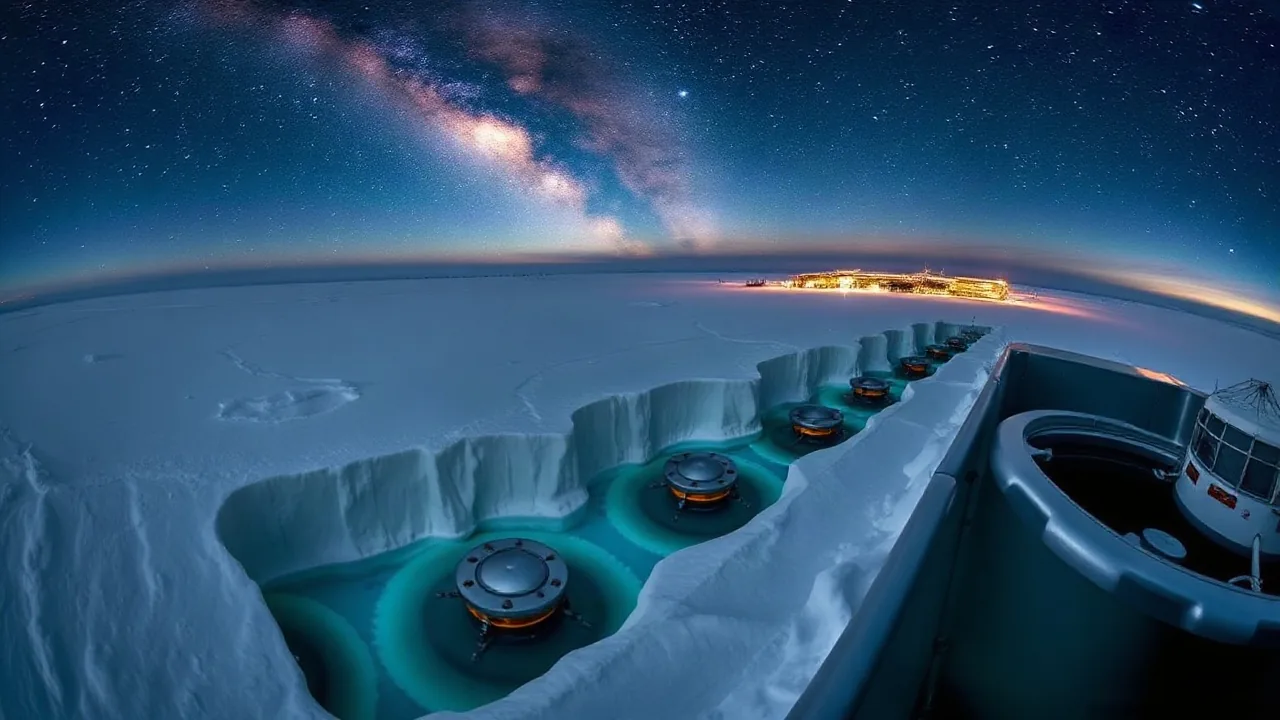
The 2026 Nobel Prize in Physics has been awarded to Professor Francis Halzen for his groundbreaking work in establishing neutrino astronomy. The Royal Swedish Academy of Sciences recognized Halzen for his theoretical insights and pivotal role in the development of the IceCube Neutrino Observatory, a monumental detector located deep within the Antarctic ice. This award celebrates the advent of a new window into the universe, allowing scientists to study cosmic phenomena through the observation of neutrinos, often called "ghostly" particles due to their elusive nature.
Neutrinos are subatomic particles with extremely little mass that interact very weakly with matter, allowing them to travel vast distances across the cosmos unimpeded by magnetic fields or interstellar dust that can obscure light. For decades, detecting these particles from distant astronomical sources was a formidable challenge. Halzen's theoretical contributions, dating back to the 1980s, laid the groundwork for understanding how high-energy neutrinos could be produced in cataclysmic cosmic events, such as supernovae and active galactic nuclei.
From Theory to Antarctic Ice Telescope
The practical realization of Halzen's vision culminated in the construction of the IceCube Neutrino Observatory, a detector comprising nearly 5,200 optical sensors spread over a cubic kilometer of pristine ice beneath the South Pole. When a neutrino occasionally interacts with an atom in the ice, it produces charged particles that emit Cherenkov radiation, which is then detected by the sensors. This massive instrument allows scientists to trace the origin of neutrinos back to their powerful cosmic sources, opening up a new field of astronomical observation.
"This is a recognition of a decades-long effort by a large international collaboration," stated Professor Halzen in a press release following the announcement. "IceCube has provided us with a completely new way to look at the universe. We are no longer limited to observing light, but can now witness the most energetic processes directly through these fundamental particles." The development and operation of IceCube involved hundreds of researchers from institutions worldwide, including significant contributions from the University of California, Berkeley, and the University of Wisconsin-Madison, where Halzen is based.
The field of neutrino astronomy promises to unlock secrets about the most energetic phenomena in the universe, providing insights into black holes, neutron stars, and the processes that accelerate particles to near the speed of light. Unlike photons, neutrinos are not easily deflected, so they carry direct information from the heart of their violent origins. This allows astronomers to probe regions of space that are otherwise hidden from view. The data gathered by IceCube has already led to the first detection of high-energy astrophysical neutrinos and the identification of a blazar, a supermassive black hole at the center of a distant galaxy, as a source of these elusive particles. This discovery marked a significant milestone, confirming theoretical predictions and solidifying the importance of neutrino astronomy as a vital component of modern astrophysics.
The Nobel Committee highlighted that Halzen's work not only provided the theoretical framework but also inspired the ambitious engineering required to build and operate a detector in one of Earth's most extreme environments. The success of the Antarctic ice observatory is a testament to human ingenuity and international scientific cooperation, pushing the boundaries of both physics and engineering to explore the cosmos.