
Northern Lights Possible Thursday as Solar Flare Sparks Storm Watch
A recent solar flare could bring the aurora borealis to Michigan skies on Thursday, August 27, with a G1 geomagnetic storm watch in effect. A partial lunar eclipse will also be visible.

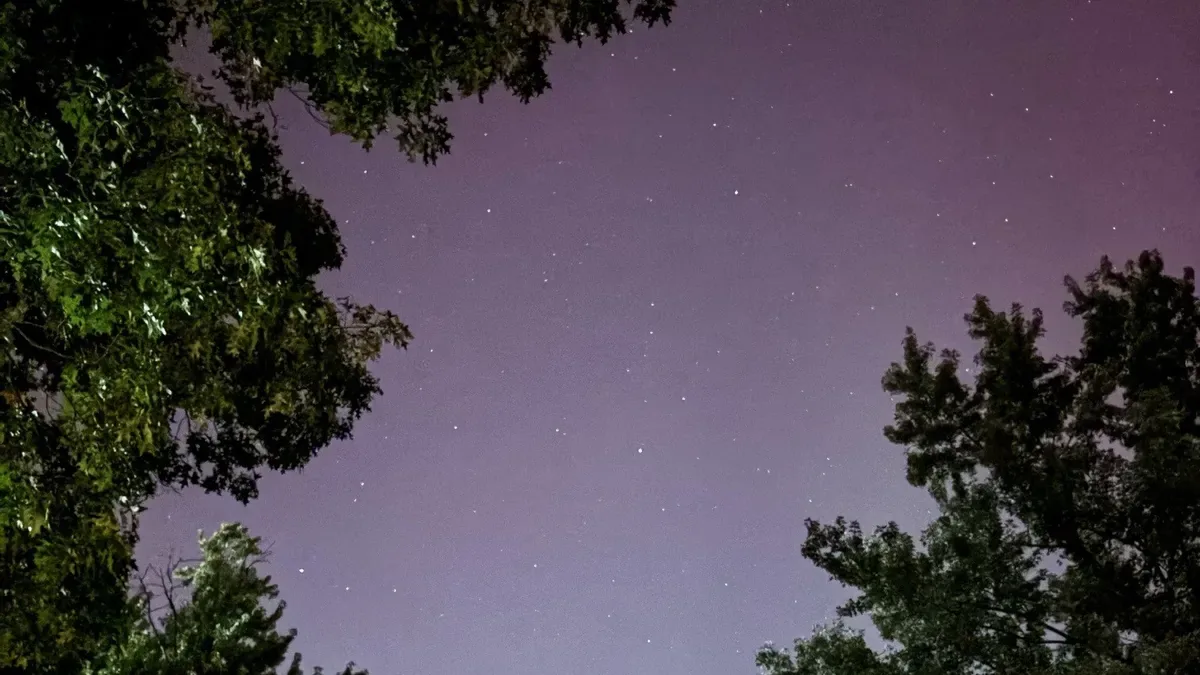
Residents across Michigan may have the chance to witness the dazzling spectacle of the northern lights on Thursday night, August 27, as a G1 geomagnetic storm watch is in effect due to a recent solar flare. The event coincides with a partial lunar eclipse, offering a dual celestial show. Stronger aurora activity is also anticipated for Friday, August 28.
The National Oceanic and Atmospheric Administration's (NOAA) Space Weather Prediction Center (SWPC) issued the G1 geomagnetic storm watch, indicating a worldwide disturbance of Earth's magnetic field that could lead to a Kp index of 5. This rating suggests potentially robust visibility of the aurora borealis, commonly known as the northern lights. A subsequent G2 geomagnetic storm watch was announced for Friday, August 28, owing to the anticipated arrival of coronal mass ejections (CMEs) that were observed leaving the Sun on August 25.
For Thursday night, the aurora could be visible overhead in the Upper Peninsula and potentially throughout the rest of the state, particularly in northern areas, provided skies remain clear and dry. The Kp index, used by NOAA to quantify the severity of geomagnetic disturbances near Earth, ranges from zero to nine. Current predictions point to minor geomagnetic storm impacts.
Celestial Events Align for Rare Viewing Opportunity
The timing of the aurora forecast, coupled with a partial lunar eclipse, presents a unique opportunity for skygazers. The lunar eclipse will see approximately 96% of the moon obscured by Earth's shadow. The eclipse is set to commence at 9:23 p.m. Eastern Daylight Time on August 27 and conclude at 3:01 a.m. EDT on August 28, with maximum totality occurring at 12:12 a.m. EDT on August 28. National Weather Service offices are advising those interested in observing these phenomena to seek out dark sky areas to maximize their viewing experience.
The aurora borealis is a natural light display in Earth's sky, predominantly seen in high-latitude regions, caused by energetic charged particles from the Sun colliding with atoms in the upper atmosphere. The colors of the aurora, such as the familiar greenish-yellow, red, or blue, depend on which atmospheric gas is excited and the energy exchanged during these collisions. Oxygen is primarily responsible for green and red hues, while nitrogen contributes to blue light. Ultraviolet light emissions, also part of the interaction, are typically only detectable by specialized satellite instruments.
For those struggling to capture the aurora with the naked eye, the SWPC suggests using smartphone cameras in night mode. Holding the device steady while capturing images can often reveal subtle auroral activity not immediately apparent to the human eye. This technological assist can enhance the experience of observing these distant celestial interactions, originating from phenomena like solar flares and CMEs originating from the Sun.
The upcoming geomagnetic storm watch and potential aurora display underscore the dynamic relationship between the Sun and Earth's magnetic field. Understanding these space weather events is crucial, as significant solar activity can impact satellite operations, power grids, and communication systems. While this event is classified as a G1 storm, indicating minor impacts, it serves as a reminder of the constant interplay between our planet and its star. The alignment of these atmospheric and astronomical events provides a timely reminder of the wonders of the cosmos.