
Massive Exosatellite Discovered Orbiting Brown Dwarf Companion
Astronomers using the VLT/CRIRES+ instrument have detected a substantial exosatellite, estimated at 0.9 Jupiter masses, orbiting a brown dwarf companion. This marks a significant advancement in the search for moons beyond our solar system.

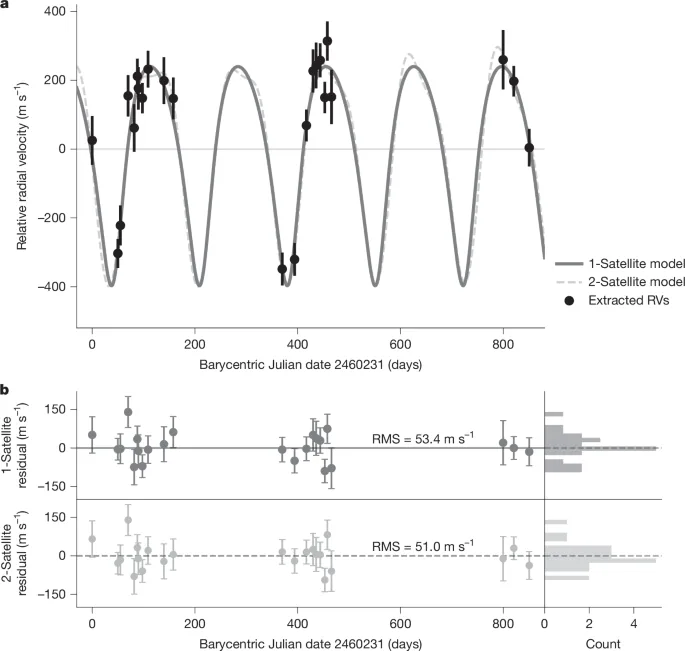
Astronomers have announced the detection of a massive exosatellite, potentially the first of its kind, orbiting a brown dwarf companion named CD-35 2722 B. The discovery, detailed in a recent study, utilized radial velocity analysis, a technique familiar from exoplanet detection, applied to spectra from the VLT/CRIRES+ instrument. This groundbreaking find represents a significant step forward in the ongoing quest to identify celestial bodies beyond our solar system that resemble moons.
Brown dwarfs exist in a fascinating mass range, bridging the gap between planets and stars. When a star hosts a substellar companion, whether a brown dwarf or an exoplanet, any object orbiting that companion can be classified as an exosatellite. While satellites of exoplanets are commonly referred to as exomoons, the terminology for objects orbiting brown dwarfs remains less defined. Despite the discovery of over 6,000 exoplanets, the definitive detection of an exomoon has remained elusive, with existing candidates often mired in controversy.
A Novel Approach to Satellite Detection
The team behind this discovery employed a novel application of the radial velocity method, a technique that has been instrumental in identifying planets around stars. By analyzing subtle shifts in light from the brown dwarf companion CD-35 2722 B, they identified a periodic signal strongly suggesting the presence of at least one orbiting satellite. This is reportedly the first instance where this method has yielded evidence for satellites around a brown dwarf companion.
The most compelling model derived from the data points to a satellite with a minimum mass approximately equal to 0.9 Jupiter masses. This celestial body appears to complete an orbit around its host brown dwarf every 170 days. While the exact classification of this object as an "exomoon" is pending a formal definition, its detection is a substantial stride. The advancement of observational technology promises that similar methods can soon be applied to detect smaller, less massive targets, bringing scientists closer to the long-sought, uncontroversial detection of exomoons.
This discovery opens new avenues for research into the formation and evolution of planetary systems, particularly those involving brown dwarfs. Understanding the prevalence and characteristics of exosatellites around these substellar objects could provide crucial insights into the complex dynamics of multi-body systems in the cosmos. The precision achieved with instruments like VLT/CRIRES+ is pushing the boundaries of what is observable, paving the way for future discoveries that could reshape our understanding of planetary and satellite formation.