
Rubin Observatory's Giant Camera Reveals 500K Galaxies in Cosmic Snapshot
Chile's Vera C. Rubin Observatory has unveiled a stunning image showcasing over 500,000 galaxies and 50,000 stars. The groundbreaking picture was captured by the world's largest digital camera.

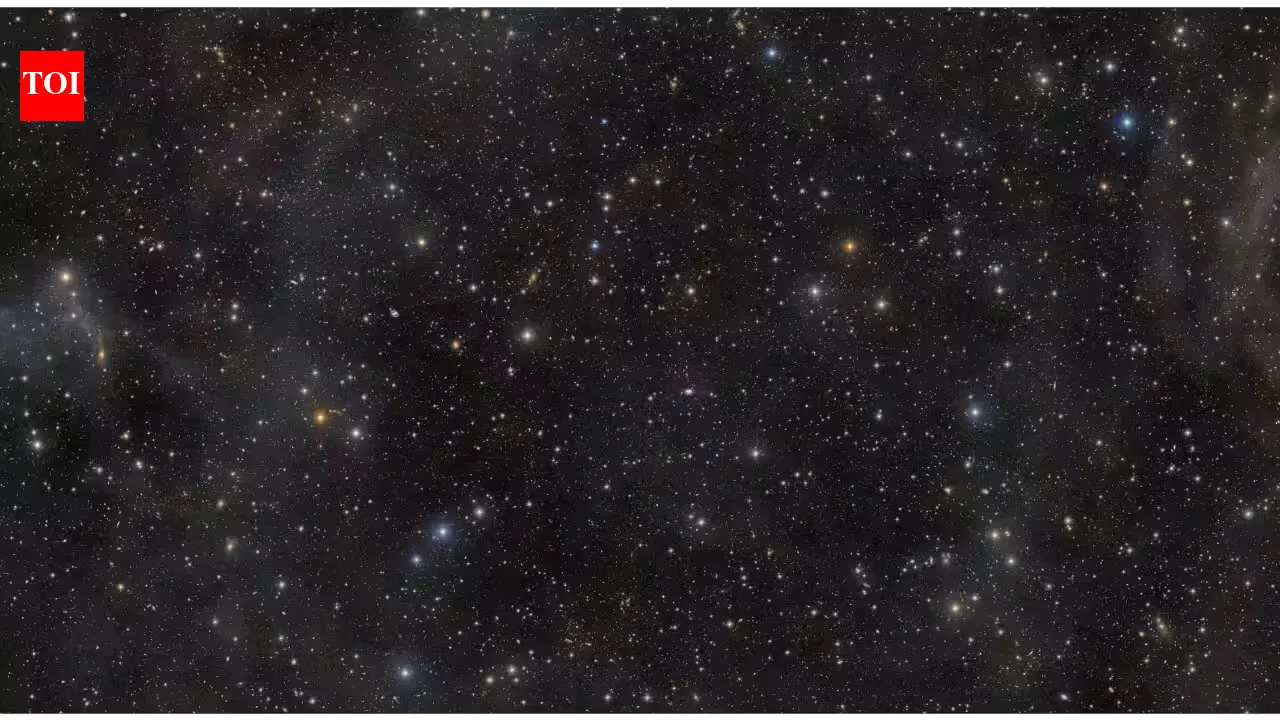
Astronomers have achieved an unprecedented view of the cosmos with the Vera C. Rubin Observatory in Chile, releasing a single, composite image that reveals more than 500,000 galaxies and over 50,000 stars. This remarkable feat was accomplished using the largest digital camera ever constructed, offering a glimpse into the universe's distant past.
The image is a product of Rubin's 3.2-gigapixel LSST Camera, affixed to the observatory’s 8.4-meter Simonyi Survey Telescope. Rather than a single exposure, the final photograph is a meticulous layering of hundreds of individual images. This process of stacking exposures allowed faint, distant light signals to accumulate, rendering visible celestial objects that would otherwise remain unseen.
The resulting panorama is densely populated with a diverse array of galaxies, including those with prominent spiral arms, smooth elliptical formations, and even galaxies captured in the throes of collision. Faint red galaxies, originating from the early epochs of the universe, are also discernible. A small number of bright stars from our own Milky Way galaxy are visible in the foreground, providing a striking contrast to the vastness beyond.
Cosmic Deep Dive in the COSMOS Field
This specific region of the sky, known as the COSMOS field, has been a focal point for astronomical research for over two decades. Its significance was first highlighted by observations from the Hubble Space Telescope in 2003, and since then, numerous powerful telescopes have been directed towards it, collecting data across the electromagnetic spectrum.
The COSMOS field's utility lies in its strategic location. Situated away from the crowded galactic plane of the Milky Way, it experiences minimal interference from nearby stars and obscuring dust clouds. This offers astronomers an exceptionally clear line of sight to a vast number of distant galaxies. Some of these galaxies are so remote that their light has traveled for billions of years to reach Earth, effectively allowing scientists to peer back in time and study galactic evolution across different eras of the universe's history within a single, continuous dataset.
The Vera C. Rubin Observatory, a joint project funded by the U.S. National Science Foundation and the U.S. Department of Energy’s Office of Science, adds crucial dimensions of depth, wide coverage, and temporal observation to this field. The observatory's mission includes the ten-year Legacy Survey of Space and Time (LSST), which aims to create the most detailed and continuously updated record of the universe ever assembled. By repeatedly imaging the COSMOS field, Rubin is building a dynamic chronicle of celestial changes, with future observations expected to reveal even fainter galaxies and finer details.
This particular image represents Rubin's Early Data Preview 2 (EDP2), the observatory's first data release derived specifically from LSST Camera observations. It integrates science validation data gathered between April 2025 and January 2026, covering approximately 3,000 square degrees of the night sky—about one-sixth of the visible Southern Hemisphere. Bob Blum, Director of Rubin Observatory at NSF NOIRLab, emphasized that this image is merely the prelude to the discoveries awaiting in the COSMOS field. He noted that continued observations over the next decade are anticipated to uncover numerous transient cosmic events, such as supernovae, providing scientists with opportunities for detailed follow-up studies.