
SpaceX Falcon Heavy Boosters Return After Roman Telescope Launch
SpaceX's Falcon Heavy rocket boosters demonstrated precision re-entry and landing on September 8, 2026, shortly after successfully launching NASA's Nancy Grace Roman Space Telescope. The reusable technology marks a significant step in space exploration.

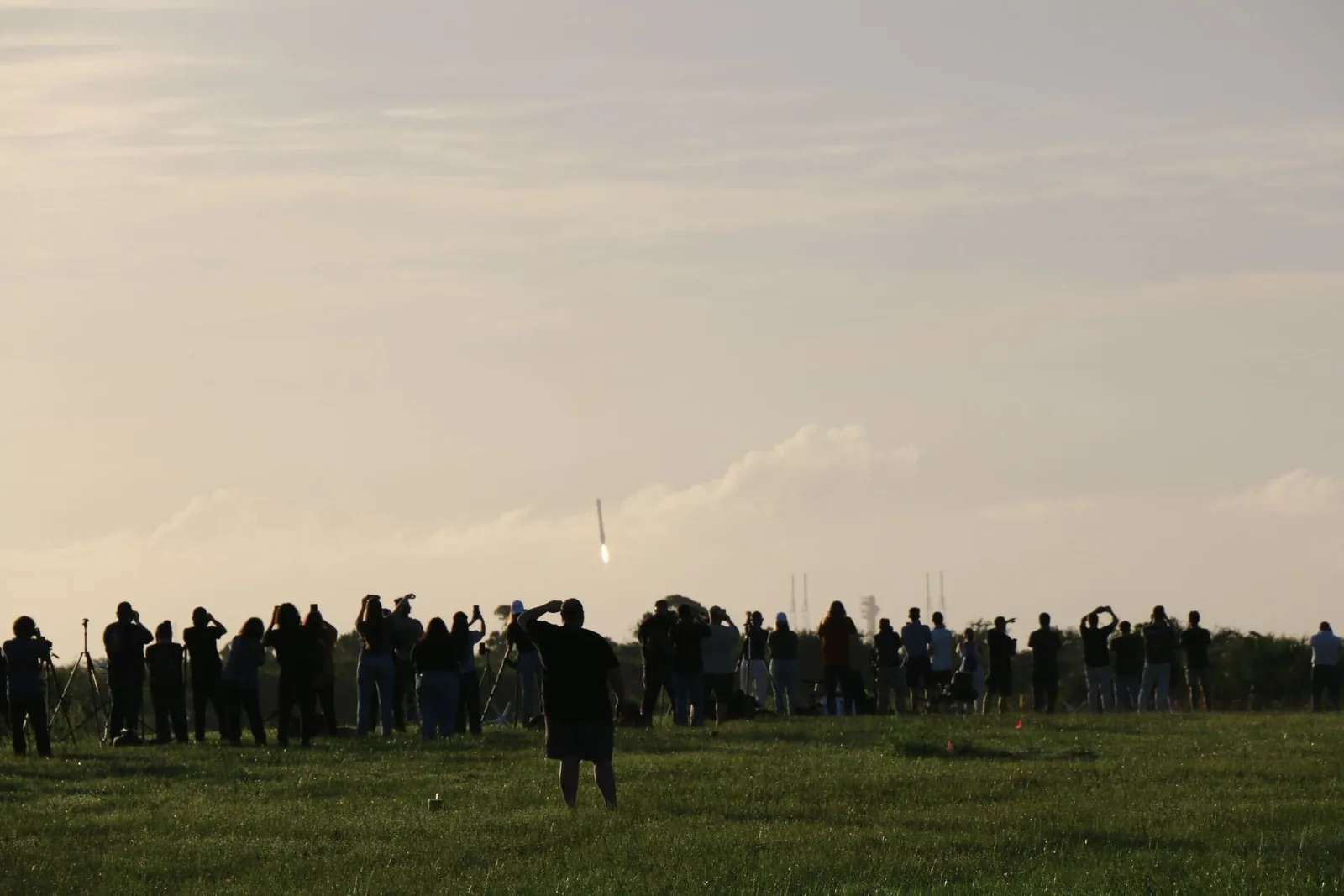
Two boosters from a SpaceX Falcon Heavy rocket completed a successful return landing on September 8, 2026, following their mission to launch NASA's Nancy Grace Roman Space Telescope into orbit. The dramatic descent and pinpoint landings were observed by onlookers at NASA's Kennedy Space Center in Florida, highlighting the advancement of reusable rocket technology.
The Nancy Grace Roman Space Telescope, NASA's next major observatory, was launched on August 30, 2026, aboard the powerful Falcon Heavy rocket. Designed to revolutionize cosmic observation, the telescope is equipped with advanced instruments, including a coronagraph for direct exoplanet imaging and a Wide-Field Instrument (WFI) with an exceptionally broad field of view. It is expected to work in conjunction with other prominent observatories like the Hubble and James Webb Space Telescopes to unveil the universe's complex structures.
The Falcon Heavy, standing approximately 230 feet tall, is capable of lifting substantial payloads, nearly 141,000 pounds, to low Earth orbit. A key feature of this rocket system is the reusability of its two side boosters. After delivering their payload, these boosters separate and execute controlled descents to land vertically back on Earth. The image captured on September 8th shows one such booster in its final moments before touchdown.
Witnessing Precision in Spaceflight
The ability of rocket components to land precisely on Earth is still a remarkable feat, even as it becomes more common. Chelsea Gohd, a contributor to Space.com, was present for the Roman Space Telescope launch and witnessed the booster landing, describing it as a breathtaking spectacle. "It was breathtaking to watch such a huge piece of equipment navigate mid-air and straighten itself before landing," Gohd recounted, noting the astonished reaction of the crowd.
One booster landed at Landing Zone 2, while the other touched down at Landing Zone 40. According to NASA, one of these boosters was completing its inaugural mission, while the other had already completed two previous flights, underscoring the robust nature of the reusable technology. The successful return of these boosters paves the way for future missions, reducing launch costs and environmental impact.
The mission of the Nancy Grace Roman Space Telescope is anticipated to yield groundbreaking scientific discoveries. Its first images of the cosmos are expected to be released next year, promising new insights into distant galaxies, exoplanets, and the fundamental nature of the universe. The successful launch and recovery of the SpaceX Falcon Heavy are critical enablers for these ambitious scientific endeavors.
The spectacle of rocket landings has captured public imagination, with one observer comparing a returning booster to a "taxi returning to its station, getting ready for the next task." This analogy highlights the functional efficiency and readiness of the reusable technology. As the field of space exploration continues to advance, such innovations in launch and recovery systems are paramount for sustained progress and exploration beyond Earth orbit.