
SpaceX Falcon 9 Carries Semiconductor Test Beds for Besxar Space Industries
Two semiconductor manufacturing test beds from Besxar Space Industries will launch on a SpaceX Falcon 9 rocket alongside Starlink satellites from Cape Canaveral on Sunday morning. The sub-orbital flights aim to test the company's 'Fabships' in the vacuum of space.

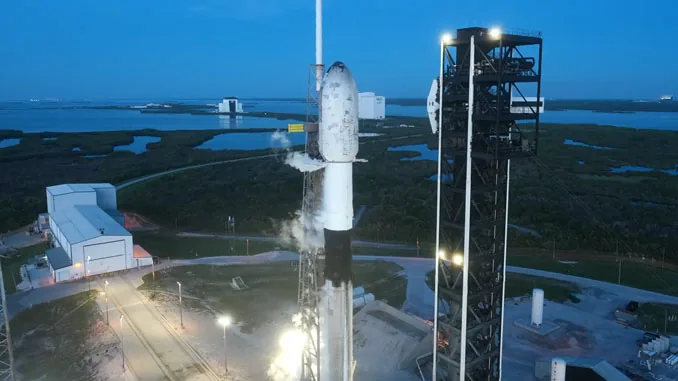
Two experimental semiconductor fabrication test beds are set to embark on a sub-orbital journey aboard a SpaceX Falcon 9 rocket, launching from Cape Canaveral on Sunday, July 5, 2026. The mission, designated Starlink 10-50, will also deploy a new batch of Starlink internet satellites. Liftoff is scheduled for 6:46 a.m. EDT (1046 UTC) from Space Launch Complex 40, with Space Force meteorologists predicting an 85 percent probability of favorable weather conditions.
The Falcon 9 rocket, a workhorse for SpaceX's satellite deployment operations, will carry 29 Starlink satellites into orbit. Additionally, the rocket's first stage booster will host two manufacturing pods developed by Besxar Space Industries, a startup based in Washington, D.C. These pods, known as ‘Clipper Class’ Fabships, will undertake an eight-minute flight to space and back, providing a unique environment for testing semiconductor substrate manufacturing. This marks a significant step in Besxar's ambition to leverage the extreme conditions of space for advanced material production.
Besxar Space Industries has ambitious plans for space-based manufacturing, having previously booked 12 Falcon 9 flights to test its 'Fabships'. The company's core objective is to utilize the near-perfect vacuum of space to produce ultra-pure semiconductor substrates and precursor materials, components crucial for next-generation electronic devices. Ashley Pilipiszyn, Founder and CEO of Besxar, articulated the limitations of Earth-based production, stating last year, “We’re reaching the limits of what can be built on Earth. AI data centers are straining against power and cooling limits, silicon is nearing its physical edge, and fabrication plants can’t achieve the vacuum or yields that next-generation materials demand.”
Advancing Semiconductor Production Beyond Earth
The Falcon 9 booster is designed to ascend beyond the Karman Line, the internationally recognized boundary of space at 100 kilometers altitude, after releasing the rocket's second stage. For Starlink missions, the first-stage booster typically continues its upward trajectory to an altitude of approximately 115 kilometers before returning to Earth for a controlled landing on a drone ship positioned in the ocean. Besxar Space Industries views these short-duration, sub-orbital flights, characterized by their rapid turnaround, as ideal for refining its space-based manufacturing processes. The 'Clipper Class' Fabships themselves are compact, roughly the size of a microwave oven, enabling them to be integrated into existing launch architectures.
Pilipiszyn, who has a background that includes early work at OpenAI, highlighted the accelerated pace of innovation enabled by space access. "With a regular cadence of launch and reentry missions, we can now iterate faster than ever—transforming space into a critical extension of America’s semiconductor supply chain,” she said. In a recent interview on the CNBC podcast ‘Manifest Space’, Pilipiszyn explained that the initial 'Clipper Class' Fabships will carry a variety of semiconductor wafers manufactured on Earth. The purpose of these trials is to assess how these terrestrial wafers withstand the intense forces of a rocket launch and subsequent atmospheric reentry. "You can think of this similar to the ultimate egg drop challenge,” she remarked. “We want to ensure not only can we get wafers to space, do our manufacturing, but also that we’re able to successfully bring back wafers without any type of cracking or damage like that.”
Besxar Space Industries has garnered support from significant entities within the technology sector. Notably, the company is part of Nvidia’s Inception Program for startups, and SpaceX itself is listed among its investors. The initial plans for Fabship testing were projected to commence before the end of 2025, with Sunday's launch representing a progression toward these goals. This mission also underscores SpaceX's ongoing commitment to its Starlink constellation, with Sunday’s launch marking the 62nd Starlink delivery mission of 2026. Following stage separation, the 29 v2 Mini Starlink satellites are expected to be deployed roughly one hour and three minutes after liftoff, continuing the expansion of SpaceX's global internet service.