
SpaceX Falcon 9 Rocket Debris to Impact Moon Wednesday
A defunct section of a SpaceX Falcon 9 rocket is on a collision course with the Moon, expected to impact on Wednesday, August 5, 2026. The debris is roughly the size of a five-story building.

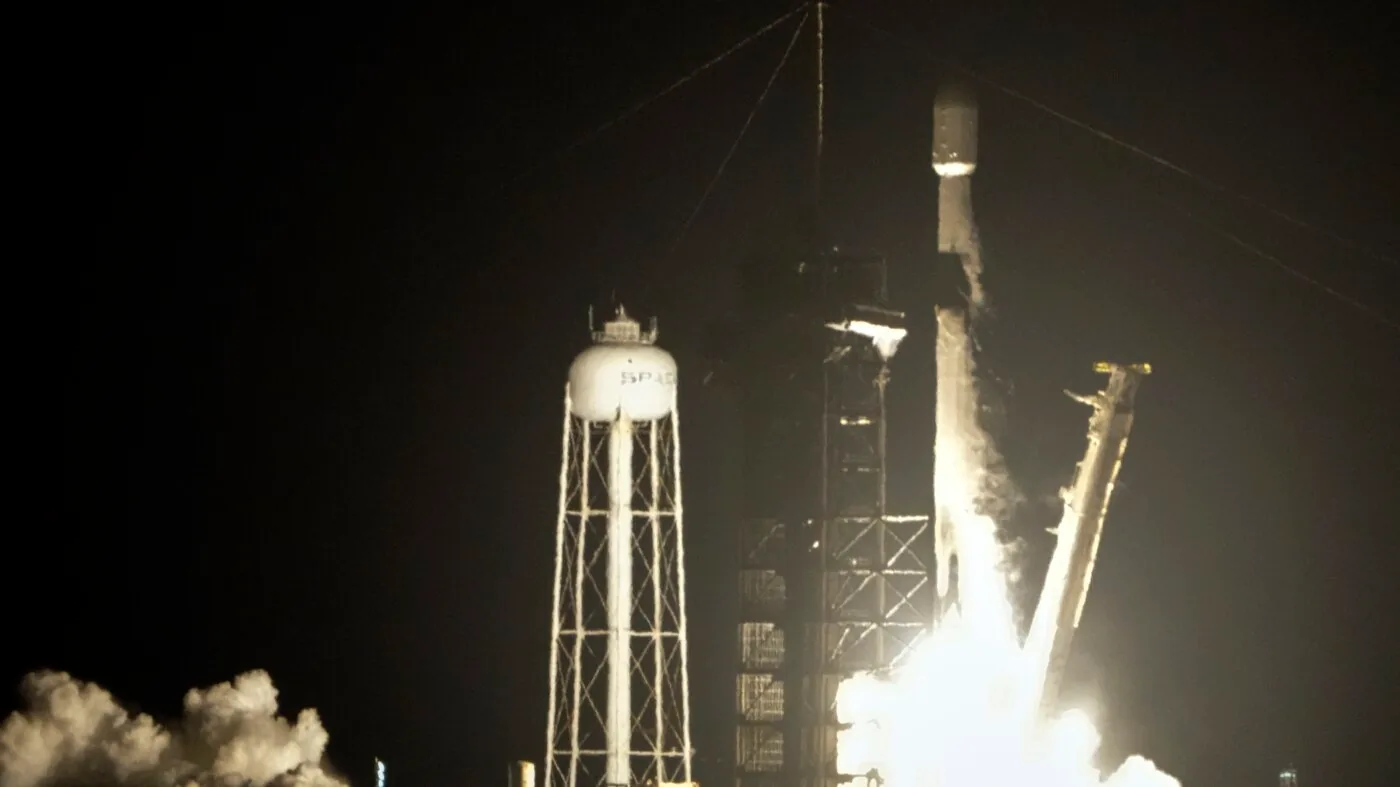
A piece of a SpaceX Falcon 9 rocket is on an unavoidable trajectory to crash into the Moon on Wednesday, August 5, 2026, according to orbital trajectory analysis. The defunct upper stage of the rocket, estimated to be the size of a five-story building, was launched in January 2025 as part of a mission carrying two lunar landers and scientific instruments. It is projected to strike the lunar surface at approximately 2:35 a.m. ET, traveling at over 5,000 miles per hour.
The impact site is expected to be in a sunlit region of the Moon's northwestern quadrant, near the prominent Einstein Crater, according to Bill Gray, an independent scientist who develops software for tracking space objects. Gray's analysis suggests the collision could excavate a crater at least 17 meters (approximately 55 feet) in diameter. While SpaceX did not intentionally set this course for the debris, its uncontrolled orbit has led to this celestial collision.
NASA's Lunar Reconnaissance Orbiter (LRO) will attempt to document the aftermath of the impact. Brent Garry, a project scientist for LRO at NASA's Goddard Space Flight Center, stated in a June discussion hosted by NASA's Solar System Exploration Research Virtual Institute (SSERVI), "After the impact we might have a little bit more knowledge of where it is. We can do some additional targeting about a week after the impact and get some targeting over where the site is." Scientists hope the LRO's observations will help characterize the impact and any resulting changes to the lunar surface.
Assessing the Visuals and Scientific Opportunity
The visibility of the impact itself and any resulting ejecta is uncertain. Some researchers anticipate that even a dust plume might be imperceptible to professional telescopes. However, Bill Gray noted on his website that "Rocks ejected by the impact may form a 'plume' that will be visible against the dark background once they're off the moon." He added, "As with much in science, the answer is 'we don't know; let's find out'....Maybe we'll see rocks ejected from the crater."
Despite the challenges, the event offers a rare opportunity for scientific observation of a lunar impact. Ben Fernando, a postdoctoral fellow and researcher at Los Alamos National Laboratory who participated in the SSERVI discussion, encouraged those with the means and awareness of the risks to observe. "To be clear, this is not something that you're going to see by pointing a pair of binoculars at the moon, but if you have the right equipment and the right time…why not take a look?" Fernando advised. Such events provide valuable data on impact dynamics and crater formation on celestial bodies, contributing to our understanding of planetary science and the history of impacts in the solar system.
This incident highlights the growing issue of space debris and the long-term consequences of rocket launches. As the number of missions to space increases, managing and tracking spent rocket stages and other orbital fragments becomes increasingly critical. Understanding the fate of such objects, whether they burn up in the atmosphere, land on Earth, or impact other celestial bodies, is vital for maintaining the safety and sustainability of space exploration. The upcoming SpaceX debris impact serves as a stark reminder of the challenges associated with operating in the near-Earth environment and beyond, prompting ongoing discussions about debris mitigation strategies and responsible spaceflight practices.