
SpaceX Rocket Stage to Crash Into Moon August 5
A spent SpaceX Falcon 9 rocket's upper stage is on a collision course with the Moon, expected to impact on August 5. The event offers scientists a unique opportunity to study lunar impacts.

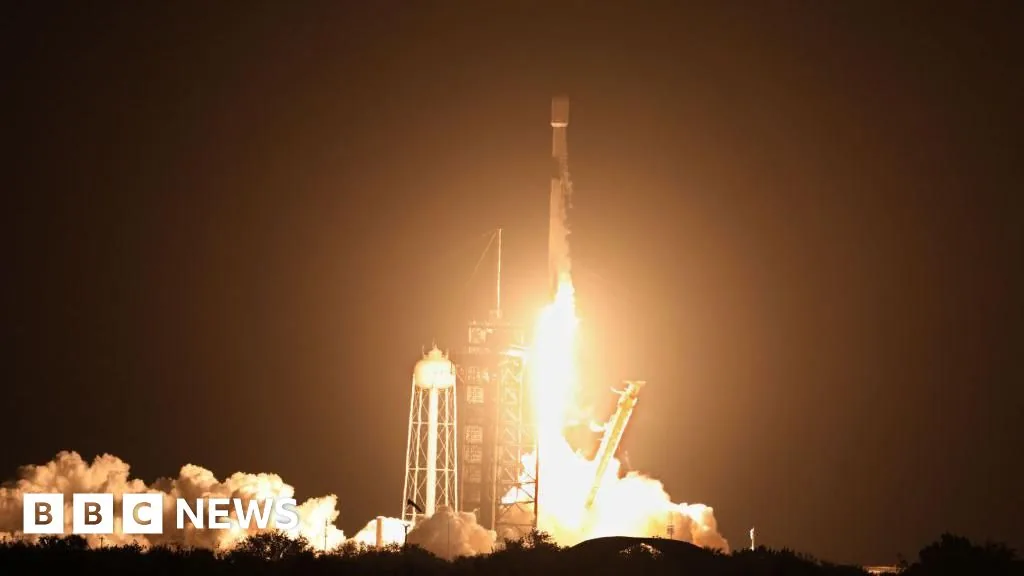
A section of a SpaceX Falcon 9 rocket, abandoned in orbit after a 2025 launch, is set to collide with the Moon on Wednesday, August 5. The upper stage of the rocket, traveling at approximately 5,400 mph, will impact the lunar surface, creating a new crater and a plume of dust. NASA's Center for Near-Earth Object Studies (CNEOS) confirmed the trajectory, noting that the event poses no danger to Earth.
The rocket stage, roughly the size of a five-story building and weighing at least 8,800 pounds, was part of a mission carrying lunar landers and scientific equipment. While parts of SpaceX rockets are designed for reusability, spent sections can remain in orbit indefinitely. This particular piece is expected to land near the famous Einstein Crater, in a region of the Moon that is illuminated by the Sun.
Studying the Impact
Astronomers anticipate the collision will generate a crater estimated to be over 56 feet in diameter. While not visible to the naked eye from Earth, the impact might be observed as a flash by those with powerful telescopes. The event is particularly significant for scientists, offering an unprecedented chance to study lunar impact dynamics. Dr. Matt Bothwell, a public astronomer at the University of Cambridge, highlighted the potential educational value: "It's going to impact and it's going to send up a huge plume of dust, maybe 50km into the air or more, and that's going to spread sideways over time."
Because the Moon lacks an atmosphere and has weaker gravity than Earth, the debris ejected from the impact will behave differently than it would on our planet. The lack of atmospheric resistance means the debris could travel much farther and higher. Advanced observations from major telescopes in the Americas, NASA's Lunar Reconnaissance Orbiter, and South Korea's Danuri probe are planned to document the flash, dust plume, and the resulting crater. Citizen-science initiatives are also enlisting amateur astronomers to film the event.
The data gathered from this unexpected celestial event will help scientists refine their models of lunar impacts. By analyzing the amount and trajectory of ejected material, researchers aim to gain insights into the Moon's subsurface composition at the impact site. This exposure of fresh material could provide clues about geological processes that have occurred beneath the lunar surface.
This impending impact also brings renewed attention to the growing issue of space debris. Dr. Bothwell expressed concern, stating, "Every single year we put more stuff in orbit. Sometimes the satellites just collide, and they shatter into more pieces. I think there's a worry about a runaway cascade, if we put so much stuff in orbit." Currently, the European Space Agency estimates there are about 54,000 objects larger than 10 cm orbiting Earth, a testament to the increasing amount of human-made material in space since the dawn of the Space Age in 1957.