
SpaceX vs NASA: Two Models Reshaping Space Exploration
SpaceX and NASA are charting divergent paths in 2026, with private enterprise accelerating launch cadence while government agencies focus on deep-space science. Their rivalry is pushing innovation across the aerospace sector.

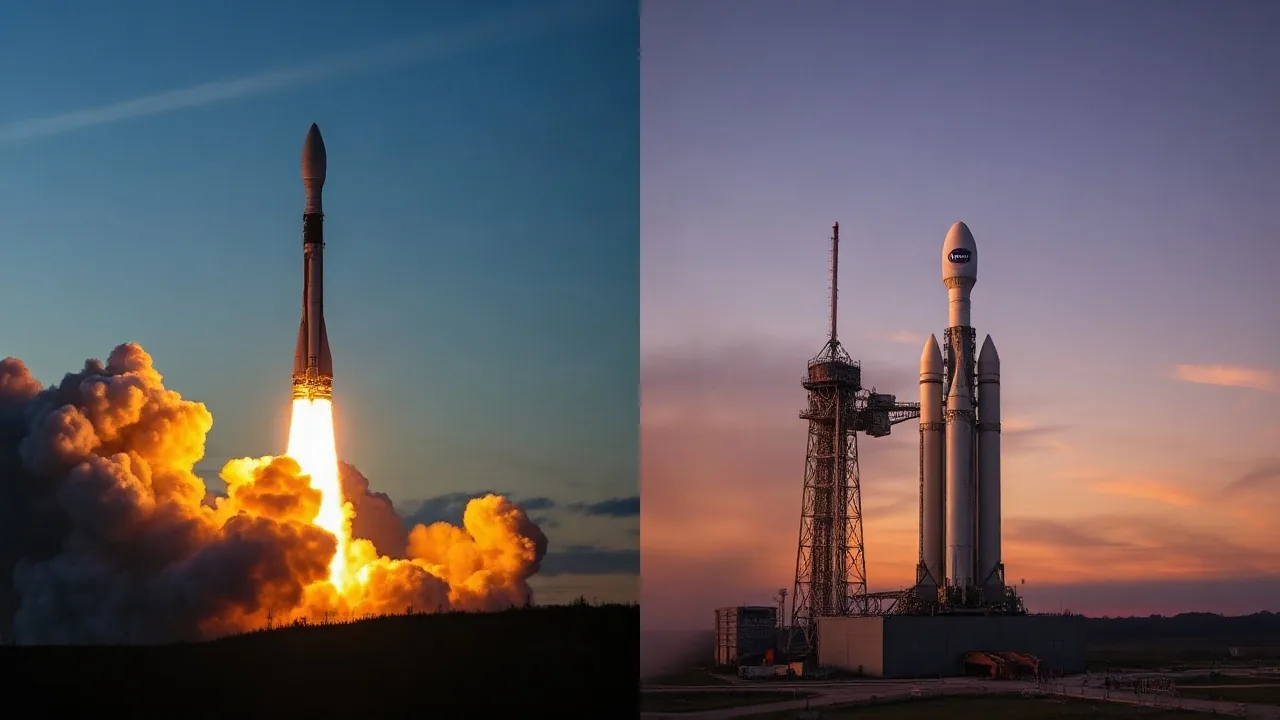
SpaceX's Starship completed its fifth integrated flight test in June 2026, catching the booster with mechanical arms while advancing toward orbital refueling tests. Simultaneously, NASA's Artemis II mission remained under review after engineering assessments revealed thermal protection system concerns on the Space Launch System. The contrast illustrates how two American space organizations are now operating under fundamentally different philosophies, timelines, and financial models.
For decades, NASA monopolized human spaceflight. Today, SpaceX operates the only active US vehicle carrying astronauts to orbit. That shift accelerated dramatically after SpaceX's commercial crew contract with NASA, which began ferrying personnel to the International Space Station in 2020 and continues through 2026.
Competing Visions and Shared Infrastructure
SpaceX versus NASA is not a simple competition for dominance. The two organizations are bound by contracts, regulatory frameworks, and shared facilities. NASA pays SpaceX roughly $55 million per astronaut seat aboard Crew Dragon, leveraging commercial economics to reduce launch costs compared to historical Space Shuttle expenses.
"SpaceX has fundamentally changed the economics of launch," said Dr. Joan Johnson-Freese, a space policy expert at the Naval War College, in an interview published by Defense News in August 2026. "But NASA's role in long-term exploration and fundamental research remains irreplaceable. They're not competitors in every dimension."
SpaceX's business model prioritizes rapid iteration and reusable rockets. The Falcon 9, now in its fifteenth year of operation, has conducted over 260 launches by September 2026. Starlink, the company's satellite internet constellation, operates roughly 6,500 satellites in orbit, generating revenue that cross-funds heavy-lift development. NASA, by contrast, operates on a five-to-ten year authorization cycle with congressional appropriations that can shift with political priorities.
The Artemis Program and Deep-Space Strategy
NASA's Artemis program targets sustained lunar presence and eventual human missions to Mars. The agency is constructing the Gateway lunar outpost and developing the Lunar Terrain Vehicle. These initiatives operate on a different timeline than commercial ventures. Artemis II, originally scheduled for 2024, continues delayed pending technical resolution.
NASA has also partnered with SpaceX through a separate contract for Human Landing System services under Artemis. SpaceX will deliver modified Starship vehicles to transport astronauts from lunar orbit to the surface. This arrangement underscores how government and private sectors now intertwine in practice, despite their philosophical differences.
NASA's 2026 budget request allocated $25.4 billion for the agency's total operations, with human exploration and lunar development consuming roughly 40 percent. SpaceX does not publish annual financial reports, but Morgan Stanley estimated in a 2024 valuation that the company's annual revenue approached $8 billion, with profitability improving through government contracts and Starlink subscriptions.
Launch Cadence and Market Dynamics
The pace of launches reveals operational divergence. SpaceX conducted 72 orbital launches in 2025 and maintained acceleration through early 2026. United Launch Alliance, a joint venture between Boeing and Lockheed Martin, flew fewer than ten missions annually. NASA's own launch manifest for FY2026 included Artemis-adjacent payloads, James Webb Space Telescope follow-up instruments, and Earth science missions, totaling roughly six to eight missions under NASA's direct control.
Private companies including Axiom Space, Sierra Space, and Relativity Space have emerged as additional players in the space exploration ecosystem. Axiom Space launched its first commercial module to the ISS in April 2024 and plans to operate a private orbital station by 2028. These developments create a more fragmented landscape than existed in 2015.
SpaceX's pricing pressures have forced competitors to reduce costs. United Launch Alliance announced in March 2026 that its Vulcan rocket, designed to replace the Delta IV Heavy, would price launches at $110 million, compared to Falcon Heavy's advertised rate of $90 million. Blue Origin's New Glenn remains under development with 2026 maiden flight expectations now slipping to 2027.
The commercial aerospace sector now conducts missions NASA once performed exclusively. In-orbit servicing, satellite manufacturing, and propellant depot development have become independent business lines. Northrop Grumman's Cygnus cargo vehicle ferries supplies to the ISS, competing with SpaceX's Dragon cargo variant and Russia's Progress, which continued operations through 2026 despite geopolitical tensions.
The Path Forward
The future of space exploration will likely remain bifurcated. NASA maintains legitimacy through peer-reviewed science, international cooperation through treaties, and long-term commitment to objectives like Mars exploration that lack near-term commercial incentive. SpaceX pursues rapid development cycles aimed at profit and, increasingly, Mars colonization as a stated objective.
By 2026, it is clear that the space industry has matured beyond a binary choice between government and private enterprise. NASA procures services from SpaceX. SpaceX relies on NASA contracts to sustain Starship development. United Launch Alliance holds national security launch contracts while competing commercially with SpaceX. This ecosystem, while competitive, generates innovation across multiple vectors simultaneously.
The resolution of technical issues on Artemis II, alongside continued Starship development, will define the competitive and collaborative landscape through 2027 and beyond. Both organizations operate under scrutiny from Congress, the public, and investors. Neither can afford failure, and neither can succeed alone.