
Spain Sees First Total Solar Eclipse in 100 Years
Millions gathered across Spain and parts of Iceland to witness the country's first total solar eclipse in over a century. The rare celestial event offered spectacular views but also prompted extensive safety measures due to wildfire risks.

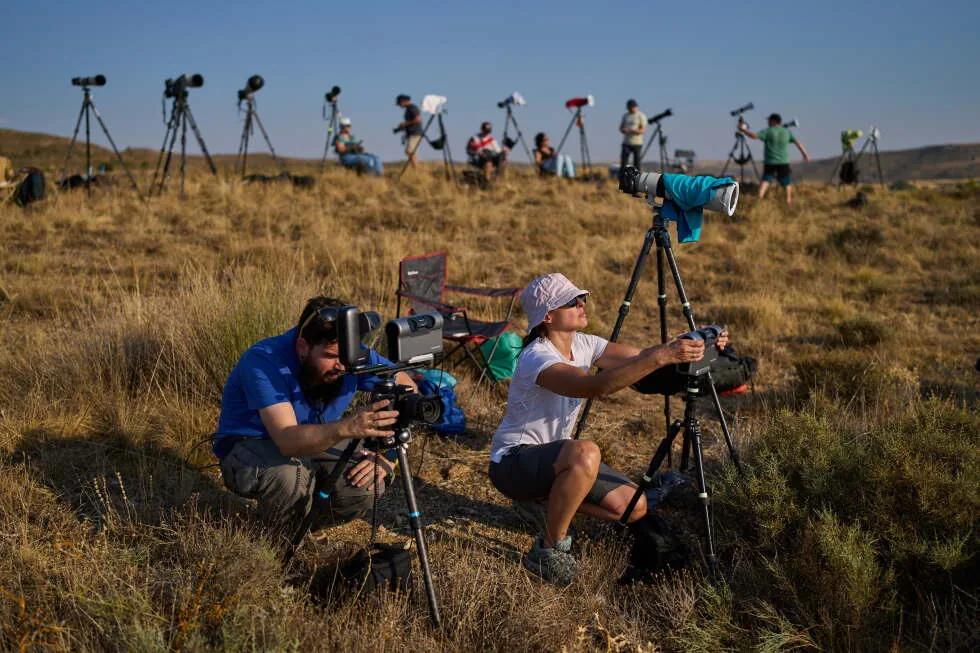
Millions of people flocked to cities and towns across Spain on Wednesday, seeking clear skies for a rare total solar eclipse, the nation's first in more than 100 years. The celestial event, where the sun, moon, and Earth align to briefly cast shadows, drew enthusiastic crowds equipped with lawn chairs and viewing gear, eager to witness the spectacle as evening approached.
The path of totality, offering the most dramatic views, stretched across northern and central Spain, with a smaller segment visible in parts of Greenland and Iceland, weather permitting. While the moon's complete obscuration of the sun, known as totality, was expected to last less than 2 1/2 minutes at its peak duration off Iceland's coast, the event would offer around a minute of totality as it neared sunset over Spain.
Safety Measures Amidst Wildfire Concerns
Amidst a challenging summer marked by intense heat and active wildfires, Spanish authorities implemented a significant public safety campaign. The influx of an estimated half-million additional visitors for the eclipse heightened concerns, particularly in popular viewing areas like A Coruña, Bilbao, and Santiago de Compostela, where hotel occupancy surged. In Medinaceli, a historic hilltop town, viewing spots and local establishments filled up hours before the event.
Óscar Pérez, a 24-year-old physics student who traveled from Germany, expressed his excitement: "It’s the first time in my lifetime that I’ll get to see a total eclipse in Spain," he said. "I’m not sure where the next one is, so it’ll be great to see it."
Spain's Interior Ministry established 350 official viewing sites in less populated regions, often called "Empty Spain." Access was restricted or limited at 123 additional locations due to environmental risks or potential evacuation hindrances, a critical consideration given the recent history of devastating wildfires. The largest wildfire in Spanish history earlier in July consumed approximately 500 square kilometers and led to tens of thousands of evacuations in Ávila. With smaller fires still active, the ministry announced the deployment of over 33,500 law enforcement officers to manage observation areas and access points.
Interior Minister Fernando Grande-Marlaska stated, "High temperatures, the accumulated dryness of vegetation, and the intense pressure on natural areas due to projected travel necessitate extreme preventive measures." Many regions faced temperatures exceeding 35 degrees Celsius (95 Fahrenheit), prompting authorities to prioritize preventing any sparks that could ignite fires, urging visitors against lighting fires, littering, or parking in vegetated areas.
Essential for safe viewing are specialized eclipse glasses, which filter out harmful solar radiation. These glasses have been widely available in supermarkets, department stores, museums, and planetariums across Spain for months. Pharmacies reported dwindling supplies, and long queues formed in Madrid for the remaining stock.
Meanwhile, aboard the MS Spitsbergen near Greenland, Captain Sverre Rud navigated his ship with 126 passengers, aiming for optimal viewing conditions. His passengers, accustomed to 24-hour daylight on their Arctic cruise, anticipated the unusual two-minute period of darkness. "Everyone is very enthusiastic," Rud commented. "When we were down for breakfast earlier, it was almost like a little bit of a Christmas Eve feeling here."
In Iceland, skywatchers faced potentially cloudy skies, with hotel rates in Reykjavík reportedly doubling for the night, reaching over $1,000 per night. The nation, preparing for its first total solar eclipse since 1954, anticipated up to 20,000 additional tourists, a significant number for a country with fewer than 400,000 residents. Hotel Keflavík, with 70 rooms, was fully booked, with guests hoping for about a minute and 45 seconds of totality. Hotel owner Steinþór Jónsson recalled the 1986 summit between U.S. President Ronald Reagan and Soviet leader Mikhail Gorbachev as a similarly hectic event, jokingly equating the eclipse to that historic moment: "Besides Reagan and Gorbachev, the eclipse is the biggest."