
Milky Way Orbit: Sun's 230 Million Year Journey & Dinosaur Origins
The Sun and its solar system complete one orbit around the Milky Way's center in roughly 230 million years. This journey coincides with the early appearance of dinosaurs on Earth.

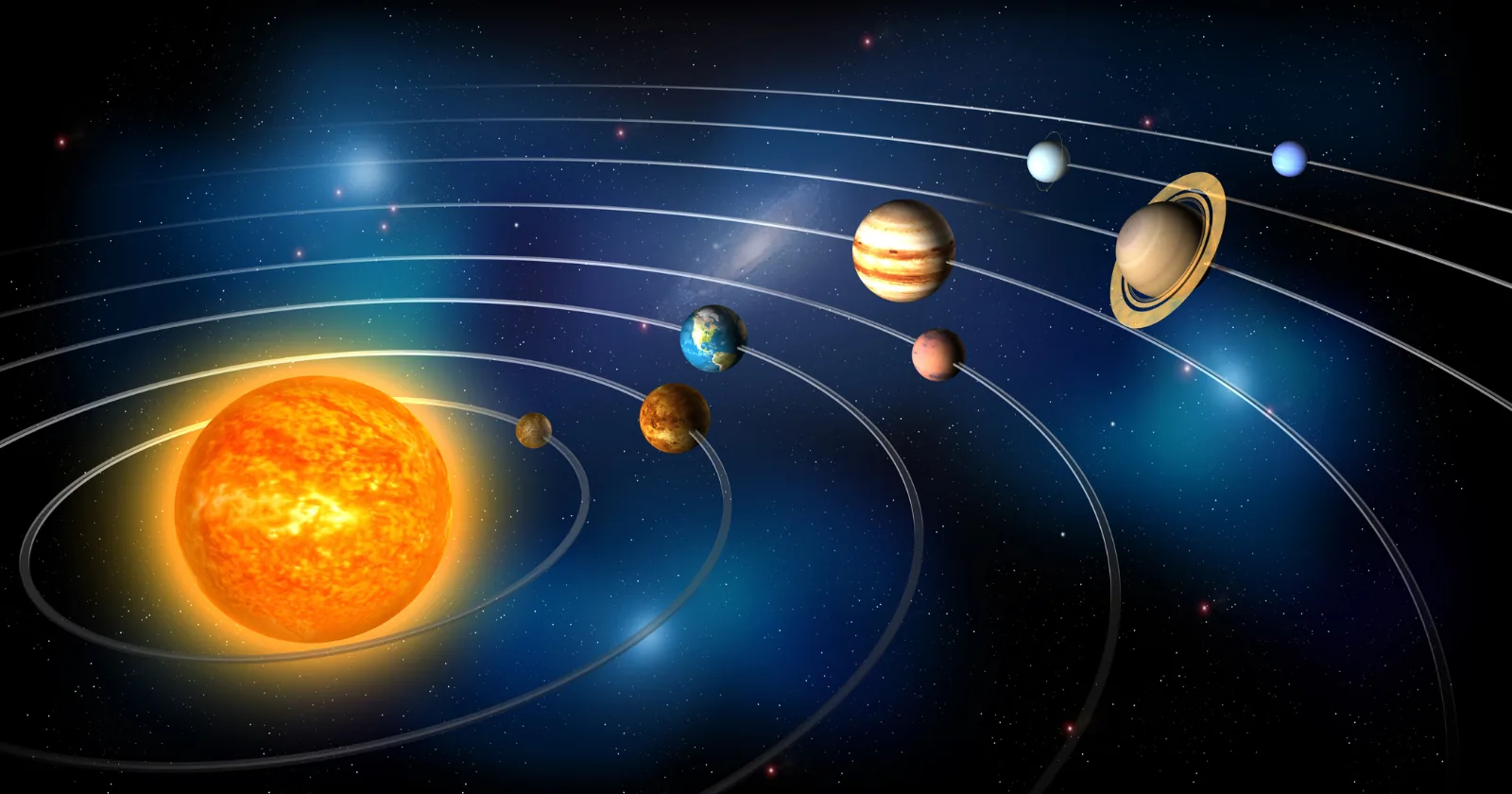
The Sun, far from being stationary, is a celestial traveler, carrying the entire Solar System on a grand orbital path around the center of the Milky Way galaxy. This colossal circuit, often referred to as a galactic year, takes approximately 230 million years to complete. This immense timeframe recently drew attention as it aligns with a significant period in Earth's history: the dawn of the dinosaurs.
When the Solar System last occupied its current position in the galaxy, Earth was experiencing the Late Triassic period. It was during this era, around 230 to 233 million years ago, that the earliest identifiable dinosaurs began to emerge in the fossil record. These early creatures, such as the small bipedal Eoraptor and Eodromaeus, and the larger predator Herrerasaurus, were discovered in formations like the Ischigualasto Formation in northwestern Argentina. However, these nascent reptiles were not yet the dominant life forms. Fossil evidence, analyzed by researchers like Paul Barrett, suggests that in the Late Triassic, dinosaurs were rare components of the ecosystem, largely overshadowed by more advanced crocodile-line reptiles. Their eventual global dominance would only follow the mass extinction event at the end of the Triassic, approximately 201 million years ago.
Galactic Clock Precision and Earth's Timeline
While the popular notion of completing a galactic lap coinciding with the rise of dinosaurs is compelling, the precise numbers involved carry notable uncertainties. Astronomers estimate the Sun's orbital period around the galactic center to range from about 225 to 250 million years, with 230 million years being a commonly cited figure. Keith Hawkins, an astronomer at the University of Texas at Austin, places this figure between 220 and 230 million years. He emphasizes that this "galactic year" is unique to our solar system's position; stars nearer the galactic core orbit faster, while those further out move more slowly.
Data from advanced missions like the European Space Agency's Gaia spacecraft has significantly improved our understanding of the galaxy's rotation curve. These observations have refined estimates for the Sun's orbital period, nudging the favored figure towards the lower end of the accepted range. Therefore, the commonly quoted 230 million years should be understood as an approximation, accurate within tens of millions of years rather than a precise count. The coincidence with the dinosaur timeline is partly due to two independently uncertain dates—the galactic orbital period and the date of the first dinosaurs—happening to fall within a similar broad timeframe.
Furthermore, the idea of returning to the "same spot" in the galaxy is a simplification. The Milky Way does not rotate as a solid body. Its spiral arms are more akin to wave patterns moving through the galactic disk, meaning the specific arm near our solar system today is not the same structure that was present during the Triassic period. The Sun also oscillates vertically through the galactic plane, completing a full up-and-down cycle roughly every 60 to 70 million years. Over hundreds of millions of years, its distance from the galactic center also drifts. Consequently, while one galactic orbit brings the Sun back to a similar radial distance and angular position, its immediate cosmic neighborhood—the surrounding stars, gas clouds, and galactic arms—is entirely different. The clock of our orbit may reset, but the specific location does not.
Scientists have explored potential links between galactic positioning and events on Earth, including mass extinctions. One hypothesis, proposed in 1984, suggested that the Sun's oscillation through the galactic plane might periodically disturb the Oort cloud, triggering comet impacts that lead to extinctions. However, this theory has faced challenges. Objections include a mismatch between the proposed plane-crossing intervals and the observed extinction periodicities, as well as ongoing debate about the regularity of mass extinctions themselves. The theory remains an unconfirmed hypothesis rather than an established scientific link.
Ultimately, the concept of the galactic year serves as a valuable tool for comprehending the vastness of geological time and our place within the cosmos. While it provides a useful temporal marker, current evidence does not strongly support it as a direct driver of terrestrial biological events. As astronomical data continues to accumulate and our measurements of the Milky Way's rotation become more precise, our understanding of this grand celestial journey will undoubtedly evolve. The defensible narrative is that approximately one galactic trip ago, at a time we can only broadly define, the first dinosaurs were small, rare, and far from ruling the planet.