
Astronomers Discover First 'Three-Headed' Asteroid, (44) Nysa
Astronomers have captured unprecedented images revealing asteroid (44) Nysa as a unique 'three-headed' celestial body. The discovery, made using advanced telescopes, offers new insights into asteroid formation.

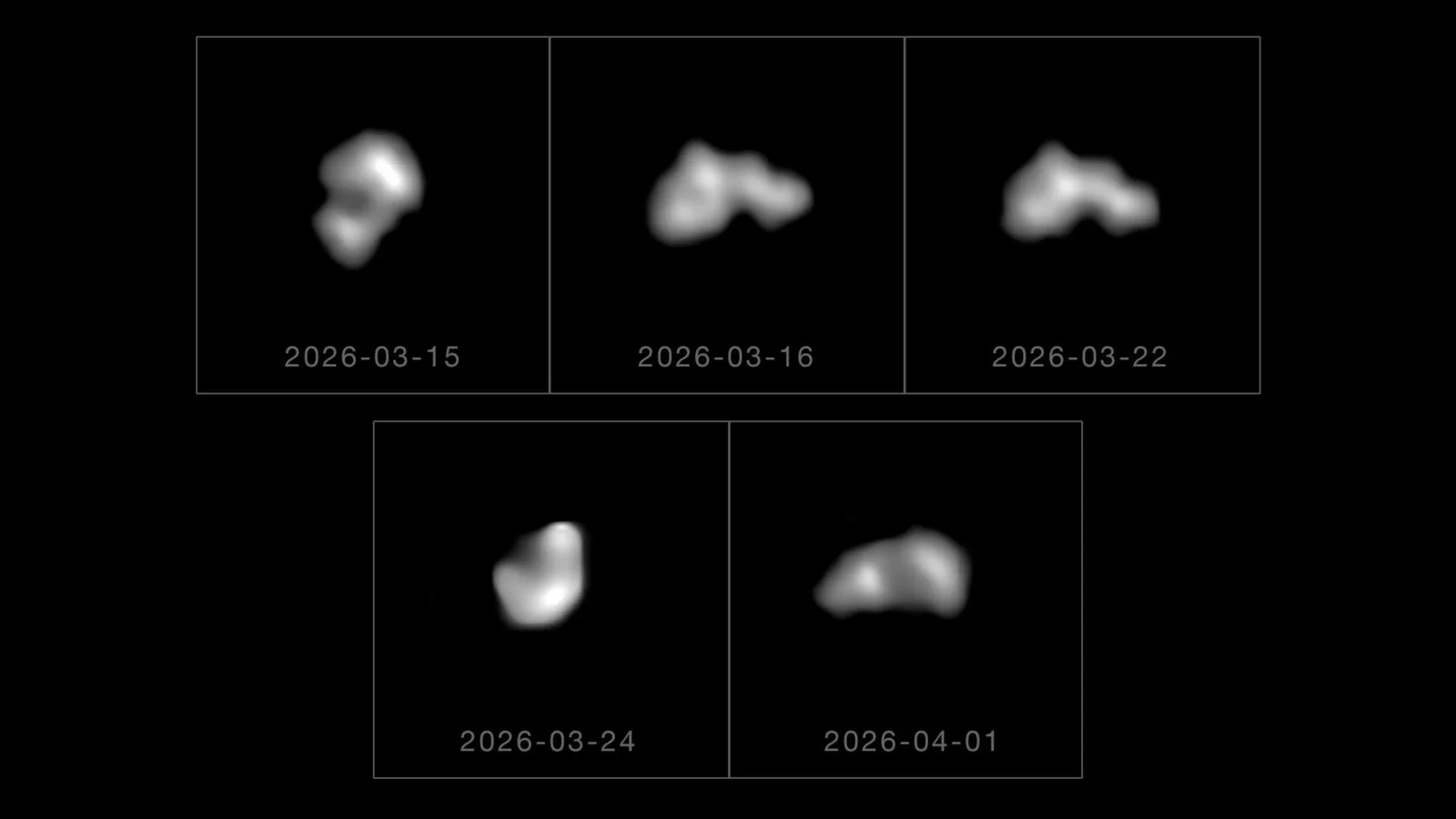
Astronomers have unveiled groundbreaking images of the asteroid (44) Nysa, revealing what is believed to be the first-ever observed "trilobate," or three-headed, asteroid in our solar system. The celestial body, located in the main asteroid belt between Mars and Jupiter, was imaged using the combined power of the Very Large Telescope in Chile and the Large Binocular Telescope in Arizona. First identified in 1857, Nysa’s distinctive three-part structure was only resolvable with the latest observational technology.
The asteroid measures approximately 47 miles (75 kilometers) at its widest point and is characterized by two narrow connecting sections that contribute to its unusual shape. Adding to the intrigue, the observations also confirmed the existence of a moon, approximately 0.6 miles (1 km) wide, designated S/2026 (44) 1, orbiting Nysa at a distance of roughly 106 miles (170 km). This discovery marks (44) Nysa as a truly exceptional object within the known cosmic landscape.
Unusual Formation Theories
The unprecedented detail captured in the new images has sparked significant scientific discussion regarding the formation of (44) Nysa. "The images reveal a remarkably unusual object," stated Kate Minker of Arizona's Lowell Observatory. "The most likely explanation is that Nysa is either a contact trinary, consisting of three connected components, or an extremely irregular coherent body unlike anything we've previously observed." This dichotomy suggests Nysa might be the result of three smaller bodies merging or a single, highly fractured object that somehow maintained its integrity.
Understanding the genesis of such unique asteroid formations is crucial for a broader comprehension of planetary system evolution. Asteroids are remnants from the early solar system, and their composition and structure can offer clues about the conditions under which planets formed. The discovery of Nysa provides a rare opportunity to study an object that defies current classifications, potentially leading to revised theories on asteroid aggregation and stability. Researchers are particularly interested in the gravitational dynamics at play between the three components of Nysa and its moon, S/2026 (44) 1, which could offer new perspectives on celestial mechanics in tight orbital systems.
The main asteroid belt itself is a vast region populated by millions of rocky bodies. While most are small, some, like Ceres, are large enough to be classified as dwarf planets. Studying individual asteroids within this belt helps scientists piece together the solar system's history, including potential collisions and material exchanges that influenced the development of planets like Earth. The unusual structure of (44) Nysa, observed with advanced instruments like the Very Large Telescope, underscores how much remains to be discovered even in well-studied areas of space.