
Total Solar Eclipse Dazzles Europe: Path, Peak Times & Live Updates
A total solar eclipse graced parts of Europe today, with millions witnessing the moon fully obscure the sun. The rare celestial event captivated onlookers across Spain, Iceland, and Portugal.

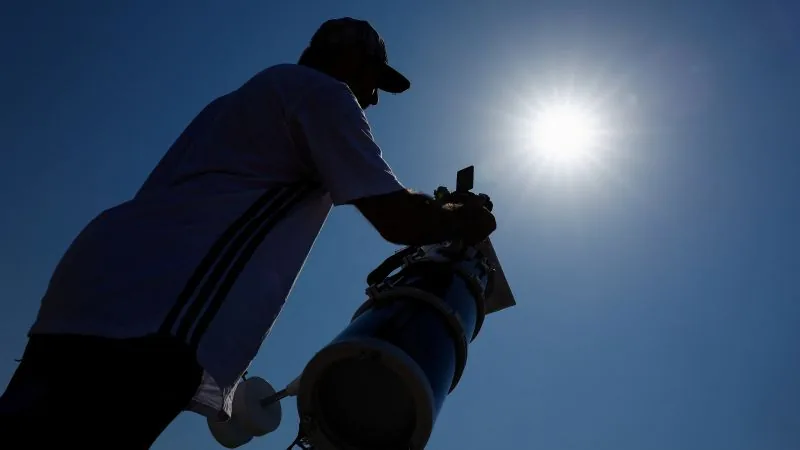
Millions across Europe witnessed a spectacular total solar eclipse on Wednesday, August 13, 2026, as the moon passed directly between the Earth and the sun. The path of totality, where the sun was completely hidden, stretched across parts of Spain, Iceland, and Portugal, drawing crowds eager to experience the rare celestial phenomenon. In Paris, onlookers gathered on lawns to observe the event, with the moon expected to block approximately 90% of the sun, causing a noticeable drop in temperature.
A total solar eclipse occurs when the moon entirely covers the sun, plunging the sky into brief darkness. This is distinct from an annular eclipse, where the moon appears smaller than the sun creating a "ring of fire," and a partial eclipse, where only a portion of the sun is obscured. While the path of totality offered the most dramatic experience, a partial solar eclipse was visible to observers in Canada, Alaska, and parts of the eastern United States.
Understanding the Celestial Mechanics
Eclipses are infrequent occurrences primarily because the moon's orbit is tilted about 5 degrees relative to Earth's orbital plane around the sun. This slight tilt means that even when the moon passes behind Earth, it doesn't always align perfectly to cast a shadow on our planet. Scientists noted that tidal forces are gradually increasing the distance between the moon and Earth by about 4 centimeters per century. This slow drift means that in billions of years, the moon will no longer be close enough to Earth to completely block the sun, rendering total solar eclipses a phenomenon of the distant past, though annular eclipses may persist.
One intriguing phenomenon observed during totality is the appearance of "shadow bands." These are faint, dark lines that race across the ground or building surfaces moments before and after the sun is fully obscured. While easily visible to the human eye, they are notoriously difficult to capture on camera. The leading scientific theory attributes shadow bands to atmospheric turbulence, though a definitive explanation remains elusive. This eclipse provided an opportunity for renewed scientific study of this mysterious effect.
For those with visual impairments, technology offered an accessible way to experience the eclipse. The LightSound device converts light intensity into audible tones, allowing visually impaired individuals in Spain and Iceland to follow the eclipse's progression through sound. Developed initially for the 2017 total solar eclipse in the United States, the technology has gained traction, with over 1,000 devices distributed for the 2024 eclipse. This year, international collaboration facilitated over 50 public viewing events across Spain featuring this sonification technology, with support from organizations like the Institute of Space Sciences. Efforts are underway to enhance the device further, incorporating elements like different light wavelengths and vibrations for a richer sensory experience.
Sky conditions varied significantly along the eclipse's path. An approaching North Atlantic storm threatened to obscure views in Iceland, particularly in Reykjavik, with reports of rain and cloud cover. Conversely, northern Spain was expected to experience clearer skies, offering better visibility for the spectacle. Cities like Valencia anticipated warm, clear conditions for the peak of the eclipse.
Authorities reiterated the critical importance of safe viewing practices. Standard sunglasses are insufficient for protecting the eyes during a solar eclipse and do not block harmful infrared radiation. Certified eclipse glasses, made with specialized black polymer lenses, are essential as they block nearly all visible, infrared, and ultraviolet light. Looking directly at the sun without proper protection can lead to permanent eye damage known as solar retinopathy, a condition that can result in vision loss and distorted sight.