
Webb Telescope Reveals Massive Star Clusters Form Faster
New research combining data from the Webb and Hubble telescopes shows that the most massive star clusters emerge from their gas clouds more quickly than smaller ones, impacting galaxy evolution and planet formation.

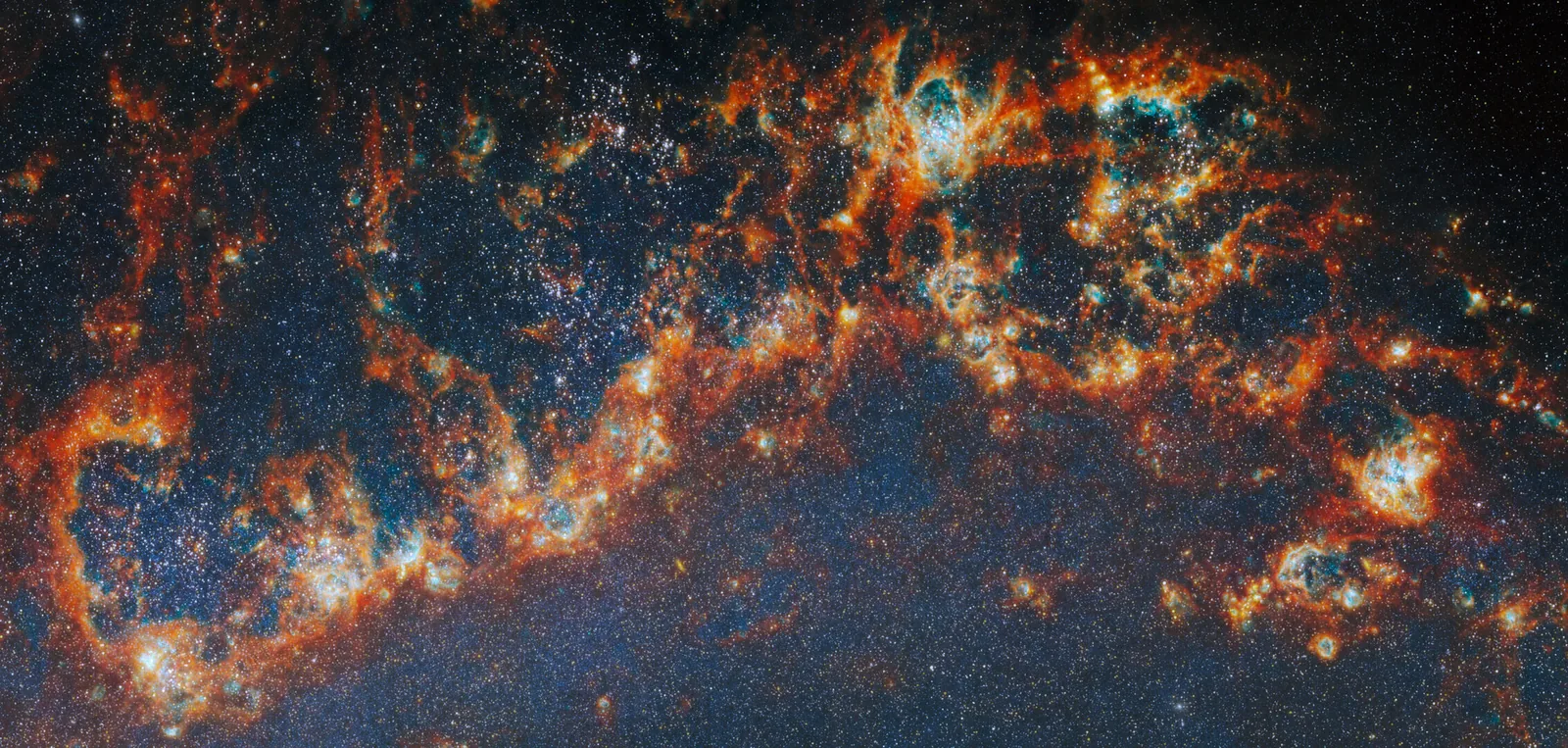
Astronomers leveraging the combined power of the NASA/ESA/CSA James Webb Space Telescope and the NASA/ESA Hubble Space Telescope have peered into four nearby galaxies, revealing that larger star clusters are born and disperse their gas shrouds at an accelerated pace. This discovery offers crucial insights into the processes of star formation and galactic evolution, as well as the conditions necessary for planets to form.
The international team of researchers analyzed data from the FEAST observing program, focusing on nearly 9,000 star clusters in galaxies Messier 51, Messier 83, NGC 4449, and NGC 628. By examining these clusters at various stages of development, they determined that more massive clusters clear away the gas from which they form faster than their less massive counterparts. This process is critical, as it signals the end of active star formation within that particular cloud and influences the surrounding galactic environment.
The birth of stars is intrinsically linked to the formation of star clusters, where vast clouds of gas collapse under gravity. As stars ignite within these clouds, their combined stellar winds, intense ultraviolet radiation, and eventual supernova explosions play a crucial role in dispersing the remaining gas. This phenomenon, known as stellar feedback, limits the amount of gas available for new star formation within a galaxy. Understanding the timeline of this dispersal is key to comprehending galactic-scale star formation and how planets are ultimately created.
Galactic Evolution and Stellar Feedback
The research, published in Nature Astronomy, utilized Webb's infrared capabilities to penetrate the dense gas clouds, allowing astronomers to observe the earliest stages of cluster formation. Hubble's optical images provided views of clusters that had already shed their gas. By analyzing the light spectrum from these clusters, scientists could estimate their mass and age. The findings indicated that the most massive star clusters were fully visible, having dispersed their natal gas within approximately five million years. In contrast, less massive clusters took between seven and eight million years to emerge from their gaseous cocoons.
“Simulations of star formation and stellar feedback have struggled to reproduce how star clusters form and emerge from their natal clouds. These results give us important new constraints on that process,” explained Angela Adamo of Stockholm University and the Oskar Klein Centre in Sweden, a lead author on the study and principal investigator of the FEAST programme. Massive star clusters, rich in hot stars, are significant emitters of ultraviolet light, a primary driver of stellar feedback. This new work confirms they also initiate this feedback process earlier than smaller clusters.
Knowledge of when and where stellar feedback is most potent throughout a galaxy's history is vital for predicting how star-forming material is distributed and consequently, how and where new stars and star clusters are likely to form. This research also has significant implications for our understanding of planet formation. The faster a star cluster clears its surrounding gas, the sooner protoplanetary discs around young stars are exposed to harmful ultraviolet radiation from neighboring stars. This accelerated exposure can limit the discs' ability to accrete additional gas from the nebula, thereby reducing the opportunities for dust grains to coalesce and form planets.
“This work brings together researchers simulating star formation and those working with observations, as well as groups researching planet formation,” said Alex Pedrini, lead author, also of Stockholm University and the Oskar Klein Centre in Sweden. “Using Webb, we can look into the cradles of star clusters and connect planet formation to the cycle of star formation and stellar feedback.” The combined observations from the Webb and Hubble telescopes provide an unprecedented, broad-spectrum view, helping to answer long-standing questions about the life cycle of star clusters and their impact on the cosmos.