
AI Accelerates Math Discoveries, Sparking Debate on Future Research
Generative AI is rapidly advancing mathematics, with new tools assisting in proofs and discoveries. This has ignited discussions within the mathematical community about attribution, ethics, and the very nature of human creativity.

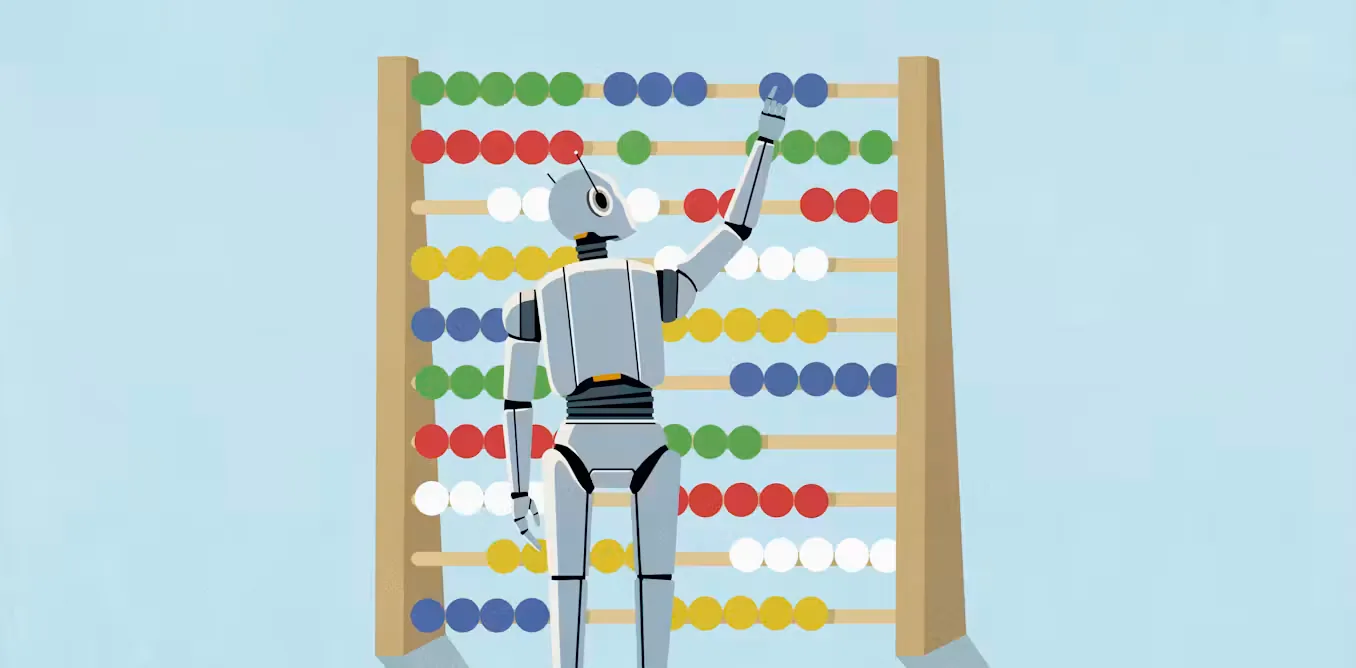
Artificial intelligence company OpenAI recently revealed ten significant advances in mathematics and computer science, achieved using its forthcoming model Astra. These breakthroughs span diverse areas such as geometry, cryptography, and coding theory, marking the latest in a series of mathematical discoveries facilitated by generative AI systems. OpenAI has publicly addressed its "responsibility to the mathematical community," acknowledging concerns regarding attribution, ensuring the accuracy of AI-generated results, and the evolving landscape of mathematical discovery. This mirrors a growing recognition that AI's technical prowess is reshaping fundamental questions about what mathematics entails and its future trajectory.
Large language models (LLMs), including prominent examples like ChatGPT and Claude, are introducing disruptions across the entire mathematical community. University departments are actively debating the ethical considerations of employing these tools in both research and education. Meanwhile, editorial boards of numerous peer-reviewed journals are experiencing a surge in AI-authored submissions, forcing them to establish protocols for assessing and disclosing AI's role. The arXiv preprint server has reported a notable increase in mathematical submissions in recent months, and funding agencies are beginning to formulate policies on the acceptable use of AI in grant applications and evaluations. These developments inevitably lead to broader philosophical inquiries into the process and purpose of mathematical endeavor. If an LLM can independently generate a proof, construct a complex example, or pose novel questions, it raises fundamental questions about the unique value of human mathematical creativity. The focus is shifting towards whether mathematics is primarily about theorem production or the cultivation of understanding, and how credit should be assigned when machines contribute to discoveries.
Concerns Grow Amidst Divergent Views
Among active mathematicians, there is a notable lack of consensus on these emerging issues. Some express significant anxiety about the discipline's future, with one mathematician describing the advent of AI-assisted mathematics as a "profound spiritual crisis." Conversely, others are actively working to define principles for the responsible integration of AI into research. The recent Leiden Declaration, endorsed by thousands of mathematicians globally, advocates for AI to serve as an augmentation to, rather than a replacement for, human creativity. It also strongly emphasizes the importance of transparency, accountability, and proper attribution in AI-assisted work. At the International Congress of Mathematicians, the field's premier gathering, renowned Fields medalist Terence Tao addressed "the age of AI," urging the community to proactively consider how AI systems can be integrated to bolster the culture and core values of mathematics.
Recent research collaborations illustrate the spectrum of attitudes toward AI. In one instance, a mathematician and his colleague Saul Freedman announced a solution to the "semiregularity problem" concerning highly symmetric networks, a problem that had been the subject of extensive research for decades. Freedman deliberately opted to exclude AI from their work, citing concerns over the technology's environmental and social impacts. Their research proceeded entirely without AI assistance. Following their announcement, two other colleagues reported that their own independent attempts to use LLMs to solve the same problem had been unsuccessful.
In a contrasting example, another colleague, Aluna Rizzoli, utilized an OpenAI model alongside a supercomputing cluster to discover an object that a research group had been seeking for over two years. While the group had expended substantial computing resources, Rizzoli's AI-driven computation took a mere 43 hours. The method generated by ChatGPT, operating within the context of the "Monster group," involved a more intricate iteration of an existing algorithm, a generalization that would have demanded months of development for human researchers. Strikingly, instead of treating this as a competitive discovery, Rizzoli invited the original collaborators to co-author a joint paper, which was subsequently published on arXiv. This instance highlights how AI discovery, when coupled with a collaborative spirit, can lead to significant advancements.
These contrasting collaborations underscore the diverse approaches to generative AI in mathematics. One deliberately eschewed the technology on ethical grounds, while the other embraced it as a powerful research partner, adhering to established research etiquette. Neither approach is inherently incompatible with producing excellent mathematical work, which perhaps defines the current moment. Rather than converging on a unified perspective, mathematicians are still actively determining AI's appropriate role within the research process. The conversation has moved beyond questioning LLMs' capability to contribute to mathematics; it is now centered on reconciling their use with the foundational values of collaboration, transparency, and intellectual integrity that underpin the discipline. The integration of generative AI into fields like mathematics is prompting a re-evaluation of established practices and the very definition of discovery in the 21st century.