
2026 Solar Eclipse to Showcase Unprecedented Solar Corona View
An upcoming total solar eclipse on August 12, 2026, promises a unique view of the sun's corona, influenced by the current phase of Solar Cycle 25.

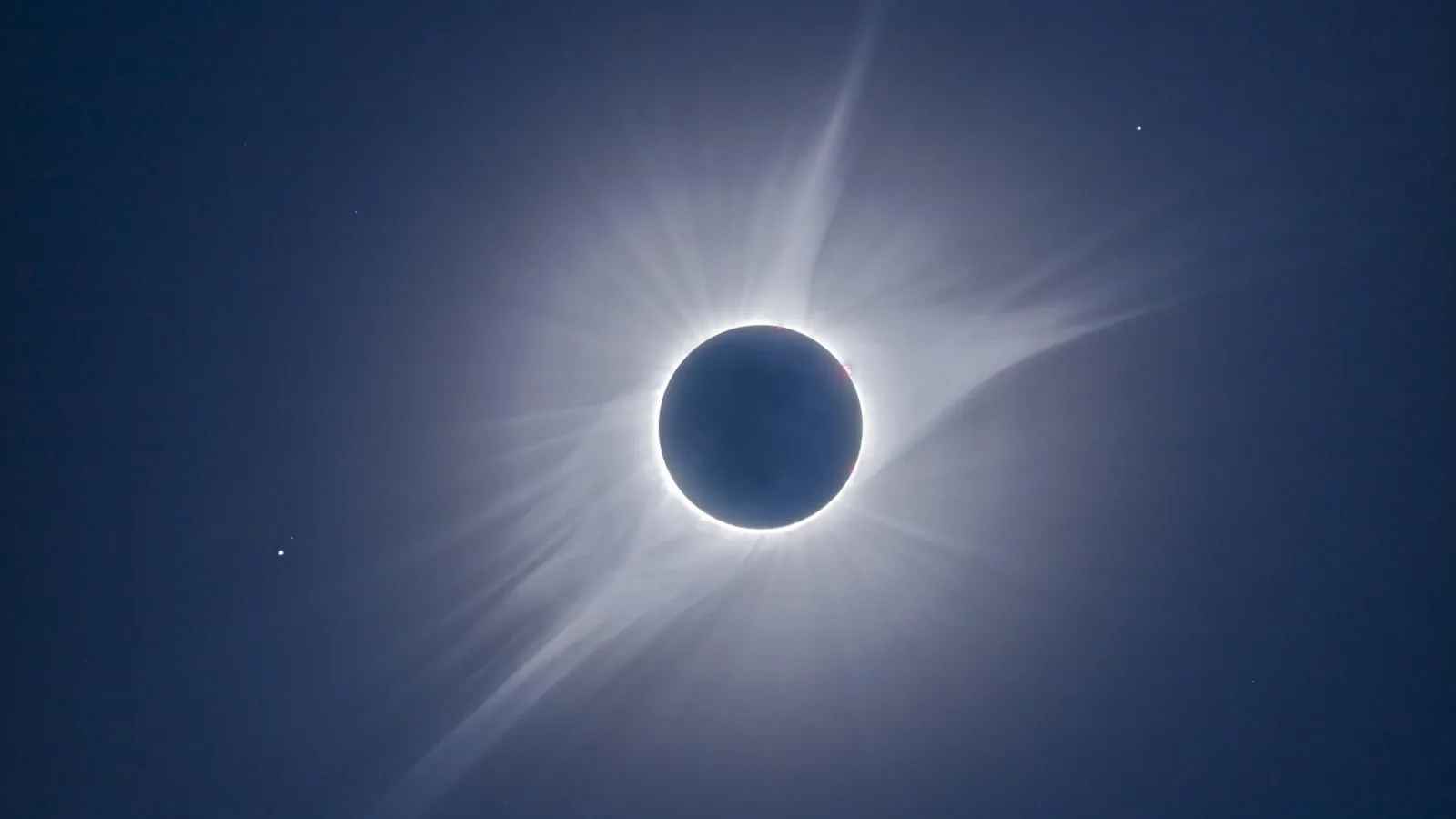
Stargazers and scientists alike are anticipating the total solar eclipse on August 12, 2026, an event poised to reveal a never-before-seen configuration of the sun's outer atmosphere, known as the corona. While the moon's obscuration of the sun's visible surface is a recurring phenomenon, the specific structure of the corona visible during the brief moments of totality is always unique, shaped by the sun's ever-shifting magnetic field and activity levels. This particular eclipse occurs during the declining phase of Solar Cycle 25, offering a distinct snapshot of solar behavior.
The solar corona, a vast expanse of plasma extending millions of miles, is typically invisible due to the overwhelming brilliance of the sun's photosphere. However, during the few minutes of totality, the moon perfectly blocks this light, allowing the delicate, spiky tendrils of the corona to emerge. These structures, often appearing larger than expected and displaying impressive depth and complexity, are a testament to the dynamic nature of our star. Unlike photographs, the human eye possesses a dynamic range capable of capturing this spectacle with remarkable fidelity.
The appearance of the corona is inextricably linked to the sun's approximately 11-year activity cycle. Dr. Ryan French, a solar physicist at the Laboratory for Atmospheric and Space Physics (LASP) in Boulder, Colorado, explains, "The sun follows a natural 11-year cycle of increasing and decreasing activity. At the peak of this cycle, called solar maximum, there are loads of sunspots on the sun, which are giant magnets nestled in the base of the sun's atmosphere." These sunspots are hotbeds for solar flares and coronal mass ejections (CMEs), leading to more complex and dynamic coronal structures. At solar minimum, with fewer sunspots, the corona tends to be more uniform and symmetrical, often resembling wings.
Solar Cycle 25's Declining Phase
The August 12, 2026, eclipse will not occur at the peak of solar activity. Solar Cycle 25 reached its maximum in October 2024. The eclipse is scheduled to take place nearly two years into the cycle's decline. While solar activity gradually decreases after its peak, NASA and NOAA anticipate that the sun will remain more active than it was in the years leading up to the cycle's maximum. "We're no longer in solar maximum — we're a third of the way past the peak in terms of amplitude and years passed," Dr. French noted. "The corona will still be far more active than during the 2017, 2019 and 2020 total solar eclipses, but much less so than 2024's."
This positioning places the 2026 eclipse in an interesting category. It is expected to present a corona that is more active than those witnessed during periods of low solar activity, but less complex and structured than the display seen near the 2024 peak. Predictions suggest a monthly sunspot number closer to 102 for August 2026, a notable decrease from the approximate 144 recorded during the April 2024 eclipse, but still considered active by recent standards. Observers can anticipate a corona featuring strong streamers extending far into space, likely with increased asymmetry compared to the more uniform appearances of solar minimum.
Historically, eclipses near solar maximums have shown dramatically different coronal structures. For instance, Solar Cycle 23, a strong cycle, produced a complex corona during its peak years, with a total solar eclipse on June 21, 2001, occurring when the monthly sunspot number was around 203. In contrast, Solar Cycle 24, a weaker cycle, saw its closest total solar eclipses to its April 2014 peak with a monthly sunspot number around 113. The 2026 eclipse, therefore, occupies a middle ground, offering a view that is neither the minimalist appearance of a quiet sun nor the highly intricate patterns of solar maximum.
The exact configuration of the solar corona is sensitive to sunspot activity near the sun's visible edge. Given the sun's 27-day rotation period, large active regions emerging on the sun's limb shortly before August 12 could significantly alter the corona's appearance. This dynamic nature means that forecasts for the corona's look, often generated by entities like Predictive Science a week prior, are typically refined on the eclipse day itself.
Adding to the spectacle, vivid pink or crimson features known as prominences may become visible. These immense structures of hydrogen plasma, held aloft by magnetic fields, are often mistaken for solar flares. "Prominences are large magnetic structures that suspend plasma in the atmosphere of the sun, and they glow very bright in a very specific wavelength of light called hydrogen alpha," explained Dr. French. Prominences are more common during periods of solar activity and can persist for days or weeks, making them easier to anticipate than fleeting solar flares. The geometry of the 2026 eclipse, with the moon appearing only slightly larger than the sun, could enhance the visibility of smaller prominences on various sides of the solar disk simultaneously. This contrasts with longer eclipses where the moon's larger apparent size might obscure prominences on one side before revealing those on the opposite side.
The rare possibility also exists of witnessing a coronal mass ejection (CME) during totality, an event that occurred during the December 14, 2020, total solar eclipse. However, observing a CME during an eclipse requires considerable luck, as these massive eruptions of plasma and magnetic field travel relatively slowly and can take many hours to escape the sun's vicinity.