
Gondwana Supercontinent Confirmed: Ancient Landmass Fueled Life's Explosion
New research confirms the existence of Gondwana as a true supercontinent, covering 80% of Earth's landmass 550 million years ago. Its formation and subsequent volcanic activity are linked to the Cambrian explosion of life.

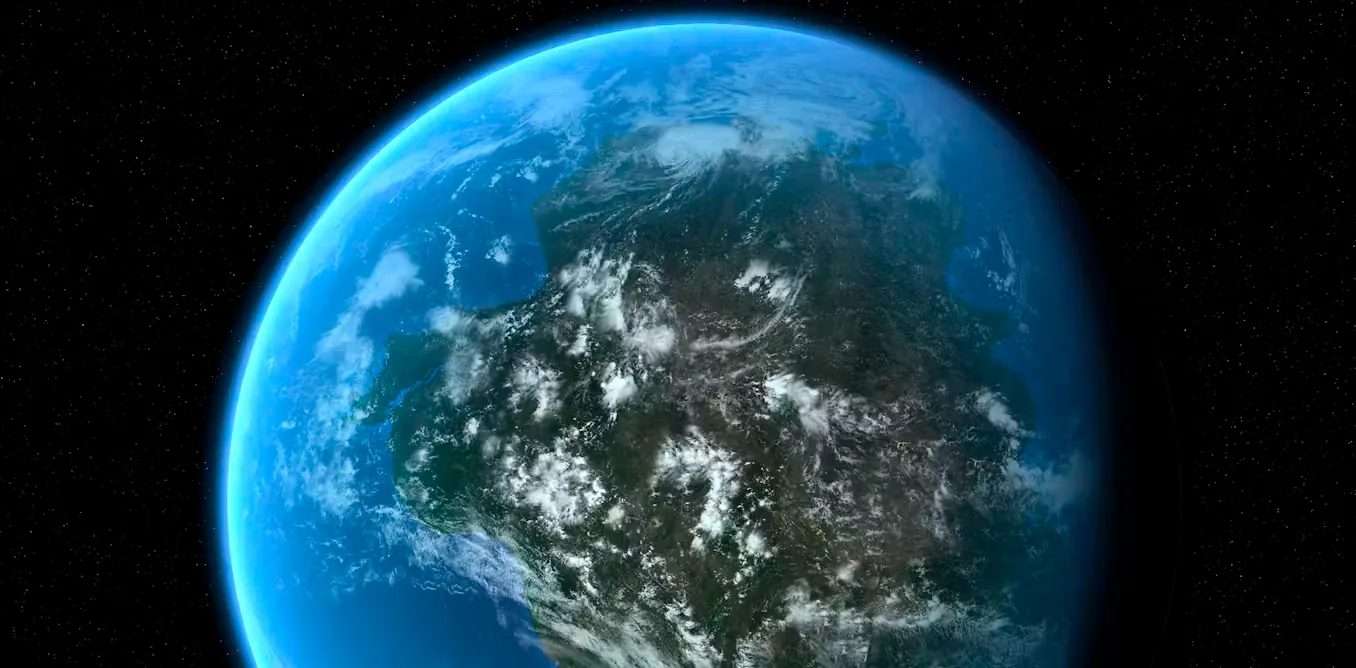
Around 550 million years ago, Earth's geography was dominated by a colossal landmass known as Gondwana, primarily situated in the Southern Hemisphere. First identified in the late 19th century by Austrian geologist Eduard Seuss, the continent's existence was inferred from unique plant fossils found across what are now separate continents like India, Australia, Africa, Antarctica, and South America, indicating their past connection. However, its status as a true "supercontinent"—defined as comprising at least 75% of Earth's continental landmass—has been a subject of scientific debate for years, with initial estimates placing Gondwana at only 64%.
A groundbreaking study published in Science Advances has now settled this debate, revealing a significant, previously unrecognized portion of Gondwana buried beneath modern mountain ranges. This discovery expands the continent's estimated landmass to approximately 80%, solidifying its designation as a supercontinent. The research team compiled a global dataset of granite samples, utilizing a specialized technique that measures radioactive isotopes to determine the age of ancient rocks. This analysis mapped the deep Earth's crust on a continental scale, unearthing evidence of a large, cohesive continental block that formed between 700 and 550 million years ago.
Gondwana's Ancient Role in Earth's Transformation
The newly identified fragments trace the original Gondwanan landmass from India and Southeast Asia, extending through much of China and into Kazakhstan. Previously, large parts of this region were believed to be ancient ocean floor. The findings indicate that this now mountainous and younger, rock-covered terrain was, in fact, an integral part of the ancient supercontinent. This significantly larger Gondwana, therefore, played a pivotal role in shaping the planet's early history and evolution.
The implications of Gondwana's true scale are profound, particularly concerning its influence on global climate and biological development. The period immediately following the supercontinent's formation, between 550 and 500 million years ago, witnessed the remarkable proliferation of life known as the Cambrian explosion. While various environmental factors have been proposed as catalysts for this event, the scale of biological change suggests a global cause-and-effect relationship, connecting geological, climatic, and biological shifts.
During Gondwana's formation phase, estimated between 750 and 550 million years ago, colossal mountain ranges akin to the Himalayas crisscrossed its interior. At this time, the continent was largely a frozen, arid landmass. However, as its constituent continental fragments coalesced, Earth's plate tectonics underwent a significant reconfiguration. This process led to the formation of a vast volcanic arc chain, encircling the entire supercontinent and stretching from Russia, through China, Australia, Antarctica, South Africa, and down to the Andes in South America. This ancient volcanic belt, estimated to be nearly 35,000 kilometers long, served as a precursor to today's Pacific Ring of Fire.
The constant volcanic eruptions along this ancient ring released immense quantities of gases, notably water vapor and carbon dioxide, into the atmosphere over millions of years. Scientific estimates suggest that current volcanic gas emissions, predominantly from the Ring of Fire, release millions of metric tons of water vapor and hundreds of thousands of tons of carbon dioxide daily. The sustained release from Gondwana's volcanic arc dramatically altered Earth's climate, transitioning it from an icehouse to a greenhouse state. This significant climatic shift is now considered the primary catalyst that spurred the unprecedented diversification and proliferation of life on Earth during the Cambrian period.