
Inouye Telescope Captures Sun's Surface Vortexes for First Time
The Daniel K. Inouye Solar Telescope has captured unprecedented images of vortex-like structures on the Sun's surface, revealing a dynamic phenomenon previously unseen by scientists. This discovery could reshape our understanding of solar atmospheric processes.

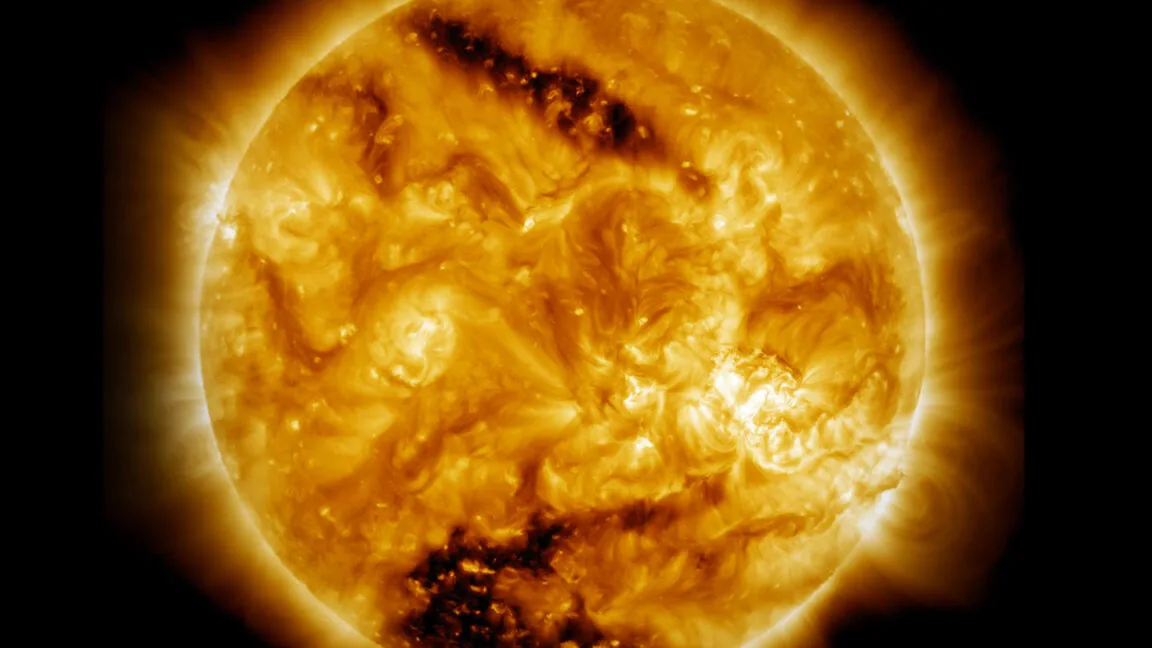
For the first time, scientists have directly observed swirling vortexes on the Sun's surface, a phenomenon driven by fluid dynamics that has long been theorized but never visually confirmed. The groundbreaking images were captured by the powerful Daniel K. Inouye Solar Telescope (DKIST) in Hawaii, revealing ubiquitous structures that may alter current models of how heat, mass, and magnetic energy are transported through the Sun's atmosphere.
These plasma whirlpools, known as Kelvin-Helmholtz instabilities, occur where fluids move at different speeds. While this physics has been understood since the 1860s and explains phenomena like ripples on water caused by wind, observing them on the Sun was hindered by their minute scale. They are too small to be resolved by telescopes with mirrors smaller than 2 meters, a limitation that has impacted solar physics for decades.
The DKIST, a 4-meter instrument operated by the National Science Foundation, entered its operational phase in November 2021, offering the resolution necessary to finally detect these elusive structures. During a brief observation window on April 14, 2025, a team led by David Kuridze and Friedrich Wöger of the National Solar Observatory focused the telescope on an active solar region. Their primary objective was to test the telescope's performance by achieving diffraction-limited imaging at a wavelength of 416 nanometers, a setting chosen to maximize resolution.
“The main goal was to achieve diffraction-limited performance with the telescope,” Kuridze stated. The telescope's optics, combined with this shorter wavelength, pushed the boundaries of observable detail. The resulting data, processed using advanced techniques to counteract atmospheric blurring, provided a movie of the solar surface with a spatial resolution of approximately 19 kilometers, near the instrument's theoretical limit.
“As a byproduct we got these amazing observations, which allowed us to see something which has never been seen before,” Kuridze said, describing the unexpected discovery.
Understanding Solar Dynamics
At the observed wavelength, the Sun's surface is characterized by granules – convection cells carrying heat – interspersed with concentrated magnetic field bundles. Previously, the boundaries between these magnetic fields and surrounding plasma appeared smooth. However, the DKIST data revealed these interfaces to be composed of intricate vortex-like structures and fine dark striations. The team identified 47 such interfaces, measuring individual vortexes between 25 and 170 kilometers in diameter, with some appearing at the edge of the telescope's resolution limit.
The dynamics of these vortexes were also striking. They could double in size in under a minute and propagated along the interfaces at speeds ranging from 0.67 to 3 kilometers per second. Kuridze explained that the instability evolves through a 'linear phase' of regular, rolling motions, followed by a 'non-linear regime' of chaotic turbulence. The formation of these curls is directly linked to the orientation of magnetic fields. When fields align with plasma flow, they suppress instabilities. However, in the observed strong magnetic regions, fields perpendicular to the flow allowed the vortexes to form unchecked.
To validate their findings, researchers performed sophisticated computer simulations. They modeled a section of the Sun's photosphere, incorporating the magnetic field map from the actual observation and synthesizing images that mimicked the DKIST's capabilities. These simulations accurately reproduced the observed vortexes' appearance and behavior, bolstering confidence that the observations were genuine and not artifacts.
This discovery has significant implications. Strong magnetic fields are known to suppress surface activity, but the presence of these vortexes along magnetic element edges suggests an unexpected stirring mechanism. This could allow cooler plasma from the edges of convection cells to mix with magnetic regions, influencing heat transfer beneath the visible surface—a process not accounted for in current models of solar convection. Furthermore, the observed twisting motions at the magnetic field interfaces could be a key mechanism for braiding magnetic field lines, a process believed to heat the Sun's outer atmosphere, the corona, through energy release.
While the findings are based on a short observation window and somewhat limited simulations, they represent a significant leap in our ability to study the Sun. The unprecedented resolution of the DKIST is providing new insights into the complex interplay of plasma and magnetic fields, promising to deepen our understanding of solar activity and its impact on space weather.