
NASA's Psyche Spacecraft Boosts Speed After Mars Flyby
NASA's Psyche spacecraft successfully used a Mars gravity assist to gain speed and test its instruments. The mission is en route to a unique metal-rich asteroid.

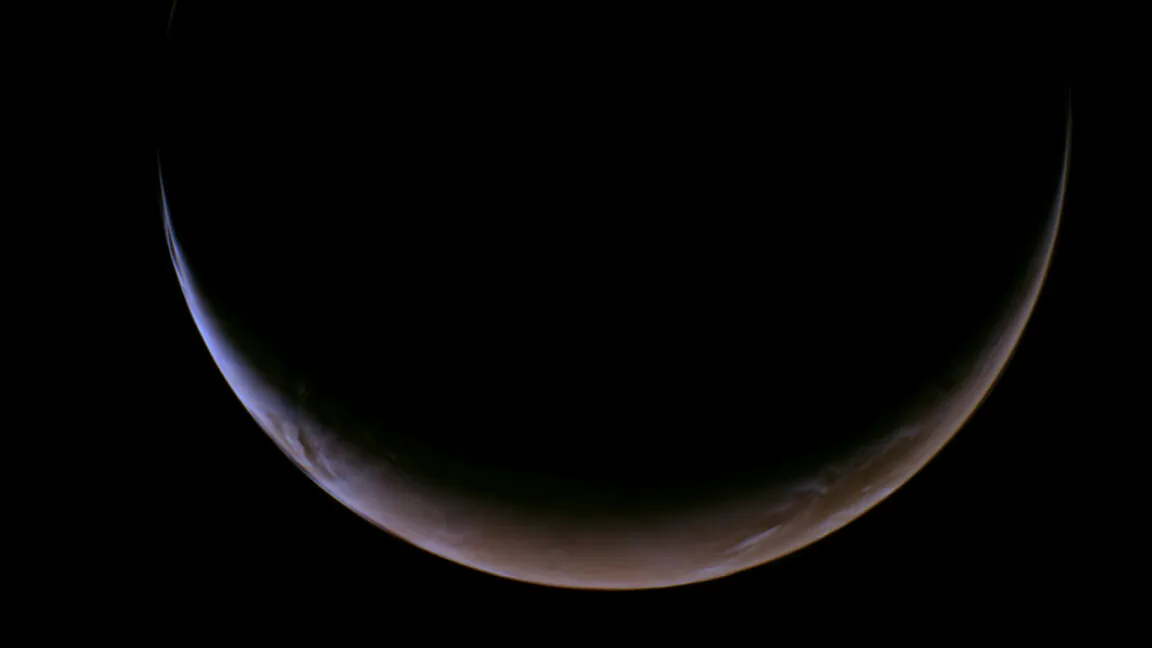
NASA's Psyche spacecraft successfully leveraged a close encounter with Mars last week, using the planet's gravity as a slingshot to increase its speed and refine its trajectory toward a distant, metal-rich asteroid. The maneuver, executed during the spacecraft's multi-year journey, served as a critical dress rehearsal for its primary mission objective: reaching the asteroid Psyche in 2029.
Launched in October 2023 from Kennedy Space Center, Florida, the Psyche mission is embarked on a 2.2 billion-mile (3.6 billion km) voyage to explore an asteroid unlike any other. This unique celestial body, also named Psyche, is believed to be the largest metal asteroid in the Solar System, offering scientists a rare glimpse into planetary cores. The mission utilizes a SpaceX Falcon Heavy rocket for its initial ascent and employs advanced plasma engines to gradually build the velocity required for its deep-space transit.
The flyby of Mars, which occurred on Friday, provided the spacecraft with its most significant propulsive boost since its departure from Earth. Mission navigators at NASA’s Jet Propulsion Laboratory in California meticulously planned the encounter, positioning the spacecraft to pass approximately 2,864 miles (4,609 km) above the Martian surface. This altitude ensured Psyche remained clear of the planet's thin atmosphere, allowing for optimal gravitational interaction.
“Although we were confident in our calculations and flight plan, monitoring the DSN’s (Deep Space Network’s) Doppler signal in real time during the flyby was still exciting,” said Don Han, Psyche’s navigation lead at JPL, in a statement. “We’ve confirmed that Mars gave the spacecraft a 1,000-mile-per-hour boost and shifted its orbital plane by about 1 degree relative to the Sun. We are now on course for arrival at the asteroid Psyche in summer 2029.”
Beyond the crucial gravity assist, the Mars flyby also served as an opportunity to test Psyche's sophisticated suite of three science instruments. These include a multispectral imager with two cameras, a gamma-ray and neutron spectrometer, and a magnetometer. While similar sensors are employed on other missions currently studying Mars, the encounter provided mission scientists with invaluable practice in operating these tools in a real-world space environment, simulating conditions they will face upon reaching the asteroid.
Capturing New Perspectives of the Red Planet
As a bonus, the encounter yielded striking images of Mars captured from an unusual vantage point. Approaching the planet from a high phase angle, meaning on the side opposite the Sun, presented Mars as a thin crescent. Sunlight illuminated diffuse clouds of dust suspended high above the planet's rust-colored terrain, highlighting the subtle features of its tenuous atmosphere. As the spacecraft sped past, its cameras documented the southern polar ice cap, offering a rare overhead perspective of this familiar, yet dramatically rendered, world.
Jim Bell, who leads the Psyche imager instrument team at Arizona State University, noted that the spacecraft acquired thousands of images during the encounter. These observations are expected to aid scientists in calibrating and characterizing the performance of the cameras. Psyche’s magnetometer may have also detected interactions between the solar wind and Mars’ upper atmosphere or its remnant magnetic field. Simultaneously, its spectrometers were focused on analyzing the chemical composition of the Martian surface beneath its flight path.
While numerous other missions are dedicated to the full-time exploration of Mars, the data gathered by Psyche during its brief passage is unlikely to yield major new discoveries. However, scientists anticipate that comparing these flyby observations with existing archival data from other Mars missions will be instrumental in calibrating the mission’s scientific instruments. This practice run is vital for ensuring the instruments are optimally tuned for the primary objective: the detailed study of asteroid Psyche.
The true scientific payoff for the Psyche mission awaits in three years. Upon arrival, the probe will dedicate over two years to meticulously surveying asteroid Psyche. This large asteroid, estimated to be the size of Massachusetts, is exceptionally rich in iron, nickel, and other metallic elements. Currently, observations from Earth-based telescopes reveal it only as a indistinct mass, making Psyche a truly uncharted territory for scientific investigation and a prime target for understanding planetary formation.