
Tyrannosaurus Rex Arms Mystery Solved: Linked to Giant Heads and Jaws
New research suggests the famously small arms of Tyrannosaurus rex and other giant theropod dinosaurs evolved in tandem with their massive heads and bone-crushing jaws, indicating a shift to biting as a primary hunting strategy.

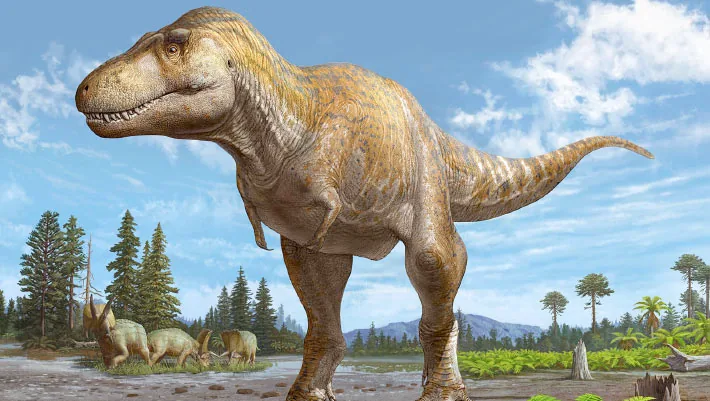
Paleontologists have proposed a compelling new theory explaining the evolutionary puzzle behind the disproportionately tiny arms of Tyrannosaurus rex and other large predatory dinosaurs. Research from University College London and the University of Cambridge suggests these diminutive forelimbs developed alongside increasingly massive skulls and powerful jaws, pointing to a significant evolutionary shift in hunting tactics from grasping prey to a bone-crushing bite.
The iconic short arms of the T. rex are not unique; other giant theropods also evolved relatively small forelimbs. "Everyone knows Tyrannosaurus rex had tiny arms but other giant theropod dinosaurs also evolved relatively small forelimbs," explained Charlie Roger Scherer, a Ph.D. student at University College London and lead author of the study. "Carnotaurus had ridiculously tiny arms, smaller than Tyrannosaurus rex." The research team investigated what evolutionary pressures might have driven this common trend.
Their findings, published in the Proceedings of the Royal Society B, revealed a strong correlation between the reduction of forelimbs and the development of large, powerfully built heads. Analyzing data from 82 species of carnivorous theropod dinosaurs, the scientists observed that shorter arms consistently appeared in lineages such as Abelisauridae, Carcharodontosauridae, Ceratosauridae, Megalosaurinae, and Tyrannosauridae. This pattern was more closely linked to skull and jaw robustness than to overall body size, dispelling the notion that small arms were merely a byproduct of larger bodies.
Evolutionary Arms Race With Giant Prey
The researchers hypothesize that the emergence of increasingly gigantic prey, including massive sauropods and other large herbivores, may have spurred an evolutionary arms race. In response to these formidable meals, theropod dinosaurs developed stronger skulls and jaws capable of subduing and consuming them. This dietary shift would have rendered grasping prey with arms less critical, leading to a gradual reduction in forelimb size over generations—an example of the evolutionary principle "use it or lose it."
"While our study identifies correlations and so cannot establish cause and effect, it is highly likely that strongly built skulls came before shorter forelimbs," Scherer noted. "It would not make evolutionary sense for it to occur the other way round, and for these predators to give up their attack mechanism without having a back-up." This suggests the head and jaws became the primary weapon, with the arms becoming vestigial.
To quantify skull robustness, the paleontologists developed a novel method. This involved assessing factors such as the tightness of cranial bone connections, the skull's dimensions (prioritizing compact shapes over elongated ones), and estimated bite force. Based on this new metric, Tyrannosaurus rex scored highest among the studied species. It was closely followed by Tyrannotitan, another massive theropod that roamed what is now Argentina during the Early Cretaceous epoch, over 30 million years before T. rex.
This evolutionary adaptation highlights how prehistoric predators adapted to their environments and prey. The focus on bite force and skull strength over arm dexterity signifies a critical phase in the evolution of apex predators, shaping them into the formidable hunters that dominated ecosystems for millions of years. The findings offer a clearer picture of the complex interplay between predator morphology and prey availability in the deep past.