
NASA Roman Space Telescope Fueled for August 30 Launch
NASA has fueled its Nancy Grace Roman Space Telescope ahead of its planned August 30 launch. The observatory is poised to revolutionize astronomy with its wide-field capabilities.

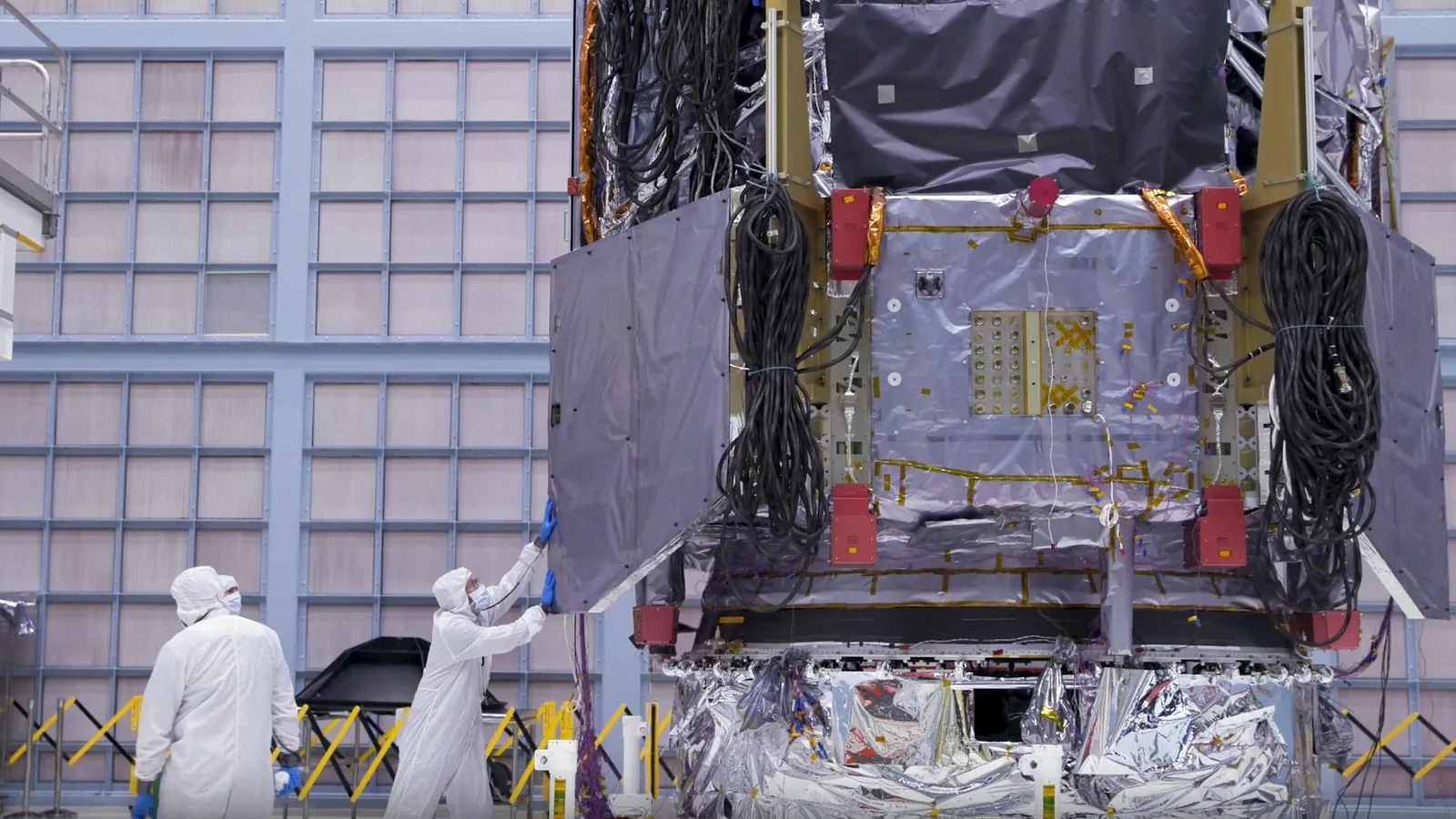
NASA announced on July 29, 2026, that the Nancy Grace Roman Space Telescope has been officially fueled, moving it one step closer to its scheduled launch on August 30. The powerful new observatory is expected to generate an immense volume of cosmic data, significantly expanding our understanding of the universe. Fueling of the observatory took place on July 25, involving the transfer of hydrazine, a highly efficient yet toxic propellant commonly used in NASA spacecraft.
The Roman Space Telescope's upcoming mission marks a significant advancement in astronomical observation. Its primary instrument, the Wide Field Instrument (WFI), will capture images of the infrared universe across a field of view 50 times wider than that of the James Webb Space Telescope (JWST). This wide-field capability will enable Roman to survey vast areas of the cosmos, complementing JWST's deep-dive observations and potentially identifying new targets for closer study.
Revolutionizing Cosmic Discovery
With its projected 500 terabytes of data annually, Roman is set to push the boundaries of astronomical knowledge. The telescope is designed to investigate key mysteries such as dark matter and dark energy, observe distant supernovae, and aid in the search for habitable exoplanets. Its wide view is particularly crucial for studying dark universe phenomena, as it will allow astronomers to observe the movements of thousands of galaxies simultaneously, providing insights into the gravitational effects of dark matter and dark energy.
"So we're going to see thousands of supernovae, and some of these are going to be further away than any supernovae we've ever seen before," Dominic Benford, program scientist for the Nancy Grace Roman Telescope, previously stated. This unprecedented observational power promises to unveil phenomena previously beyond our reach.
The telescope is scheduled to launch aboard a SpaceX Falcon Heavy rocket from Kennedy Space Center, Florida. Following launch, Roman will travel to its operational orbit at the second Sun-Earth Lagrange point (L2), approximately one million miles from Earth. This gravitationally stable location is ideal for space observatories, minimizing the need for propellant to maintain its position. Similar to JWST, Roman's stable orbit at L2 will allow its solar arrays to consistently face the Sun for power while its instruments point towards deep space.
NASA's ambitious Roman Space Telescope project is reportedly nine months ahead of schedule and under budget, fueling optimism that the August 30 launch date will be met. The successful fueling and impending launch represent a major milestone for the space agency and the global scientific community, heralding a new era in our exploration of the cosmos.