
Nereid Moon: Neptune's Ancient Survivor of Cosmic Collision
New research suggests Neptune's moon Nereid may be the sole intact survivor of a cataclysmic ancient collision that destroyed its sibling moons. Data from the James Webb Space Telescope challenges previous theories about its origin.

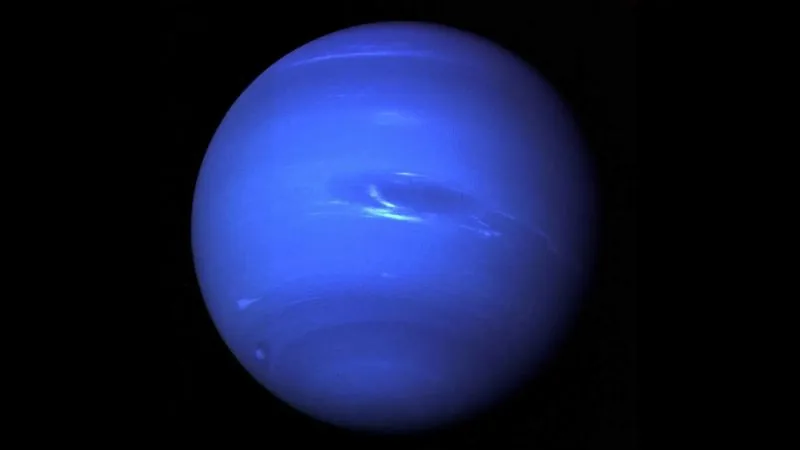
Nereid, Neptune's third-largest moon, may be the only intact remnant of a primordial moon system shattered by a massive collision early in the solar system's history, according to a new analysis utilizing data from the James Webb Space Telescope. Neptune, the solar system's most distant planet, possesses a unique and chaotic collection of moons, unlike the more orderly satellite systems of Jupiter, Saturn, and Uranus. Neptune's largest moon, Triton, orbits in the opposite direction of the planet's rotation, a phenomenon scientists attribute to its likely origin in the Kuiper Belt and subsequent capture by Neptune's gravity over 4 billion years ago.
This capture event is believed to have caused Triton to collide with and destroy Neptune's original moons. While the planet's seven inner moons are considered remnants of this ancient cataclysm, appearing as disrupted rubble piles, Nereid now emerges as a potential untouched survivor. "I think Nereid is the only intact survivor of this process," stated Matthew Belyakov, a planetary science graduate student at the California Institute of Technology and lead author of the study published in Science Advances. "The other survivors are Neptune’s innermost moons, but they are not intact because we have images of them from Voyager, and they look like disrupted rubble piles. So they are surviving material from the initial system, but not fully intact moons."
Nereid's Composition Challenges Kuiper Belt Origin
This new hypothesis challenges the long-held assumption that Nereid, like Triton and other irregular Neptunian moons, was a captured object from the Kuiper Belt. New infrared data from the James Webb Space Telescope reveals that Nereid's surface composition does not align with known Kuiper Belt objects. Nereid, named after the sea nymphs of Greek mythology, is a faint and distant moon, with its only prior image being a blurry photograph from the 1989 Voyager 2 fly-by. It has one of the most eccentric orbits in the solar system, taking 360 Earth days to complete a single revolution around Neptune.
Despite its classification as an irregular satellite, Nereid stands out. "It’s twice as big in diameter as the next largest one, which is Phoebe around Saturn, and it’s not all that distant from its host planet compared to a lot of the other irregular satellites," Belyakov explained. Some of Nereid's characteristics have long made astronomers question its Kuiper Belt origin. The recent 10-minute observation by the James Webb telescope, designed to analyze the composition of distant objects, provided crucial new insights. "What we found was an object that was highly water-rich on the surface, brighter than a lot of Kuiper Belt objects, and with some presence of CO2," Belyakov said. "The overall signature was more similar to that of regular satellites around Uranus rather than Kuiper Belt objects."
Comparisons with data from 54 Kuiper Belt bodies, also gathered by the James Webb telescope, further supported these findings. Computer simulations conducted by Belyakov and his team explored the plausibility of Nereid being part of Neptune's original moon system. "What we found in our simulations is that in the cases where Triton survives, rather than get destroyed or kicked into Neptune," Belyakov noted, "around 25% of the time one or more moons can survive the Triton encounter on distant orbits." This survival rate, he added, is comparable to the likelihood of Nereid being a captured object.
The simulations suggest a scenario where Triton's collision with Neptune's original moons occurred within the first 100 million to 200 million years of the solar system's existence. During this cosmic upheaval, Nereid would have been spared, flung into its current eccentric orbit, while Triton's own orbit was altered, settling it into its present path closer to Neptune. "I think people have already wanted this to be true," Belyakov commented on Nereid's revised origin story. "Now we can start the actual science feedback loop. There is more data to be gathered for Nereid compositionally that can help us really talk through the formation of the Neptunian system, and if we treat Nereid as a regular satellite, maybe that can tell us a lot about how satellites form around ice giants."
While additional James Webb observations could strengthen the case, a definitive understanding of Nereid's true nature would likely require a dedicated mission to Neptune. Currently, no such mission is planned, leaving the 1977-launched Voyager 2 as the sole spacecraft to have studied the Neptunian system in detail. Carolyn Porco, a planetary scientist involved in the Voyager and Cassini missions, described the new study as a "lovely and simple examination" of Neptune's moon system. She elaborated, "It is Triton that was the captured body and it subsequently caused havoc, gravitationally scattering Neptune’s original moons hither and thither but mostly out of Neptune orbit." Porco added, "The authors show it is plausible that Nereid lucked out by remaining in orbit around Neptune but at a much larger distance than Triton. This would explain why its composition observed by James Webb does not match that of the bodies in the Kuiper Belt." Leigh Fletcher, a professor at the University of Leicester, also noted the significance of the James Webb telescope's capabilities, stating, "Given those destructive processes, I don’t think we expected to see anything left of Neptune’s original satellite system, other than rubble and debris." He believes further JWST observations could reveal finer details and bolster the argument for Nereid's original satellite status.