
SpaceX Moon Crash: What the Impact Crater Reveals
A SpaceX rocket stage is set to collide with the lunar surface, creating a new crater and providing unexpected data on moon geology. Scientists are preparing to study the impact.

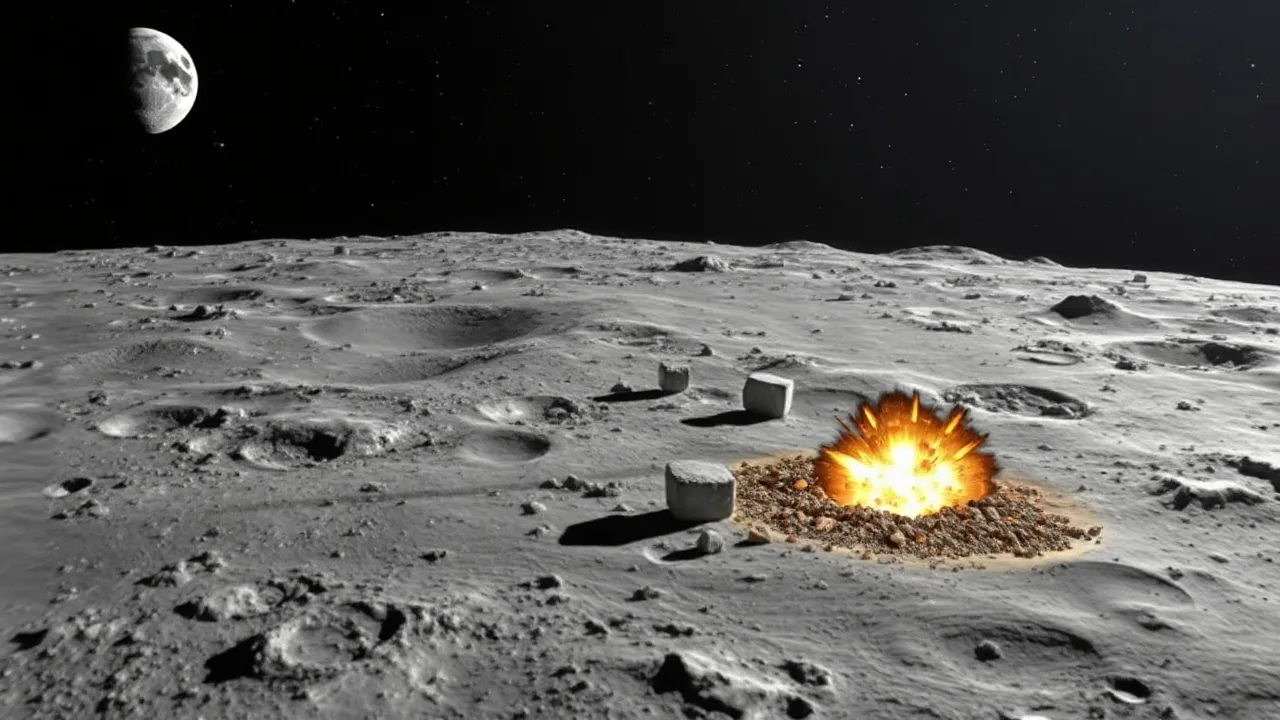
SpaceX's Falcon 9 upper stage, launched in February 2015, is on a collision course with the moon. After years of drifting through space, the defunct rocket booster will strike the lunar surface in 2026, carving a fresh crater into the regolith and generating a burst of seismic data that lunar researchers are eager to analyze.
The uncontrolled impact represents one of the first measurable collisions between commercial spaceflight debris and the moon. While rocket bodies have crashed there before, this event offers astronomers and geophysicists a rare, albeit accidental, opportunity to probe the moon's interior structure and test detection methods for future space debris monitoring.
"We're looking at this as an unintended science experiment," says Dr. Noah Petro, a lunar scientist at NASA's Goddard Space Flight Center. "The seismic waves generated by the impact will tell us about the moon's subsurface composition in ways we can only partially access from orbit."
How the Crash Will Unfold
The Falcon 9 second stage, weighing approximately 4 metric tons, has been in a chaotic orbit for over a decade. Its trajectory decayed gradually due to solar radiation pressure and gravitational perturbations. NASA's Planetary Defense Coordination Office began tracking the debris trajectory in 2022 after recognizing the high probability of lunar impact.
Collision speed is estimated at 2.58 kilometers per second, roughly 5,800 miles per hour. At that velocity, kinetic energy will vaporize most of the rocket body on contact, excavating a crater estimated between 10 and 20 meters in diameter. The explosion will scatter regolith across the impact zone and generate powerful seismic waves that will propagate through the moon's crust and mantle.
The impact site lies in or near the Hertzsprung basin on the moon's far side, a region already studied by lunar orbiters from NASA, the European Space Agency, and China's space program. Multiple instruments aboard active lunar missions, including NASA's Lunar Reconnaissance Orbiter and the Lunar Impact Flash Detection System, are positioned to record the event in real time.
Scientific Value and Lunar Geology Questions
This collision will test how well scientists understand lunar geology and subsurface structure. Seismic data from the impact will complement measurements taken by Apollo missions in the 1960s and 1970s, filling critical gaps in our knowledge of the moon's interior.
The moon possesses a complex internal architecture:
- A thin, rigid crust averaging 50 kilometers thick
- A fractured megaregolith layer extending 1 to 2 kilometers below the surface
- A mantle of denser rock extending to the core
- A partially molten or liquid outer core
Seismic waves travel at different speeds through each layer. By recording arrival times and wave characteristics, scientists can refine three-dimensional maps of lunar interior density and composition. This data informs theories about the moon's thermal history, mineral distribution, and long-term evolution.
Dr. Renee Weber, a seismologist at NASA's Marshall Space Flight Center, notes that the Falcon 9 impact will "extend our seismic network in ways a controlled mission might not afford." Passive seismometry from natural moonquakes and micrometeorite impacts has provided limited information; an artificial impact of known mass and velocity offers ground truth for calibration.
Broader Implications for Space Exploration
The event highlights growing concerns about space exploration debris accumulating in Earth orbit and beyond. As commercial spaceflight expands, operators and regulatory agencies must develop protocols for deorbiting spent stages responsibly. The Falcon 9 impact demonstrates the consequences of uncontrolled decay.
SpaceX and other launch providers now conduct controlled reentries for most rocket stages, burning them up in Earth's atmosphere or landing first stages for reuse. However, older or forgotten debris from early missions continues to pose hazards. The International Space Agency and space agencies worldwide are developing tracking systems and impact crater prediction models to forecast similar collisions.
The 2026 Falcon 9 impact will serve as a validation point for these prediction algorithms. If forecasts match actual crater dimensions and seismic signatures, confidence in future aerospace impact modeling will improve, enabling better risk assessments for human settlements on the moon or near-Earth orbit congestion.
Private companies developing lunar landers and lunar bases must account for the hazard from orbiting debris. Understanding where and how impacts occur, and what damage they cause, directly informs design standards for habitats and equipment.
The Falcon 9 upper stage will remain the largest piece of commercial rocket debris to strike the moon in the 21st century, at least for now. As space debris populations grow and more missions target cislunar space, additional uncontrolled impacts are inevitable. Scientists and engineers are treating August 2026 as a dress rehearsal for managing a more crowded lunar environment.