
Sun May Have Consumed Planet, Leaving Chemical Fingerprint
New research suggests our sun might have absorbed an Earth-sized planet billions of years ago. Scientists believe this event left a distinct chemical signature deep within the star, potentially explaining its current composition.

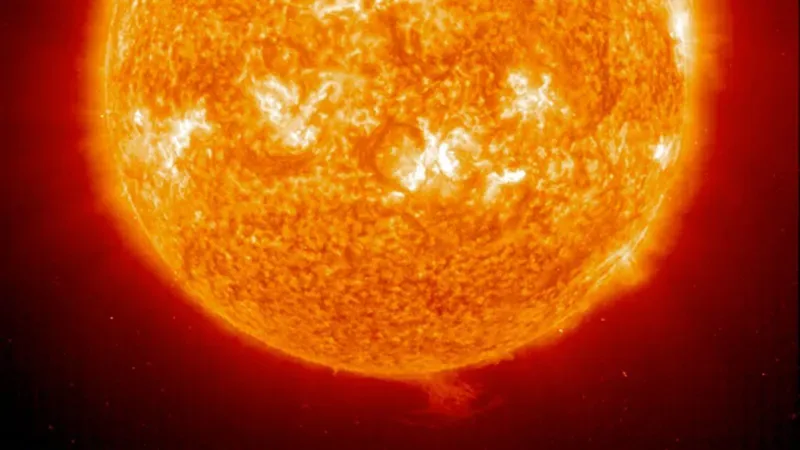
Astronomers have put forth a compelling new theory suggesting that our sun may have consumed an Earth-sized planet in its early history, leaving behind a unique chemical signature. This hypothesis, detailed in a recent study published in Monthly Notices of the Royal Astronomical Society, could offer crucial insights into the sun’s internal structure and its unusually low abundance of lithium.
According to Mutlu Yildiz of Ege University in Turkey, who led the research, the absorption of a planet several times more massive than Earth billions of years ago might be responsible for these observed characteristics. "Our new study suggests that a planet several times more massive than Earth may have fallen into the young sun and left a lasting chemical imprint deep inside it," Yildiz stated.
This isn't the first time scientists have observed or theorized about stars devouring planets. In 2023, astronomers reported witnessing a star in the process of engulfing a planet. The observed star, similar to our sun, had expanded significantly due to old age, ultimately consuming a nearby gas giant roughly the size of Jupiter or larger. This celestial event, which occurred near the Aquila constellation approximately 10,000 to 15,000 years ago, involved a star about 10 billion years old. The dramatic process generated a bright flash of light followed by a prolonged emission of dust detectable in infrared energy.
Understanding Stellar Evolution and Composition
The discovery of such stellar consumption events provides valuable data for understanding the life cycles of stars and the complex chemical processes occurring within them. The sun's composition, particularly its depleted lithium levels, has long been a subject of scientific inquiry. Standard models of stellar evolution have struggled to fully account for this anomaly. The theory that a substantial planetary body was incorporated into the sun early in its existence offers a potential explanation, suggesting that the planet’s own chemical makeup was mixed into the sun’s outer layers.
Researchers like Kishalay De from the Massachusetts Institute of Technology first identified the luminous outburst associated with such an event in 2020. While initially reviewing sky survey data from the California Institute of Technology’s Palomar Observatory, De and his team initially suspected they were observing a binary star system. However, further analysis and data processing revealed that the event was not a star consuming another star, but rather a star engulfing its planet. This distinction is critical for refining our understanding of planetary system dynamics and stellar interactions.
The implications of this discovery extend beyond understanding our own sun. It suggests that such planetary ingestions might be a more common phenomenon in the galaxy than previously thought. Studying these events helps astronomers map the fate of planets that orbit too closely to their stars, especially as stars age and expand. The energy released during such an engulfment can be substantial, potentially influencing the surrounding environment. Furthermore, the chemical fingerprint left behind offers a unique window into the composition of exoplanets that may no longer exist in their original form.
The ongoing study of these phenomena contributes to the broader field of astronomy, providing observational evidence for theoretical models of stellar and planetary evolution. As technology advances and observational capabilities improve, scientists anticipate discovering more instances of stars consuming planets, further enriching our cosmic perspective and our knowledge of the universe's dynamic history. The search for definitive proof of our sun’s potential planetary meal continues, but this hypothesis provides a compelling narrative for a long-standing solar mystery.